
Resources
Explore a wide range of valuable resources on GCED to deepen your understanding and enhance your research, advocacy, teaching, and learning.
2,199 Results found
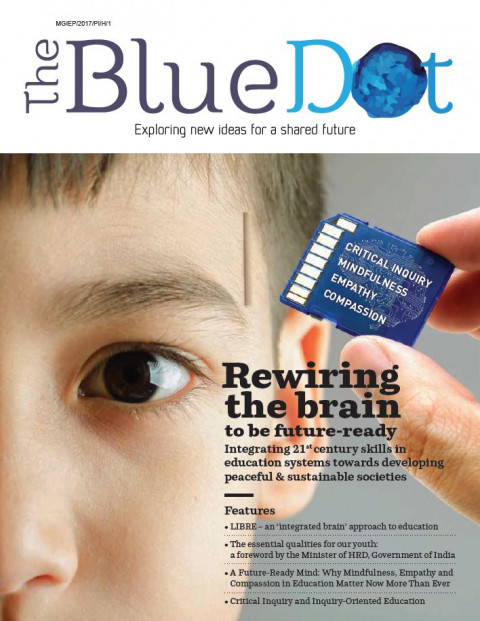 Rewiring the Brain to be Future-ready: Integrating 21st Century Skills in Education Systems Towards Developing Peaceful & Sustainable Societies (The Blue Dot Issue 6, 2017) Year of publication: 2017 Corporate author: Mahatma Gandhi Institute of Education for Peace and Sustainable Development (MGIEP) In the sixth issue of the Blue Dot, we focus on the importance of these 21st century skills for the young. The issue includes a foreword by the Minister of Human Resource Development, Government of India on the importance of inculcating 21st century skills in education systems and our Cover Story, which introduces UNESCO MGIEP’s LIBRE programme that follows an ‘integrated brain’ approach to education.Additionally, we feature opinions by specialists from academia, research and the industry on the lacuna present in existing education systems and the opportunities available to address this gap by introducing socio-emotional skills and inquiry oriented learning into curricula. Amongst various experts, we hear from Ines Kudo and Joan Hartley from The World Bank on the importance of ‘Teaching empathy and compassion in schools’; Prof. K.P. Mohanan on ‘Critical Inquiry and Inquiry oriented education’ and Dr. Marilee Bresciani Ludvik on how mindfulness forms the foundation for cultivating compassion.Further, we present excerpts from a collection of ‘Ask me Anything’ sessions focused on socioemotional skills, hosted on Knowledge Commons, UNESCO MGIEP’s knowledge sharing platform.We have been honoured to have the opportunity to host and learn from experts such as Dr. Richard Davidson, recognised as one of ‘The 100 most influential people in the world’ in 2006 by the Time Magazine and Chade-Meng Tan, currently the Chairman of Search Inside Yourself Leadership Institute and Co-chair of One Billion Acts of Peace, which has been nominated eight times for the Nobel Peace Prize.
  Paths Towards Citizen Participation Among Kanak Youth in Koné (New-Caledonia) Year of publication: 2018 Author: Ève Desroches-Maheux Corporate author: Lien social et Politiques Based on an ethnographic fieldwork, this article explores the forms and modalities taken by the civic participation of the Kanak youths living in Province Nord, New Caledonia. Being at the dawn of a referendum on its accession to a full sovereignty, this French territory of a sui generis status is now at a turning point in its history. In preparation for this event, the Nouméa Accord laid the foundations of a New-Caledonian citizenship, situated, for the moment, within the French citizenship. However, this citizenship in construction poses the question of the place given in it to the Kanak, the indigenous people of the territory. Approaching citizenship as a set of “political subjectivation processes” producing a citizenship simultaneously “determined by the state and by the subjects composing it ”, we explore the answers and “negotiation attempts” made by the Kanak youths toward it. Results show that despite some negative representations playing against them, the youths still appropriate possibilities opened up by public policies and programs in hope to make their grievances heard and to implement structuring projects. Furthermore, as those forms of civic practices are used as handles to resist French hegemony in Province Sud by youths that seek above all to strongly affirm their Kanak identities, north youth participation in the public space appears rather embedded in an inclusive approach toward other communities. Les chemins de la participation citoyenne des jeunes Kanak de Koné (Nouvelle-Calédonie) Year of publication: 2018 Author: Ève Desroches-Maheux Corporate author: Lien social et Politiques En partant d’un terrain ethnographique, cet article explore les formes et modalités de la participation « citoyenne » des jeunes Kanak vivant en province Nord, en Nouvelle-Calédonie. Étant à l’aube du référendum sur son accession à la pleine souveraineté, ce territoire français de statut sui gereris se situe à un moment charnière de son histoire. En préparation à cet événement, l’accord de Nouméa vint poser les bases d’une nouvelle citoyenneté néo-calédonienne située, pour le moment, à l’intérieur de la citoyenneté française. Cette citoyenneté en construction pose toutefois la question de la place qui y est accordée aux Kanak, peuple autochtone du territoire. Abordant la citoyenneté comme un ensemble de « processus de subjectivation politique », produisant une citoyenneté à la fois « déterminée par l’État et par les sujets qui la composent », nous explorerons les réponses et « tentatives de négociations » de jeunes Kanak envers cette dernière. Les résultats montrent que malgré les représentations négatives qui pèsent sur eux, les jeunes s’approprient les possibilités ouvertes par les politiques et les programmes publics dans l’espoir de faire entendre leurs doléances et de mettre en oeuvre des projets structurants. De plus, alors que ce type de pratiques citoyennes constituent un levier de résistance face à l’hégémonie française en province Sud pour les jeunes qui cherchent avant tout à y affirmer leur identité kanak, l’implication des jeunes du Nord dans l’espace public s’inscrit plutôt dans une démarche inclusive face aux autres communautés.
  Working Towards Citizenship: Shared Destiny, Social Demand and Decolonisation of the Educational System in Contemporary New Caledonia Year of publication: 2009 Author: Marie Salaün | Jacques Vernaudon Corporate author: Anthropologie et Sociétés | Université Laval The situation in contemporary New Caledonia could be described as almost experimental. The territory is engaged in an innovative process of decolonisation and, within the next ten years or so, should witness the emergence of a New Caledonian citizenship, transcending the ethnic divisions engendered by colonisation through the elaboration of a « common destiny ». As a breeding ground for the inequalities which the current re-balancing process is attempting to alleviate, the educational system has been a key focus for Kanak independence movement demands over the last thirty years. This article presents some data from the first inquiries with parents whose children are involved in Kanak languages and culture classes, which have been included in the new curriculum, no longer national but local, since 2005. This recent inclusion seems to have encountered some forms of support which override community boundaries, since speaking a vernacular language is seen as a way of asserting one’s membership in a truly « local » community. What can we learn from developments in the social demand regarding a new multilingual educational system of interethnic coexistence that New Caledonians are committed to define? La ciudadanía como horizonte : destino común, petición social y descolonización actual de la escuela en Nueva-Caledonia Year of publication: 2009 Author: Marie Salaün | Jacques Vernaudon Corporate author: Anthropologie et Sociétés | Université Laval La Nueva-Caledonia contemporánea presenta una situación cuasi-experimental para la investigación. Comprometida en un proceso de descolonización original, deberá conocer dentro de unos diez años el surgimiento de una ciudadanía neo-caledoniense que trascienda, en un destino común, las divisiones étnicas originadas por la colonización. En tanto que fuente de desigualdades que el actual reequilibrio entre comunidades trata de paliar, la institución escolar ha estado en el centro de la reivindicación independentista kanac desde hace treinta años. Este artículo presentará algunos resultados de las primeras encuestas entre los padres de familia cuyos hijos siguen los cursos de Lenguas y cultura kanac, tal y como lo prescriben los nuevos programas, que desde 2005 son locales y no nacionales. Veremos que la reciente consideración de las lenguas kanak encuentra una cierta adhesión que rebasa las fronteras entre comunidades, el uso de una lengua vernácula se percibe como una manera de afirmar la membresía a lo « local ». ¿Qué significan las transformaciones de la petición social frente a una escuela plurilingüe, símbolo de cohabitación particular que los Neo-caledonienses se han comprometido con definir? La citoyenneté comme horizon : Destin commun, demande sociale et décolonisation de l’école en Nouvelle-Calédonie aujourd’hui Year of publication: 2009 Author: Marie Salaün | Jacques Vernaudon Corporate author: Anthropologie et Sociétés | Université Laval La Nouvelle-Calédonie contemporaine présente une situation quasi-expérimentale pour la recherche. Engagée dans un processus de décolonisation original, elle doit connaître d’ici une dizaine d’années l’émergence d’une citoyenneté néo-calédonienne transcendant, dans un destin commun, les clivages ethniques nés de la colonisation. En tant qu’une des sources des inégalités que l’actuel rééquilibrage entre communautés tente de pallier, l’institution scolaire a été au coeur de la revendication indépendantiste kanak depuis trente ans. L’article présente quelques résultats des premières enquêtes auprès de parents dont les enfants suivent l’enseignement Langues et culture kanak, tel qu’il est inscrit dans les nouveaux programmes, désormais locaux et non plus nationaux depuis 2005. La récente prise en compte des langues kanak rencontre une certaine adhésion qui outrepasse les frontières entre communautés, la pratique d’une langue vernaculaire étant vue comme un moyen d’affirmer son appartenance au « local ». Que nous disent les évolutions de la demande sociale face à une école nouvellement plurilingue, symbole du vivre-ensemble particulier que les Néo-Calédoniens se sont engagés à définir?
  Подготовка и поддержка учителей для решения задач обучения 21-го века в Азиатско-Тихоокеанском регионе Year of publication: 2016 Corporate author: Regional Bureau for Education in Asia and the Pacific | UNESCO Bangkok Подготовка и поддержка учителей для решения задач обучения 21-го века в Азиатско-Тихоокеанском регионе. Междисциплинарные компетенции в области политики и практики в области образования. Это итог исследований III фазы ERI-Net для междисциплинарных компетенций в области политики и практики в образовании.
  Education for Sustainable Development in Central Asia: Analysis of Achievements, Challenges and Outlook Year of publication: 2018 Author: Tatiana Shakirova Corporate author: Regional Environmental Centre for Central Asia (CAREC) The article of the manager of the CAREC programme "Education for Sustainable Development" (ESD), Dr of Biology Tatiana Shakirova is devoted to the review of ESD process from 2002 to 2018, analysis of experience, lessons learned and challenges and perspectives for ESD development in Central Asia. Taking into consideration all the global and regional challenges in ESD, today CAREC is reconsidering and rethinking its role in ESD process in Central Asia. The main objective of the ESD Programme today is to provide a regional platform for dialogue, exchange of knowledge, experience, innovations and best educational practices/tools implemented at local/national/regional levels, and support CAREC's inter-program activities on education and capacity building, as well as intersectoral, interagency, interregional cooperation on ESD in the region with the involvement of all stakeholders and international expertise. Образование в Интересах Устойчивого Развития в Центральной Азии: Анализ Достижений, Вызовы и Взгляд в Будущее Year of publication: 2018 Author: Tatiana Shakirova Corporate author: Regional Environmental Centre for Central Asia (CAREC) Статья менеджера программы «Образование для устойчивого развития» (ОУР) РЭЦЦА, кандидата биологических наук Татьяны Шакировой посвящена обзору процесса ОУР с 2002 по 2018 годы, анализу опыта, уроков, а также вызовам и перспективам развития ОУР в Центральной Азии.Принимая во внимание глобальные и региональные вызовы в ОУР, сегодня РЭЦЦА пересматривает и переосмысливает свою роль в процессе ОУР в Центральной Азии. Основная цель Программы ОУР сегодня – это предоставление региональной площадки для диалога, обмена знаниями, опытом, инновациями и наилучшими образовательными практиками/ инструментами, реализованными на местном/национальном/региональном уровнях, и поддержка межпрограммной деятельности РЭЦЦА по образованию и повышению потенциала, а также обеспечение межсекторального, межведомственного, межрегионального сотрудничества по ОУР в регионе с привлечением всех заинтересованных сторон и международной экспертизы.
 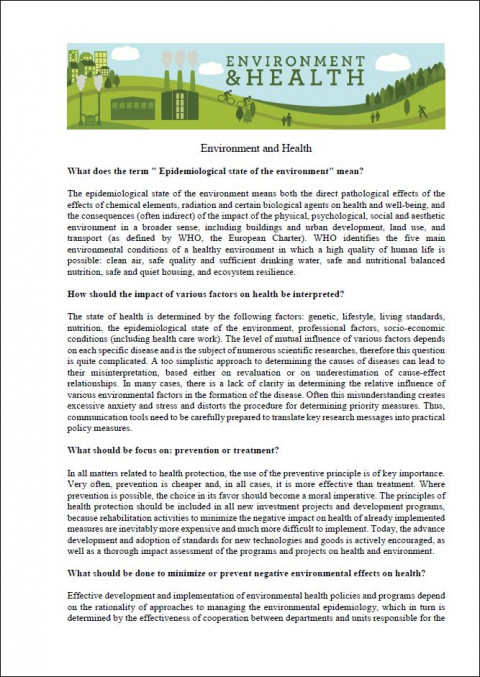 Publications Series within the CAREC Environment and Health Program Year of publication: 2018 Author: Irina Bekmirzaeva Corporate author: Regional Environmental Centre for Central Asia (CAREC) This publication was prepared by CAREC Environment and Health Program which aims to inform and raise awareness and knowledge among interested stakeholders on the interrelationship between environment and medicine. These publications are primarily developed to respond to numerous requests from representatives of Central Asian countries working on environmental and health issues in the region. The narrative style, language and terminology of the information have been designed for a wider audience. All information presented in these publications is based on the CAREC’s expertise and experience, as well as data from World Health Organization (WHO), the United Nations Development Program (UNDP) and the United Nations Environment Program (UNEP) and other international organizations.In the next issues of CAREC Environment and Health Program publications, we will focus on selected environmental health issues, including air quality and health, water and health, waste and health, sustainable development goals (SDGs), etc.