
Resources
Explore a wide range of valuable resources on GCED to deepen your understanding and enhance your research, advocacy, teaching, and learning.
1,180 Results found
 세계시민교육 학교 만들기 가이드 -전학교적 접근으로 실천하는 세계시민교육 Year of publication: 2018 Corporate author: 유네스코 아시아태평양 국제이해교육원 '전학교적 접근으로 실천하는 세계시민교육'이라는 부제를 갖고 있는 본 도서는 학교 차원에서 세계시민교육을 실천할 때 참고할 수 있는 유용한 가이드를 제공한다. 세계시민교육은 지식뿐 아니라 가치관, 태도, 행동의 변화까지 아우르기 때문에 교실을 넘어 학교, 가정, 지역사회까지 그 실천 범위가 확장되었을 때 더욱 효과적이다. 본 도서는 세계시민교육의 범위를 확장시켜 전학교적으로 실천하기 위한 전략과 활동 계획 구축에 대한 가이드를 구체적으로 제공하고 있다. 또한, 현장의 목소리를 담아 세계시민교육을 실천하며 겪었던 어려움, 고민, 극복 방안, 참고 사례 등을 나누고자 하였다. 여는 글PART I. 함께 그려보는 세계시민교육 학교의 비전Step 1_세계시민교육 학교, 왜 필요한가요?Step 2_세계시민교육 학교, 누가 만들 수 있나요?Step 3_세계시민교육 학교, 어떻게 만들 수 있나요?Step 4_세계시민교육 학교, 무엇을 하면 되나요? PART II. 학교에 부는 변화의 바람Story 1_아이들을 위한 변화를 만드는 교사 Story 2_학교 변화의 디자이너, 교장Story 3_다시 생각하는 학교의 역할
  Training Tools for Curriculum Development: A Resource Pack for Global Citizenship Education (GCED) Year of publication: 2018 Corporate author: UNESCO International Bureau of Education (IBE) | APCEIU The overarching objective of ‘A Resource Pack for Global Citizenship Education (GCED)’ is to share a broader understanding of GCED theory and practice, in order to support its effective development and implementation at the policy, school and classroom levels. The Resource Pack provides comprehensive guidance for national policymakers, curriculum specialists and developers, teacher educators, teachers, school leaders and district level administrators.The key topics covered are:Module 1: IntroductionModule 2: National PoliciesModule 3: CurriculumModule 4: Teaching, Learning and AssessmentModule 5: Teaching and Learning ResourcesModule 6: Whole School ApproachModule 7: Teacher Education and Professional Development Herramientas para Desarrollo Curricular: Recursos para la Educación para la Ciudadanía Mundial (ECM) Year of publication: 2018 Corporate author: UNESCO International Bureau of Education (IBE) | El Centro Asia Pacífico de Educación para el Entendimiento Internacional (APCEIU) El objetivo principal de “Recursos para la Educación para la Ciudadanía Mundial (ECM)” es el compartir una comprensión más profunda y amplia de la teoría y práctica de la ECM para poder propiciar su desarrollo efectivo e implementación a nivel de las políticas, escuelas y aulas. Los Recursos propician una guía comprensiva para los diseñadores de políticas nacionales, los especialistas y expertos en desarrollos de planes de estudios, formadores de maestros, educadores, líderes escolares y administradores a nivel de los distritos. Los principales temas abordados son:Módulo 1: IntroducciónMódulo 2: Políticas NacionalesMódulo 3: Diseño curricular Módulo 4: Enseñanza, aprendizaje y evaluaciónMódulo 5: Recursos para Enseñanza y AprendizajeMódulo 6: Enfoque Escolar IntegralMódulo 7: Formación de Maestros y Desarrollo Profesional
 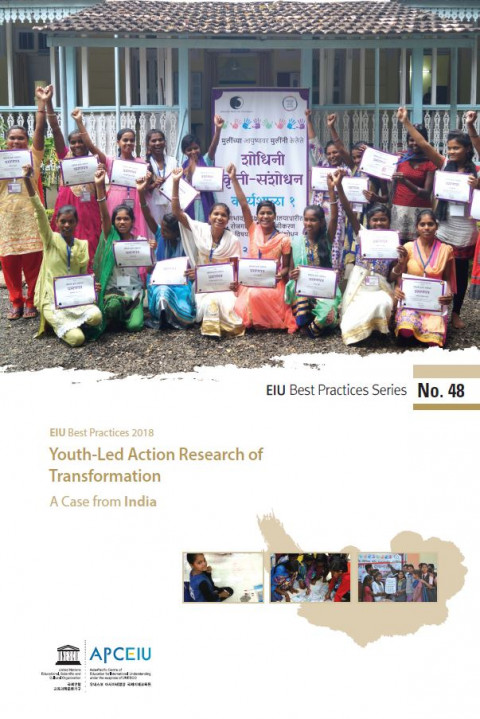 EIU Best Practices Series No. 48: Youth-Led Action Research of Transformation; A Case from India Year of publication: 2018 Corporate author: APCEIU This action research project is about the education for livelihood and life skills of marginalized young girls. This project was based from my experience in the Youth-Led Action Research Project organized by ASPBAE and UNESCO Institute of Lifelong Learning (UIL), which gradually led to the conception of the present action research project for the empowerment of the marginalized rural girls suppressed by patriarchal social systems. The Shodhinis are the subjects and objects of this action research. A hundred girls from ten villages conducted action research on the topics of gender, education, livelihood and life skills to young marginalized young girls aged between 14 to 25 years old in their respective communities. The Shodhinis discovered the joys of learning as they took positive steps in discovering and empowering themselves. The research enabled them to conduct various research methods like census and in-depth surveys of their fellow girls in their villages. As part of the research process, the girls also drew up a community map to understand their village. The relevance of this project to GCED values cannot be overemphasized especially in developing the cognitive, emotional and the behavioral dimensions of the girls themselves.This project not only focuses on analyzing the findings derived from the gathered data but also on generating action based on the data. It helped improve the way Shodhinis looked at themselves, their families, and their communities, inspiring them to become agents of change in their own lives as well as those of other girls in their villages. By amplifying their voices and opinions in the decision making processes at the family and community levels – for instance, by lobbying for the construction of libraries – the Shodhinis were able to demonstrate their leadership skills in shaping the development of their villages, thereby enhancing their dignity and self-worth.
  Reconciliation, Peace and Global Citizenship Education: Pedagogy and Practice Year of publication: 2019 Corporate author: APCEIU The Asia-Pacific Centre of Education for International Understanding launched the publication entitled Reconciliation, Peace and Global Citizenship Education: Pedagogy and Practices. This book is the result of the fruitful discussions and presentations made during the 4th International Conference on Global Citizenship Education held on 3-4 September 2019 in Seoul, Republic of Korea.The intention of this publication is not only to continue and deepen the discourses made by the speakers of the Conference, but also to provide the readers with opportunity to explore how pedagogy and practices of Global Citizenship Education can contribute to building peace and reconciliation across the globe. Part. I Global Citizenship Education for peace and reconciliation: OverviewLearning to live together and a life worth livingHow GCED can contribute to peace, reconciliation and sustainable developmentTransformative pedagogy for building peacePromoting peace through mindfulness programmes in schoolsGlobal memory, global citizenship and reconciliationThe role of Media and Information Literacy Part. II Global Citizenship Education for peace and reconciliation: Putting it into practiceFacing History and Ourselves in South AfricaClassrooms in Peace in ColombiaPreparing young people to be global citizens through integrated schools in Northern Ireland Part. III Global Citizenship Education for peace and reconciliation: Supporting effective implementationPolicy development and implementationChallenges in curriculum and textbook development for low-and middle-income country
 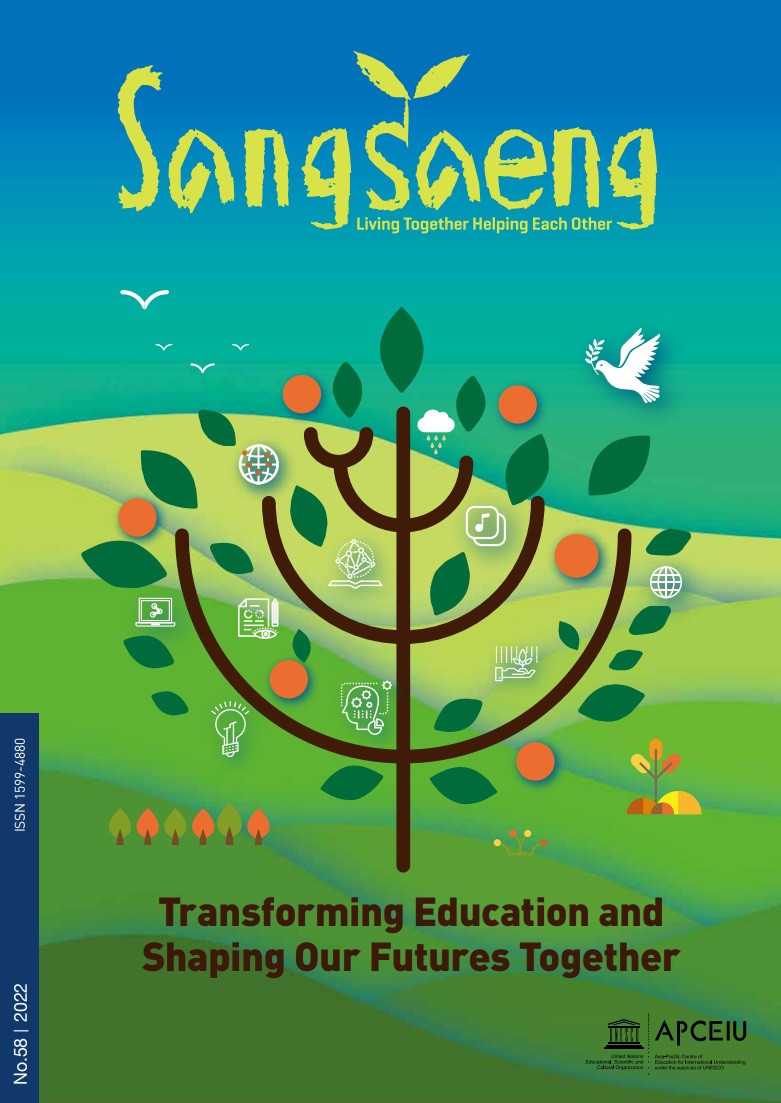 Transforming Education and Shaping Our Futures Together (SangSaeng no.58, 2022) Corporate author: APCEIU As humanity is facing unprecedented social, economic and environmental challenges, positive changes are necessary. And education plays a key role in adapting and responding to a changing world as it can be the most reliable tool to shape our future into a more inclusive, sustainable, and just world. In this context, SangSaeng No. 58 focuses on “Transforming Education and Shaping Our Futures Together” with the goal of exploring possible alternatives to educational systems and practices. Contents 03 Editor’s Note 04 Special ColumnTransformative Education for Learning to Live Together / Lim Hyun Mook 08 FOCUS: Transforming Education and Shaping Our Futures Together 08 Global Movement to Educate for Peace – Develop Hope by Focusing on an Educational Renaissance that’s Deliberate / Fernando M. Reimers 12 University as the Foundation of Education – Effective Education System Discovers Attributes that Help to Excel / Madhav Das Nalapat 15 Vision for a Feminist, Decolonized Education – Develop Two-accountability Education that Furthers Today’s Standard / Shamah Bulangis 19 Best Practices 19 Best of Both Worlds – Collaborative Approach to Transforming Education / Dailess Banda-Zulu and Sibylle Freiermuth 23 Leading Impactful Transformation in Local Community – Grassroots Level Educational Innovation that Inspires Future Action / IniOluwa Odekunle 26 Special Report 26 Asia-Pacific Education Ministers Call for Responsive Covid-19 Learning Recovery, Transformation of Education Systems – Highlights of the Second Asia-Pacific Regional Education Minister’s Conference (APREMC-II) / Jenelle Babb, Worapot Yodpet, Seek Ling Tan 29 Transforming Education: A Call to Action – Education Stakeholders Gather to Reimagine Education and Revitalize Commitments at the Transforming Education Pre-Summit / Transforming Education Summit Secretariat 32 Story TimeMy Role Model Teacher / Joseph Sandamira 34 Letter OneCambodian Approach Toward Educational Development for Better Future Connectedness, Readiness / Mok Sarom 36 Peace in My MemoryLost and Found Peace in War Times – Defining Secret Puzzle of Peace in War-torn Ukraine / Valeria Moroz 40 Understanding the Asia and the PacificBringing Living Heritage to Asia-Pacific Classrooms – Contextualizing School Activities with Living Heritage Supports Teachers, Improves Learning Outcomes, Safeguards Living Heritage / Duong Bich Hanh and Vanessa Achilles 44 GCED Youth Network Shapers for Today and Tomorrow’s Education – Youth Tackle Educational Topics to Further Develop, Improve, Transform / Diego Manrique 47 Letter TwoSupporting Global Citizenship Education in Kenya / Jane Nyaga 49 APCEIU in Action
  21세기 대전환 시대 대학이 나아갈 길: 변혁 역량을 키워주는 세계시민교육 Year of publication: 2023 Author: 강경희 | 김윤철 | 김형숙 | 박순용 | 장준호 | 최윤정 | 한경희 Corporate author: 유네스코 아시아태평양 국제이해교육원 이 책은 대학에서 세계시민교육을 계획하거나 실행하고 있는 교수자가 참고할 만한 내용을 담고 있다. 전공 분야 별로 세계시민교육 수업을 어떻게 설계하고 진행할 수 있는지 등을 포함해 대학 세계시민교육의 방향과 내용에 관한 제안을 실천 사례를 바탕으로 제시하고 있다. 목차:펴내는 글1장. 대학 세계시민교육의 의의와 방향2장. 교양대학의 세계시민교육3장. 대학 사회과학분야의 세계시민교육4장. 대학 공학분야의 세계시민교육5장. 대학 미술분야의 세계시민교육6장. 초등 교사교육의 세계시민교육7장. 중등 교사교육의 세계시민교육: 사회과를 중심으로부록참고문헌
  21st Asia-Pacific Training Workshop on EIU GCED Mentorship Programme - Final Report Year of publication: 2022 Corporate author: APCEIU This report summarizes 18 GCED projects implemented in the Asia-Pacific region by the alumni of APCEIU’s 21st Asia-Pacific Training Workshop on EIU/GCED (2022).The Mentorship Programme consisted of two tracks.1) Track A: Individual Mentorship with APCEIU’s expert groups (Concretizing the GCED project with guidance from mentors)2) Track B: Developing GCED Training Programme using Design Thinking Strategy with APCEIU & Habi Education LabAsia-Pacific Training Workshop on EIU/GCED (APTW) is APCEIU’s flagship TOT (Training of Trainers) programme for educators and teacher trainers in the Asia-Pacific region, which benefitted more than 600 educators over the last 22 years. Since 2021, it has been shifted to a comprehensive training programme composed of online training workshops, mentorship, and local project implementation to further empower participants to bring changes in their local communities.In 2022, marking its 21st turn, APTW was virtually held from 30 May to 7 June with 52 passionate educators from 19 UNESCO member states in the Asia-Pacific region. This year with the theme of ‘Preparing educators for a post-pandemic world: GCED as a key to change’, the Workshop provided opportunities to explore the timely issues and pedagogies to prepare educators for the post-pandemic world.
  Establishing a Monitoring System for Global Citizenship Education in South Korea: A Preliminary Study with a Focus on Policy Area Year of publication: 2019 Corporate author: APCEIU The Asia-Pacific Centre of Education for International Understanding published a report titled "Establishing a Monitoring System for Global Citizenship Education in South Korea: A Preliminary Study with a Focus on Policy Area." The purpose of this research report is to provide implications for the development of indicators for Global Citizenship Education (GCED) which is the target 4.7 of the Sustainable Development Goals (SDGs) and the establishment of a Korean monitoring system for data accumulation. It is difficult for GCED to set up common indicators to monitor the implementation of each country, as it comprehensively deals with the direction and contents of education, whereas other targets of SDG4 are relatively clear targets and goals such as guaranteeing educational opportunities and improving educational conditions. For this reason, this study proposed Korean indicators based on domestic and international trends and analysis of issues concerning the development of SDG4.7.1 indicators and reviewed the domestic status in implementation based on them, thereby contributing to the development and consolidation of global indicators development and monitoring systems in the future. 세계시민교육 지표 개발 및 데이터 축적을 위한 모니터링 체제 구축 연구 Year of publication: 2019 Corporate author: 유네스코 아시아태평양 국제이해교육원 유네스코 아태교육원은 “세계시민교육 지표 개발 및 데이터 축적을 위한 모니터링 체제 구축 연구” 보고서를 발간하였다. 본 연구보고서는 지속가능발전목표(SDGs)의 4번 교육 목표 중 7번째 세부목표(SDG4.7)인 세계시민교육의 지표 개발과 데이터 축적을 위한 국내 모니터링 체제 구축을 위한 시사점을 제공하는데 목적이 있다. SDG4.7이 추구하는 세계시민교육은 교육기회의 보장이나 교육여건 개선 등 비교적 대상과 목표가 명확한 다른 SDG4의 세부목표와 달리 교육의 방향성과 내용을 포괄적으로 다루기 때문에, 국가별로 이행 여부를 모니터링하기 위한 공동의 지표 설정에 어려움이 있다. 이와 같은 이유로, 본 연구에서는 SDG4.7.1 지표 개발에 대한 국내외 동향과 쟁점 분석을 토대로 국내 지표를 제안하고 이를 바탕으로 국내 이행 수준을 검토함으로써, 향후 글로벌 지표 개발과 모니터링 체제를 발전 및 공고화하는데 기여하고자 하였다.