
Resources
Explore a wide range of valuable resources on GCED to deepen your understanding and enhance your research, advocacy, teaching, and learning.
1,322 Results found
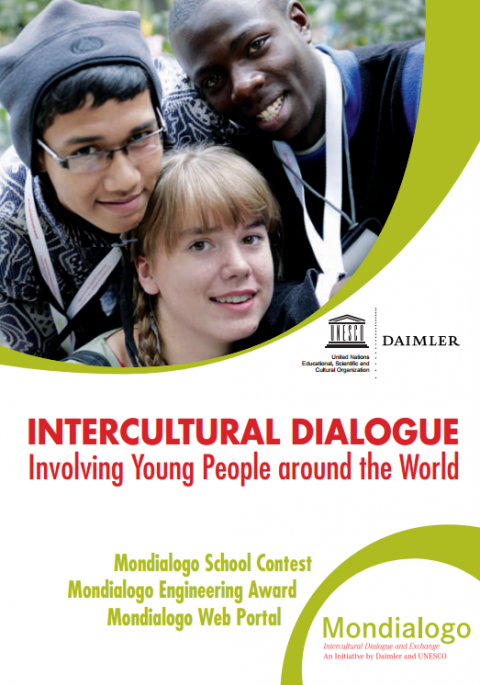 Intercultural dialogue: involving young people around the world Year of publication: 2010 Author: Elizabeth Khawajkie Corporate author: UNESCO | DAIMLER It is hoped that this review will help to highlight why there is a persistent call for the continuation of such endeavors, like Mondialogo, which promoted dialogue among cultures and people, mutual respect and understanding so effectively. The Mondialogo journey, begun as an exploratory exercise, ended with compelling and often moving experiences. Le dialogue interculturel: la participation des jeunes à travers le monde Year of publication: 2010 Author: Elizabeth Khawajkie Corporate author: UNESCO | DAIMLER Il est à espérer que cet examen permettra de mettre en évidence la raison pour laquelle il y a un appel persistant pour la poursuite de ces efforts, comme Mondialogo, qui a favorisé de manière efficace le dialogue entre les cultures et les peuples, le respect mutuel et la compréhension. Le voyage Mondialogo, commencé comme un exercice exploratoire, a pris fin avec des expériences convaincantes et souvent en mouvement.
  Report on the survey on the implementation of the road map for arts education Year of publication: 2010 Corporate author: UNESCO The Road Map for Arts Education is a reference document that aims to explore the role of arts education in meeting the need for creativity and cultural awareness in the 21st Century, while placing emphasis on the strategies required to introduce or promote arts education in the learning environment. Within this conceptual framework, all UNESCO Member States interested in initiating or developing arts education practices can mould their own national policy guidelines, adapted to their socio-cultural specificities. With the Road Map, UNESCO advocates the essential role of arts education within societies, to create a common ground of understanding for all stakeholders. The development of the Road Map for Arts Education was a lengthy and comprehensive consultation process. The document was first elaborated by a group of experts and UNESCO, then presented at the First World Conference on Arts Education (Lisbon, 2006) and later revised and updated, following recommendations from NGOs and Member States. The Road Map was finally distributed to the UNESCO Member States in November 2007 in English and French and then translated into Spanish and Russian following popular demand. More than a year after this distribution, UNESCO launched a wide-ranging survey in order to assess the implementation of the Road Map in its 193 Member States. Through its National Commissions, the Organization relayed this document to Ministries of both Education and Culture. The aim of this exercise was threefold: to learn whether the Road Map was being applied and to what extent it was influencing policy decisions at national level; to act as a reminder of the importance of the UNESCO reference document and encourage its use; finally, to assess the situation of arts education in the responding countries. Thus, this survey not only acted as a catalyst for the implementation of the Road Map, but also provided precious knowledge on arts education around the world. The Member States’ responses also contributed greatly to the Second World Conference on Arts Education (Seoul, May 2010), inspiring one of its main themes and the topics for a number of workshops. They also encouraged a more integral participation of these States in the conference through preparatory consultations.
  UN Decade of Education for Sustainable Development, 2005-2014: the DESD at a glance Year of publication: 2005 Corporate author: UNESCO This document briefs on the Decade of Education for Sustainable Development (DESD), detailing its objectives, the implementation plans, good practices, and challenges that DESD faces. Décennie des Nations Unies pour l'Éducation au Développement Durable, 2005-2014: l'DEED un coup d'oeil Year of publication: 2005 Corporate author: UNESCO Ce document mémoires sur la Décennie de l'Éducation pour le Développement Durable (DEDD), détaillant ses objectifs, les plans de mise en œuvre, les bonnes pratiques et les défis auxquels fait face DEDD. Análisis de los contextos y estructuras de la educación para el desarrollo sostenible 2009: principales conclusiones y camino a seguir Year of publication: 2009 Corporate author: UNESCO This document suggests key findings and ways forward in review of the contexts and strctures of education for sustainable development. Contextes et structures de l'education pour le développement durable 2009: principales conclusions et propositions d'action Year of publication: 2009 Corporate author: Organisation des Nations Unies pour l'éducation, la science et la culture (UNESCO) This document suggests key findings and ways forward in review of the contexts and strctures of education for sustainable development.
  Drivers and barriers for implementing learning for sustainable development in pre-school through upper secondary and teacher education Year of publication: 2007 Author: Inger Björneloo | Eva Nyberg Corporate author: UNESCO This publication is the product of the workshop on Drivers and Barriers for Implementing Learning for Sustainable Development in Pre-School through Upper Secondary and Teacher Education held in Göteborg, Sweden in March 2006. The workshop was the second in the series of workshops emanating from the Learning to Change Our World International Consultation on Learning for Sustainable Development, held in Göteborg in May 2004 on behalf of the Swedish Government. The purpose of this paper is to make visible some of the pluralism of different perspectives on education for sustainable development. This pluralism, which, during the workshop seemed to hinder progress, could through this be turned into a forceful driver instead of remaining a frustrating barrier. Pilotes et obstacles pour la mise en œuvre d'apprentissage pour le développement durable dans l'enseignement préscolaire à travers l'enseignement secondaire et supérieur enseignant Year of publication: 2007 Author: Inger Björneloo | Eva Nyberg Corporate author: UNESCO Cette publication est le résultat de l'atelier sur les moteurs et les obstacles à la mise en œuvre de l'apprentissage pour le développement durable dans l'enseignement préscolaire à travers le secondaire et la formation des enseignants, tenu à Göteborg en Suède en mars 2006. Cet atelier était le deuxième de la série d'ateliers Apprendre à changer notre monde Consultation internationale sur l'apprentissage pour le développement durable, tenue à Göteborg en mai 2004 au nom du gouvernement suédois. Le but de cet article est de rendre visible un peu du pluralisme des différentes perspectives sur l'éducation pour le développement durable. Ce pluralisme, qui, au cours de l'atelier, semblait gêner le progrès, pourrait devenir un moteur puissant au lieu de rester une barrière frustrante. Décennie des Nations Unies pour L'Education au Service du Développement Durable (DEDD 2005-2014): les deux premières années Year of publication: 2007 Corporate author: Organisation des Nations Unies pour l'éducation, la science et la culture (UNESCO) The implementation of the DESD has made considerable progress since its international launch in March 2005. Apart from regional and national launches, progress has been achieved in both institutional and programmatic areas at international, regional and national levels. The objective of this report is not solely to highlight and showcase to Member States all that has been achieved in the two years since the international launch. The report also takes stock of on-going UNESCO initiatives, established prior to the Decade, which are providing major contributions to the implementation of the DESD, and thus cannot be by-passed. Equally important are the recommendations to remedy problems in the implementation of the DESD and strengthen those measures that are working efficiently.