
Resources
Explore a wide range of valuable resources on GCED to deepen your understanding and enhance your research, advocacy, teaching, and learning.
1,180 Results found
 Inaugural Meeting of the GCED Actors' Platform: Final Report Year of publication: 2020 Corporate author: APCEIU This final report gives an overview of discussions and outcomes from the “Inaugural Meeting of the GCED Actors’ Platform” on 2 September 2019 in Seoul, Republic of Korea, held back-to-back with the 4th International Conference on GCED (3-4 September 2019, Seoul) In line with the call for closer collaboration on GCED inter-regionally, the GCED Actors’ Platform was launched by UNESCO Headquarters and APCEIU in 2019. Convening regional coordinators and different partners working on GCED, the “Inaugural Meeting of the GCED Actors’ Platform” provided an open space for the participants to discuss ways to coordinate activities and promote synergies.The regional representatives have imparted their own experiences and challenges on the ground and shared best practices of facilitating GCED.
  Asia-Pacific Teacher Exchange for Global Education Year of publication: 2019 Corporate author: APCEIU | Korea R. Ministry of Education Asia-Pacific Teacher Exchange for Global Education (APTE) is a bilateral teacher exchange programme between the Republic of Korea and Asia-Pacific partner countries, hosted by the Ministry of Education of the Republic of Korea and implemented by the Asia-Pacific Centre of Education for International Understanding under the auspices of UNESCO (APCEIU) in collaboration with the Ministries of Education of the partner countries. Launched with two partenr countries -- Mongolia and the Philippines -- in 2012, APTE has grown into a well-known regional programme, now working with seven partner countries in the Asia-Pacific region -- Cambodia, Indonesia, Malaysia, Mongolia, Philippines, Thailand, and Vietnam. 다문화가정 대상국가와의 교육교류사업 Year of publication: 2019 Corporate author: 유네스코 아시아태평양 국제이해교육원 | Korea R. Ministry of Education 「다문화가정 대상국가와의 교육교류사업」은 대한민국 교육부가 주최하고 유네스코 아시아태평양 국제이해교육원이 주관하며, 교류 대상국 교육부가 현지 협력주체로서 함께하는 한국 - 아태지역 국가양자 간 교육교류 사업이다. 2012년도에 몽골과 필리핀, 두 나라를 대상으로 시작한 본 교육교류사업은 지난 8년간 급성장하여, 2020년 현재에는 아태지역 7개국 (말레이시아, 몽골, 라오스, 인도네시아, 캄보디아, 태국, 필리핀)과 교류를 실시하고 있다.
  Global Citizenship Education: A Guide for Policymakers Year of publication: 2017 Author: Swee-Hin Toh | Gary Shaw | Danilo Padilla Corporate author: APCEIU In order to assist UNESCO Member States to integrate and strengthen Global Citizenship Education (GCED) in national education policies, strategies and plans to achieve SDG Target 4.7 effectively, the Asia-Pacific Centre of Education for International Understanding (APCEIU) has developed and published Global Citizenship Education: A Guide for Policymakers (hereafter referred to as the Guide).The Guide is mainly divided into two parts. Part 1 provides an overview of GCED, including the following three sections: the background to GCED; the rationale for GCED; and the concept of GCED. In Part 2, various selection strategies which allow each country to incorporate GCED into its current education system aligned with its own priorities and context, were divided and suggested into five major policy areas as follow: policy review and development; curriculum review and development; capacity building; knowledge creation; sharing and dissemination; and monitoring and assessment.The Guide was first published in English and Korean and additional translations will be available in the future in other languages, including French and Arabic to provide access to more readers worldwide. We hope that the Guide will provide an opportunity for policymakers and practitioners to share their experiences and insights. 세계시민교육 정책 개발을 위한 가이드 Year of publication: 2017 Author: Swee-Hin Toh | Gary Shaw | Danilo Padilla Corporate author: 유네스코 아시아태평양 국제이해교육원 유네스코 아시아태평양 국제이해교육원은 유네스코 회원국이 국가 교육정책에 세계시민교육을 반영하고 이를 통해 지속가능발전목표 4.7을 효과적으로 달성하는 것을 돕기 위해 『세계시민교육 정책 개발을 위한 가이드(Global Citizenship Education: A Guide for Policymakers)』를 개발ㆍ출간하였다.본 가이드는 크게 두 부분으로 나뉜다. 첫 번째 장에서는 세계시민교육의 배경과 논리, 그리고 개념을 차례로 살펴봄으로써 세계시민교육을 개괄하고자 하였다. 그리고 두 번째 장에서는 각국이 자신의 우선적 목표와 맥락에 맞게 세계시민교육을 현행 교육 시스템에 반영할 수 있도록 하는 다양한 선별적 전략들을 정책 검토ㆍ개발, 교육과정 검토ㆍ개발, 역량 강화, 지식의 창출ㆍ공유ㆍ확산, 모니터링 및 평가 등의 5가지 주요 정책 영역으로 나누어 제시하고자 하였다.본 가이드는 영어와 한국어로 우선 출간되었으며, 향후 전 세계의 더 많은 독자들에게 접근성을 제공하기 위하여 프랑스어와 아랍어를 포함한 다른 언어로도 추가 번역될 예정이다. 모쪼록 본 가이드가 정책입안자들과 실천가들에게 서로의 경험과 통찰을 나누는 계기를 제공할 수 있기를 바란다.
  [Video] Pedagogical Principles of GCED Year of publication: 2018 Corporate author: APCEIU Here we introduce a fast, fun, and friendly way of learning GCED.The series of bite-sized animation will take you on a journey to GCED in minutes!
 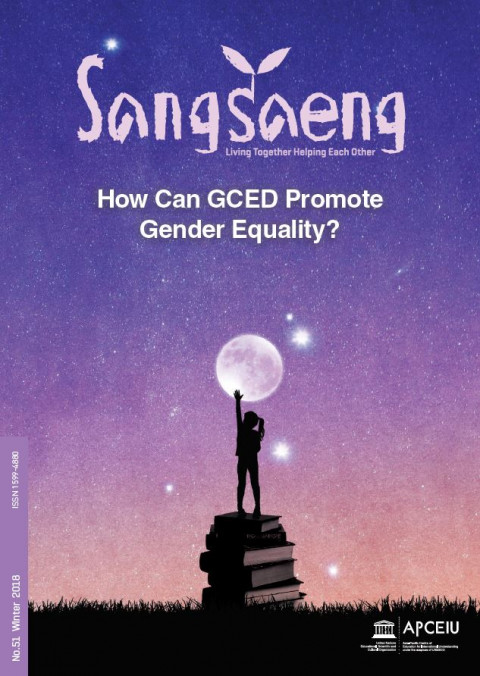 How Can GCED Promote Gender Equality? (SangSaeng no. 51 Winter 2018) Year of publication: 2018 Corporate author: APCEIU The 51th issue of SangSaeng, under the theme of “How Can GCED Promote Gender Equality?,” explores the role of GCED to bolster gender equality. In this issue, readers are reminded that GCED is not an abstract idea- rather, it is connected to real-life issues such as questioning gendered roles, expectations and stereotypes that are prevalent in many societies; and therefore, it can be a vital accelerator in building a more equitable world. 3 Director’s Message 4 Special ColmunTools that Promote Gender Equality 8 Focus : How Can GCED Promote Gender Equality?8 Bringing Gender Equality to Science World12 Women For Better World15 Setting GCED Principles to Promote Girls’ Education in Tado18 Path to Building Next Gen Men 22 Best Practice22 Using GCED to Promote Gender Equality in Senegal26 Adapting GCED into a Specific Learning Environment 29 Special ReportThe 3rd International Conference on GCED 32 InterviewGirls in GCED 35 Youth NetworkGlobal Citizenship Education in Refugee Crisis Relief 38 LetterPoetry - The Sword in Our Sheath 42 Peace In my MemoryBachcha Posh : An Inside Look 46 Understanding the Asia-Pacific RegionGrafting Human Rights Tree in Five ‘Stans’ 50 APCEIU in Action Comment l’ECM peut-elle promouvoir l’égalité des genres ? (SangSaeng N° 51 Hiver 2018) Year of publication: 2018 Corporate author: APCEIU SangSaeng (상생), mot coréen d’origine chinoise, se compose de deux caractères : Sang (相), qui signifie « mutual » (les uns les autres) et Saeng (生), qui signifie « vie ». Mis ensemble, ils signifient « vivre ensemble », « s’entraider ». C’est notre vision pour la région Asie-Pacifique. SangSaeng (相生) se veut une plateforme de débats constructifs sur les sujets, méthodes et expériences dans le domaine de l’éducation à la compréhension internationale. SangSaeng vise aussi à promouvoir l’Éducation à la citoyenneté mondiale, une des trois priorités de l’Initiative mondiale pour l’éducation avant tout, lancée par les Nations Unies en 2012. SangSaeng est publié deux fois par an par le Centre Asie-Pacifique d’éducation pour la compréhension internationale (APCEIU) sous l’égide de l’UNESCO. Version française produite par le Bureau régional de l'UNESCO pour l'Afrique de l'Ouest (Sahel) et édiitée avec l'appui de l'APCEIU. 3 MESSAGE DU DIRECTEUR4 RUBRIQUE SPECIALE Outils pour la promotion de l'égalité des genres8 FOCUS: COMMENT L'ECM PEUT-ELLE PROMOUVOIR L'ÉGALITÉ DES GENRES? 08 L'ÉGALITÉ DES GENRES DANS LE MONDE SCIENTIFIQUE 12 LES FEMMES POUR UN MONDE MEILLEUR 15 FIXER DES PRINCIPES D'ECM POUR PROMOUVOIR L'ÉDUCATION DES FILLES DES FILLES TADO 18 SUR LA VOIE DES HOMMES DE LA PROCHAINE GÉNÉRATION 22 BONNES PRATIQUES 22 Utiliser l'ECM pour promouvoir l'égalité des genres au Sénégal 26 Adapter l'ECM à un environnement d'apprentissage spécifique29 REPORTAGE SPÉCIAL La 3e Conférence internationale sur l’ECM: Une plate-forme durable et robuste pour l’ECM32 ENTRETIEN Les filles dans l'ECM35 RÉSEAU DE JEUNES L'éducation à la citoyenneté mondiale dans l'aide au réfugiés en situation de crise38 LETTRE Poésie - l'épée dans notre fourreau 42 LA PAIX DANS MA MÉMOIRE Bachcha Posh : Un regard intérieur46 COMPRENDRE LA REGION ASIE-PACIFIQUE Greffer l'arbre des droits de l'homme dans les cinq « Stans »50 APCEIU EN ACTION 어떻게 세계시민교육이 성 평등에 기여할 수 있을까? (상생 제51호 2018년 겨울호) Year of publication: 2018 Corporate author: 유네스코 아시아태평양 국제이해교육원 상생 51호는 “어떻게 세계시민교육이 성 평등에 기여할 수 있을까?”라는 주제로 성 평등을 강화하기 위한 세계시민교육의 역할을 다룬다. 이번 호를 통하여 독자들은 세계시민교육이 추상적인 것이 아니라, 우리의 실제 삶과 관련이 있으며, 많은 사회에서 만연한 성 역할, 기대, 고정관념에 대해 의문을 던지는 교육이며, 더욱 평등한 사회를 만드는 데 기여하는 주요한 촉진제가 될 수 있음을 깨닫게 될 것이다. 3 발간사4 스페셜 칼럼 : 성 평등을 증진시키는 도구들 8 포커스: 어떻게 세계시민교육이 성 평등에 기여할 수 있을까?8 과학계에 도입하는 성 평등12 더 나은 세상을 위해 힘쓰는 여성들15 소녀 교육을 위한 Tado의 세계시민교육 원칙 세우기18 다음 세대의 남성들을 양성하는 길 22 모범 사례22 세계시민교육을 통한 세네갈의 성 평등 증진26 중앙아시아 학생들의 창의적이고 실제적인 능력 향상을 위한 세계시민교육 사례 연구29 스페셜 리포트 : 3차 세계시민교육 국제회의: 세계시민교육을 위한 탄탄하고 지속 가능한 플랫폼을 위하여 32 인터뷰 : 필리핀에서 여성 교육 향상에 힘쓰는 세 명의 젊은 연구자들과의 인터뷰35 유스 네트워크 : 위기 상황에 적용한 세계시민교육38 시 : 우리의 칼집에 꽂힌 검42 내 기억 속의 평화 : 성별을 숨기고 살아야 하는 아프가니스탄 소녀 이야기46 아시아-태평양 지역 이해하기 : 5개의 ‘스탄’ 국가에 인권의 나무를 접붙이다50 교육원 활동
 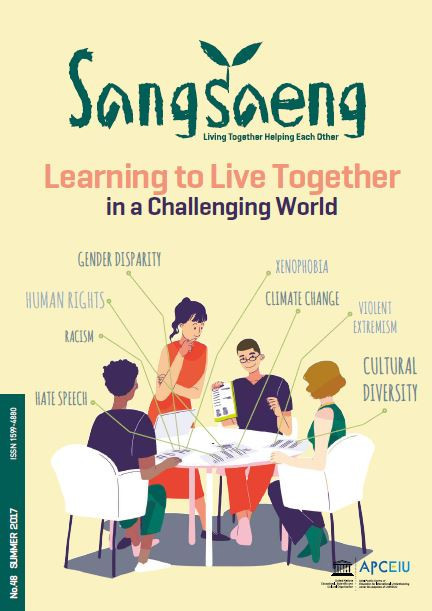 Learning to Live Together in a Challenging World (SangSaeng no. 48 summer 2017) Year of publication: 2017 Corporate author: APCEIU The 48th issue of SangSaeng, “Learning to Live Together in a Challenging World,” has been published. With nationalism on the rise and support for populist perspectives, this edition of SangSaeng emphasizes the global community’s efforts for tolerance and learning to live together. It contains articles reminding us of the importance of empowering learners to assume active roles to face and resolve global challenges. 3 Director’s Message4 Special Column4 Education of Harmony, Peace and Happiness8 We Must Educate Global Citizens to Sustain Peace in the World11 Focus: Learning to Live Together in a Challenging World11 Access to Equitable Quality Education.14 How Business Helps People Learn to Live and Work Together17 Challenges in the Horn of Africa and Desire for Human Dignity20 Ethnic Identity in the Era of Minority Recognition 23 Special ReportShrinking Spaces: A Perspective from Iraq26 Best Practices26 Free2Choose-Create30 Strengthening Literacy Learning in Lesotho35 Youth NetworkGCED & Youth: An Open Forum in Jeju38 InterviewThe Power of Music: An Agent of Transformation42 Understanding the Asia-Pacific Region42 Naadam: A Celebration of Culture46 Bomena in Bhutan50 APCEIU in Action