
Resources
Explore a wide range of valuable resources on GCED to deepen your understanding and enhance your research, advocacy, teaching, and learning.
1,180 Results found
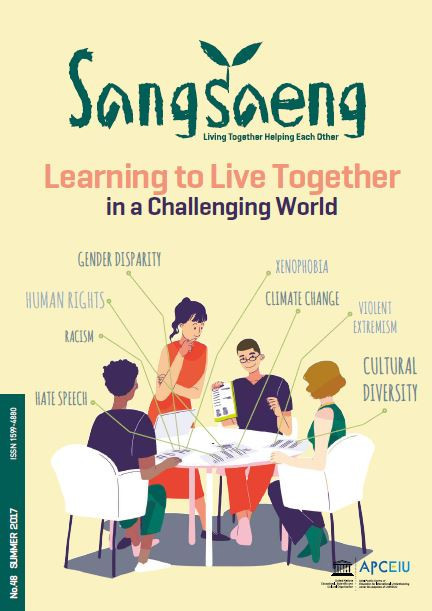 더불어 살아가기 위한 교육이 직면한 도전 (상생 제48호 2017년 여름호) Year of publication: 2017 Corporate author: 유네스코 아시아태평양 국제이해교육원 48호 <상생>이 “더불어 살아가기 위한 교육이 직면한 도전”이라는 주제로 발간되었다. 이번 호는 국가이기주의와 포퓰리즘 등 도전적인 상황 속에서 관용과 더불어 살아가기 위한 교육(Learning to Live Together)을 지켜나가는 국제사회의 노력을 살펴보고, 학습자들이 도전적인 상황을 직면하고 적극적인 역할을 수행하도록 역량을 키우는 것이 얼마나 중요한지 일깨워준다. 3 발간사4 스페셜 칼럼4 공존과 평화, 행복을 위한 교육8 우리는 세계평화를 지속시키기 위해 세계시민교육을 해야 한다11 포커스: 더불어 살아가기 위한 교육이 직면한 도전11 질적 교육에 평등하게 접근하기14 비즈니스가 함께 살고 일하도록 가르치는 방법17 아프리카 북동부 지역의 인간존엄을 향한 열망과 도전20 소수자 인정 시대의 종족 정체성 23 스페셜 리포트축소되는 공간: 이라크의 관점26 국제이해교육 모범사례26 안네프랑크하우스 Free2Choose-Create30 레소토 리터러시 교육 강화35 유스네트워크세계시민교육과 청년: 제주포럼38 인터뷰음악의 힘: 변혁의 주체42 아시아태평양 지역 이해하기42 나담: 축하의 문화46 부탄 보메나50 교육원 활동
  고등학교 세계시민교육 문턱 낮추기 프로젝트 – 사회과군 편 Year of publication: 2021 Author: 김다영 | 김병연 | 윤신원 | 황태성 Corporate author: 유네스코 아시아태평양 국제이해교육원 유네스코 아태교육원은 ⟪고등학교 세계시민교육 문턱 낮추기 프로젝트 – 사회과군 편⟫을 발간했다. ⟪고등학교 세계시민교육 문턱 낮추기 프로젝트⟫의 첫 시리즈인 이 책은 보다 많은 고등학교 선생님들이 학교 현장에서 세계시민교육을 실천할 수 있도록 진입장벽을 낮추고자 기획되었다. 특히 세계시민교육 관련 내용이 많이 포함되어 있는 사회과군 선생님들이 실제 수업에서 진행한 세계시민교육 교수학습 사례를 담았다. <목차>서문1장. 질문과 토론으로 이어가는 세계시민교육 1.1. 자문자답(自問自答), 저를 소개합니다 1.2. 2021년, 수업을 이렇게 설계했어요 1.3. 학생들과 함께 수업을 만들어갔어요사례 1] 불평등 현상과 사회정의사례 2] 사회정의 관점에서 세계화 바라보기사례 3] 평화의 관점에서 통일 문제 탐구 1.4. 수업을 되돌아보며 2장. 지구적으로 생각하고 지역적으로 행동하는 우리는 ‘세계시민’ 2.1. 선생님은 왜 ‘세계시민교육’을 하나요? 2.2. ‘세계시민교육’, 어렵지 않아요!사례 1] 세계화와 먹거리 문제사례 3] 지속가능발전을 위한 국제개발협력의 주체사례 2] 기후 위기와 지속가능한 세계 2.3. 미래 세대를 위한 교육, 우리 함께해요 3장. 지역이해와 활동 중심으로 구성하는 세계시민교육 3.1. 세계시민교육, 이렇게 만났어요 3.2. 세계시민교육, 무엇부터 시작해야 할까요? 3.3. 세계시민교육과 연결성사례 1] 영상을 통한 자연과 인간과의 관계 이해하기사례 2] 모둠 활동을 통한 나와 지역사회 연결하기 3.4. 세계시민교육과 인권사례 1] 세계인권선언 그림 카드 만들기사례 2] 인권 시 작성하고 낭송하기 3.5. 다문화교육과 세계시민교육사례 1] 영상을 통한 다문화교육사례 2] 포토스탠딩을 통한 다문화교육 3.6. 실천을 통한 세계시민교육사례 1] 100원 경매를 통한 기부 활동사례 2] SDGs 이해하고 실천하기 3.7. 글을 마치며
  2016 한-유네스코 펠로우십 프로그램 최종보고서 Year of publication: 2016 Corporate author: 유네스코 아시아태평양 국제이해교육원 본 보고서는 2016년 9월 1일부터 10월 31일까지 열린 ‘2016 한-유네스코 펠로우십 프로그램’에서이루어진 활동 내용과 성과물에 대한 요약을 담고 있다. 올해 10회를 맞이하는 본 프로그램에는 아시아태평양 및 아프리카 17개국 25명의 교육자들이 참가하였으며, 두 달간 기초교육, ICT교육(e-러닝), 세계시민교육 및 소녀교육의 4가지 주제영역에 대한 참가자들의 이해 증진과 역량강화를 위한 연수로 진행되었다. 이 보고서를 통해, 다양한 주제관련 강의, 워크숍, 현장학습활동, 교육자료 개발 프로젝트 등으로 이루어진 이 프로그램의 내용과 참가자들의 교육현장에서 의미 있게 적용될 수 있는 결과물과 실행계획 등 성과에 대한 내용을 살펴볼 수 있다. 문의: 유네스코 아태교육원 교육연수실(ent@unescoapceiu.org)
 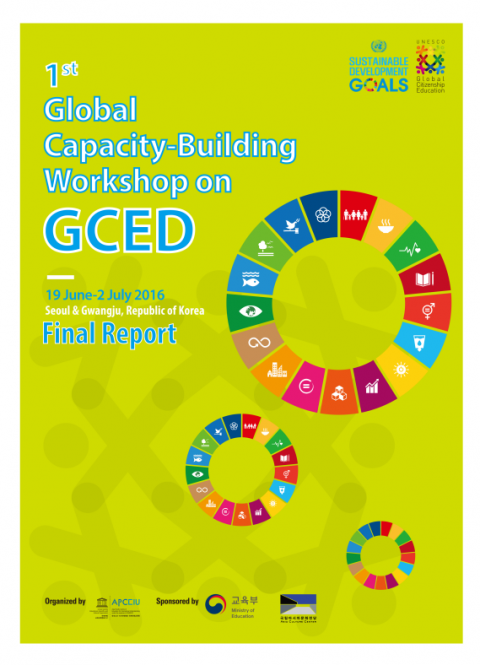 Final Report: 1st Global Capacity-Building Workshop on GCED Year of publication: 2016 Corporate author: APCEIU This report provides an overview of the activities carried out during the 1st Global Capacity-Building Workshop on GCED held in Seoul and Gwangju, Republic of Korea from 19 June - 2 July, 2016. APCEIU organized the 1st Global Capacity-Building Workshop on GCED in collaboration with UNESCO in order to contribute to achieving the Sustainable Development Goals(SDGs) target 4.7 by enhancing the capacity of teacher educators and trainers in implementing GCED. This intensive 2-week workshop provided the participating educators with the opportunities to better understand the concept and internalize the pedagogical principles of GCED while sharing their experiences and working on collaborative action plans. For more information, please contact APCEIU's Office of Education and Training at ent@unescoapceiu.org.
 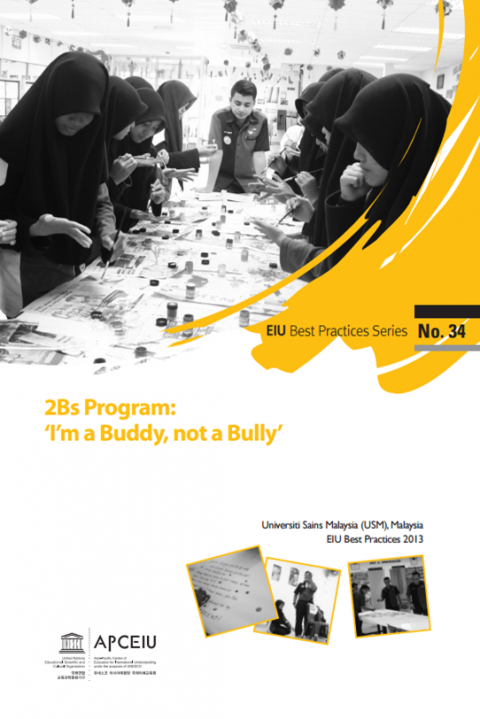 EIU Best Practices Series No.34: 2Bs Program: 'I'm a Buddy, not a Bully' Year of publication: 2013 Corporate author: Азиатско-Тихоокеанский центр образования для международного понимания (APCEIU) This issue is one of APCEIU's EIU Best Practices Series, which aims to encourage educators, scholars, and activists to implement and share local initiatives on EIU. The Series No.34 introduces the 2Bs Program implemented in boarding schools in Malaysia, highlighting the importance of education in preventing bullying behavior. The program involves three phases, such as employing creative and fun pedagogy approaches, rehabilitation, and student potential development to effectively raise awareness surrounding the issue and encourage behavior change. Such initiative is exemplary in combatting challenges that arise from cultural differences, and in fostering understanding.
 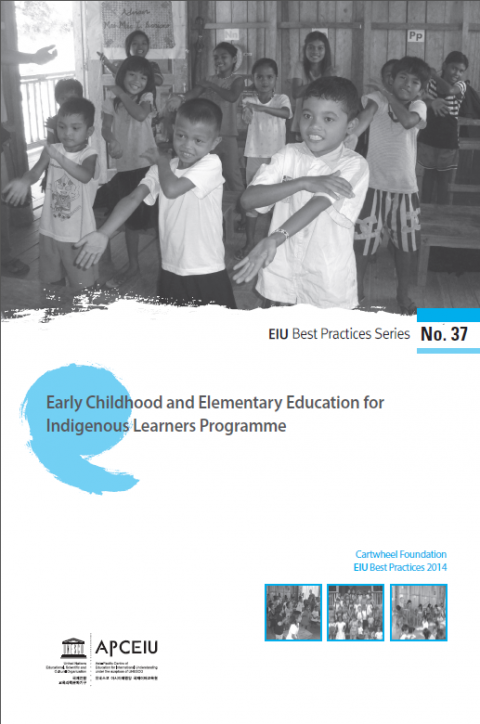 EIU Best Practices Series No.37: Early Childhood and Elementary Education for Indigenous Learners Programme Year of publication: 2014 Corporate author: APCEIU This monograph is one of APCEIU's EIU Best Practices Series, which aims to encourage educators, scholars, and activists to implement and share local initiatives on EIU. The Series No.37 introduces the Early Childhood and Elementary Education (ECEE) for Indigenous Learners Programme initiated in the Philippines. The indigenous peoples (IP) reside in the mountainous regions, away from basic social services and struggling with poverty, malnutrition, and lack of proper education. The aim of ECEE is to facilitate access to quality and culturally-relevant early childhood and elementary education for the Higaonon indigenous children. To achieve this, activities such as curriculum indigenization and teacher training are provided in collaboration with the community members. As the program creates learning process for all through openness, sharing, and collaboration, this is an exemplary case of EIU/GCED pedagogical approach.
 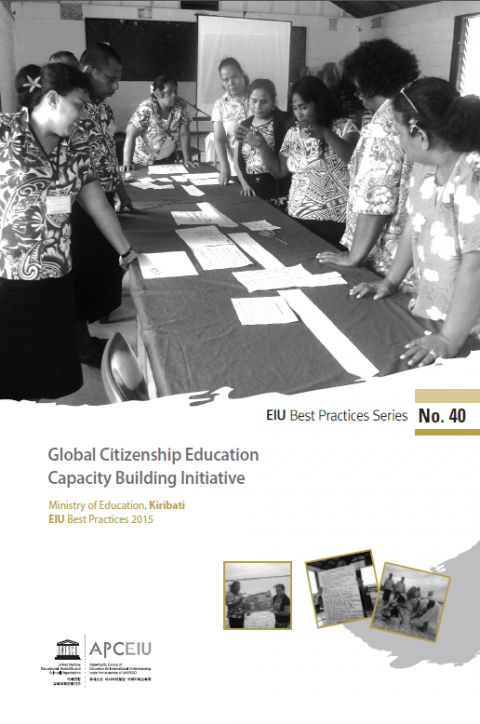 EIU Best Practices Series No.40: Global Citizenship Education Capacity Building Initiative: Misitry of Education, Kiribati Year of publication: 2015 Corporate author: APCEIU This monograph is one of APCEIU's EIU Best Practices Series, which aims to encourage educators, scholars, and activists to implement and share local initiatives on EIU. The Series No. 40 introduces a successful hosting of workshop on GCED in Kiribati. Considered the first of its kind in Kiribati, the workshop brought together education officers and teachers to learn about emerging concept of GCED and EIU and means for implementation. The exemplary workshop involving fieldtrips and seminars has created a wave of learning opportunities for key stakeholders at all levels, paving way to put GCED into practice.
 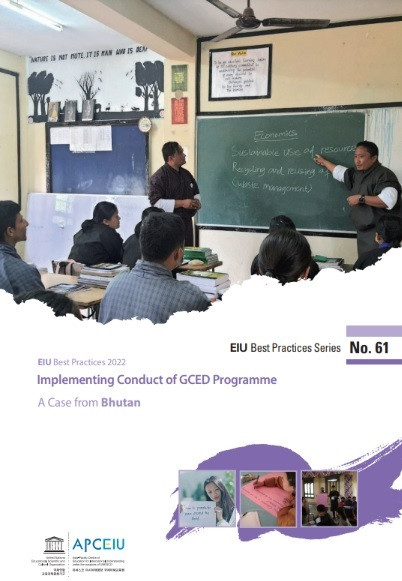 EIU Best Practices 2022: Implementing Conduct of GCED Programme; A Case from Bhutan (EIU Best Practices Series; no.61) Year of publication: 2022 Author: Santosh Kumar Biswa Corporate author: Centre Asie-Pacifique d'éducation pour la compréhension internationale (APCEIU) This monograph is one of APCEIU's EIU Best Practices Series, which aims to encourage educators, scholars, and activists to implement and share local initiatives on EIU. The Series No.61 is focusing on equipping youths, teachers and people around the world with the concept of GCED through his capacity-building and familiarization programme in schools and communities.
  [Summary] Global Citizenship Education Forum: Sharing Stories of Empowering Citizens to Tackle Global-Local Challenges Year of publication: 2022 Corporate author: Permanent Delegation of the Republic of Korea to UNESCO | Group of Friends for Solidarity and Inclusion with Global Citizenship Education | APCEIU This report shares the overview of the Global Citizenship Education Forum held under the theme ‘Sharing Stories of Empowering Citizens to Tackle Global-Local Challenges’ on Friday, 13 May 2022. The event was co-organized by the Permanent Delegation of the Republic of Korea to UNESCO and the Asia-Pacific Centre of Education for International Understanding (APCEIU) in collaboration with the Group of Friends for Solidarity and Inclusion with GCED (Afghanistan, Armenia, Austria, Bangladesh, Canada, Colombia, Italy, Jordan, Kenya, Kuwait, Philippines, Republic of Korea, Saudi Arabia, Senegal and Serbia). This report shares the summary of the event, particularly the presentations on GCED activities implemented by practitioners from Armenia, Austria, Colombia, Jordan, Kenya and the Philippines to influence more GCED programmes/initiatives on various contexts and backgrounds.
  Asia-Pacific Teacher Exchange for Global Education 2022: Final Report Year of publication: 2022 Corporate author: APCEIU | Korea R. Ministry of Education The Asia-Pacific Teacher Exchange for Global Education (APTE), which has been in place since 2012, marks its 10th anniversary this year. APTE had been conducted according to the existing programme execution system and flow chart until 2019. However, the Office of International Teacher Exchange (ITE) focused on online exchange due to the pandemic crisis. This year’s APTE programme followed last year’s online formula and presented a new direction for utilization even post-pandemic. These efforts are expected to enhance global educational competencies for a more sustainable Global Citizenship Education.