
Resources
Explore a wide range of valuable resources on GCED to deepen your understanding and enhance your research, advocacy, teaching, and learning.
6 Results found
 Gender Equality is the Key to a Successful Social and Economic Formation of the New Uzbekistan (Science and Education; vol. 3, no. 6) Year of publication: 2022 Author: Dilafruz Vafokhojaeva Corporate author: Tashkent State University of Economics Strengthening gender equality, especially in the labor market, is an important factor in the formation of the social state. For the development of the effective measures directed at gender equality it is necessary to analyze, first of all, horizontal (on branches of economy, professions) and vertical (on positions, level of income) differentiation between women and men, and also position of those social and demographic groups of women which have or have no opportunities for combination of career and a family. Гендерное равенство - залог благополучного социальногоэкономического формирования нового Узбекистана (Science and Education; vol. 3, no. 6) Year of publication: 2022 Author: Dilafruz Vafokhojaeva Corporate author: Tashkent State University of Economics Укрепление гендерного равноправия, особенно на рынке труда и в политической сфере, является важным фактором формирования социально-экономического государства. Для выработки эффективных мер, направленных на гендерное равноправие, надо анализировать прежде всего горизонтальную (по отраслям экономики, профессиям) и вертикальную (по должностям, уровню доходов) дифференциацию между женщинами и мужчинами, а также положение тех социально-демографических групп женщин, которые имеют или не имеют возможностей для совмещения карьеры и семьи.
  Pedagogical and Methodological Conditions for Studying Traditional Musical Heritage in Education Year of publication: 2022 Author: Ilkhom Akhtamovich Kushaev This article examines the post-independent process of training bachelors in higher educational institutions of the Republic of Uzbekistan and analyzes the organizational and territorial framework for the implementation of this work today. The article examines and analyzes the specificity of the educational process in the field of education in the period of independence, in particular, in the field of music education of the pedagogical faculty of higher educational institutions. Педагогико-методические условия изучения традиционного музыкального наследия в образовании Year of publication: 2022 Author: Ilkhom Akhtamovich Kushaev В данной статье исследуется пост-независимый процесс подготовки бакалавров в высших учебных заведениях Республики Узбекистан и анализируются организационно-территориальные рамки для реализации этой работы сегодня. В статье исследуется и анализируется специфика образовательного процесса в сфере образования в период независимости, в частности, в сфере музыкального образования педагогического факультета высших учебных заведений.
 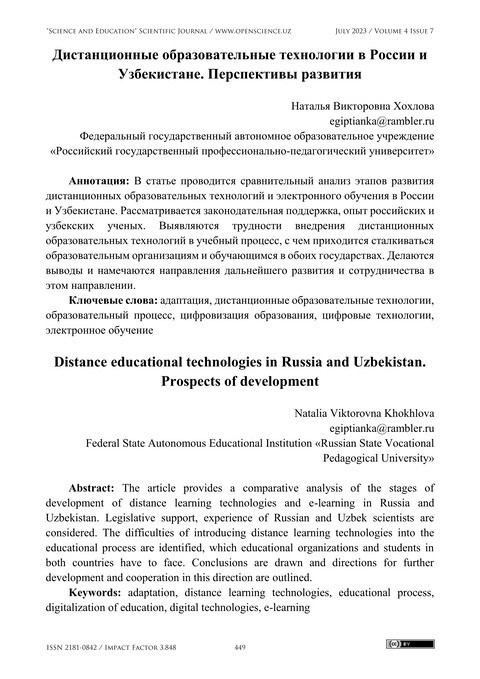 Distance educational technologies in Russia and Uzbekistan: Prospects of development (Science and Education; Vol.4, Issue.7) Year of publication: 2023 Author: Наталья Викторовна Хохлова The article provides a comparative analysis of the stages of development of distance learning technologies and e-learning in Russia and Uzbekistan. Legislative support, experience of Russian and Uzbek scientists are considered. The difficulties of introducing distance learning technologies into the educational process are identified, which educational organizations and students in both countries have to face. Conclusions are drawn and directions for further development and cooperation in this direction are outlined. Дистанционные образовательные технологии в России и Узбекистане: Перспективы развития (Science and Education; Vol.4, Issue.7) Year of publication: 2023 Author: Наталья Викторовна Хохлова В статье проводится сравнительный анализ этапов развития дистанционных образовательных технологий и электронного обучения в России и Узбекистане. Рассматривается законодательная поддержка, опыт российских и узбекских ученых. Выявляются трудности внедрения дистанционных образовательных технологий в учебном процессе, с чем приходится сталкиваться образовательными организациями и обучающимися в обоих государствах. Делаются выводы и намечаются направления дальнейшего развития и сотрудничества в этом направлении.