
Resources
Explore a wide range of valuable resources on GCED to deepen your understanding and enhance your research, advocacy, teaching, and learning.
15 Results found
 Localizing the 2030 Agenda and Global Citizenship Education: An Essential Dialogue Year of publication: 2020 Corporate author: Diputació de Barcelona Diputació de Barcelona has produced a document that offers guidelines to strengthen the links between Global Citizenship Education (GCE) actions and localizing SDGs initiatives, in order to drive real changes in local policies.What we call Global Citizenship Education (GCE) brings together key elements of different educational trends, such as development education, peace education or education for sustainability, among others. Each of them has decades of experience in promoting changes in citizen’s knowledge, attitudes and behaviours through formal or informal channels. This experience can help to reinforce the 2030 Agenda’s capacity to generate real change towards a more sustainable future for the planet, connecting local and global realities and highlighting interdependencies and co-responsibility. The document points out what can be done at the local level to improve this dialogue between SDG and GCE with practical proposals such as introducing GCE perspective in the SDGs training activities or implementing joint initiatives between development cooperation departments and other areas to reach new audiences. Localización de la agenda 2030 y la educación para la ciudadanía global: Un diálogo imprescindible Year of publication: 2020 Corporate author: Diputació de Barcelona Este documento pretende contribuir al diálogo entre los procesos de localización de la Agenda 2030 y la ECG, así como ofrecer orientaciones concretas para la acción local.
  Alert 2024! : Report on Conflicts, Human Rights and Peacebuilding Year of publication: 2024 Corporate author: Escola de Cultura de Pau (ECP) Published since 2001, this yearbook analyses the state of the world in terms of conflict and peacebuilding based on three axes: armed conflict, tensions and gender, peace and security. The analysis of the most relevant events of the year and the nature, causes, dynamics, actors and consequences of the main scenarios of armed conflict and socio-political tension in the world allows for a comparative regional view and the identification of global trends, as well as elements of risk and preventive warning for the future. Likewise, the report also identifies opportunities for peacebuilding or for the reduction, prevention or resolution of conflicts. Alerta 2024!: Informe sobre conflictos, derechos humanos y construcción de paz Year of publication: 2024 Corporate author: Escola de Cultura de Pau (ECP) Editado desde 2001, este anuario analiza el estado del mundo en términos de conflictividad y construcción de paz a partir de tres ejes: conflictos armados, tensiones y género, paz y seguridad. El análisis de los hechos más relevantes del año y de la naturaleza, causas, dinámicas, actores y consecuencias de los principales escenarios de conflicto armado y tensión socio-política en el mundo permite ofrecer una mirada comparativa regional e identificar tendencias globales, así como elementos de riesgo y alerta preventiva de cara al futuro. Del mismo modo, el informe también identifica oportunidades para la construcción de paz o para la reducción, prevención o resolución de conflictos.
 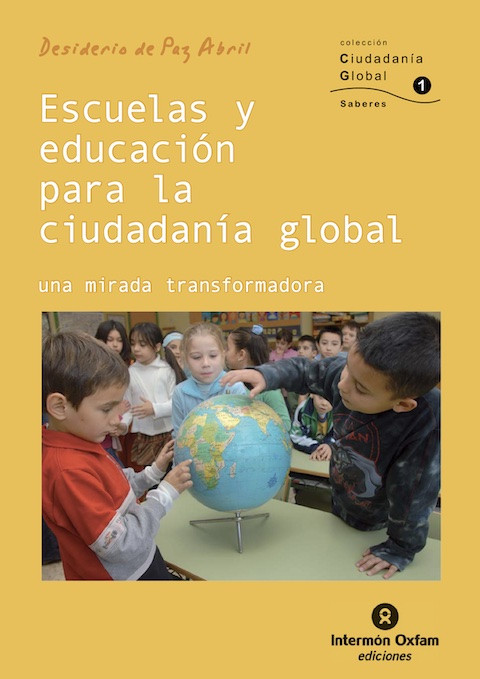 Escuelas y educación para la ciudadanía global: Una mirada transformadora Year of publication: 2013 Author: Desiderio de Paz Abril Corporate author: Agencia Española de Cooperación Internacional para el Desarrollo (AECID) | Oxfam Intermón Una escuela participativa es la base para alcanzar una sociedad democrática que trascienda el formalismo de las votaciones y los procesos electorales para posibilitar universos en los que sean reales la igualdad de oportunidades, la justicia y la auténtica libertad, desde una ciudadanía crítica y reflexiva. El libro se divide en 2 partes, En la primera se argumenta la necesidad de defender un nuevo modelo educativo humanista y global, y se evidencia la perspectiva esperanzadora que proporciona la fuerza de los discursos de Habermas y Freire para caminar en esta dirección. En la segunda parte del libro se profundizan diferentes enfoques de la práctica escolar, en tres maneras de aprehender la realidad educativa, tres principios organizadores y legitimadores de la acción y tres maneras de hacer la práctica educativa escolar (enfoque técnico-instrumental, enfoque práctico-signifi cativo y enfoque crítico-comunicativo).
  Gender Violence (Mente y Cerebro; no. 48) Year of publication: 2011 Author: Francisca Expósito Corporate author: Prensa Científica This article deals with the ideological nature of gender violence, favored by the social asymmetry between women and men. Violencia de género (Mente y Cerebro; no. 48) Year of publication: 2011 Author: Francisca Expósito Corporate author: Prensa Científica En este artículo se se aborda la naturaleza ideológica de la violencia de género, favorecida por la asimetría social entre mujeres y hombres.
  [Video] Learning about SDG 4 Year of publication: 2017 Corporate author: United Cities and Local Governments (UCLG) Life is continual learning, we learn to read to understand a constantly changing role, to participate and to live together. We learn in the classroom and beyond its world. Cities are places of opportunity but they can be also be places of exclusion. There are 758 million people over the age 15 in the world who can't read or write. Two out of three of them are women. Local governments because they are close to the people are able to respond to their needs and contribute to create equal educational opportunities. They work to ensure that facilities are ideal for learning and community life. They promote the adoption of sustainable life styles and provide education in values. Local government work with educators and administrations to ensure adequate resources and to improve education. In all these ways local governments contribute to achieve sustainable development goals for ensuring inclusive and quality education for all and promote lifelong learning.
 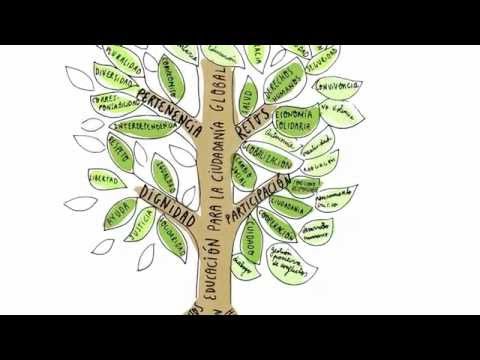 Educación para la Ciudadanía Global Year of publication: 2015 Author: AM Ketterer Corporate author: Universitat de Barcelona | Agencia Española de Cooperación Internacional para el Desarrollo (AECID) La Educación para la Ciudadanía Global orienta los aprendizajes hacia unas finalidades que están presentes en el currículo:- Promover el sentimiento de pertenencia a una comunidad planetaria.- Descubrir la interdependencia de los derechos humanos en la globalización.- Generar una cultura de la solidaridad.- Capacitar para la acción por un desarrollo humano y sostenible.Estos aprendizajes pueden relacionarse con los intereses del alumnado y, de hecho, muchos de ellos conectan con sus vivencias de la globalización.
 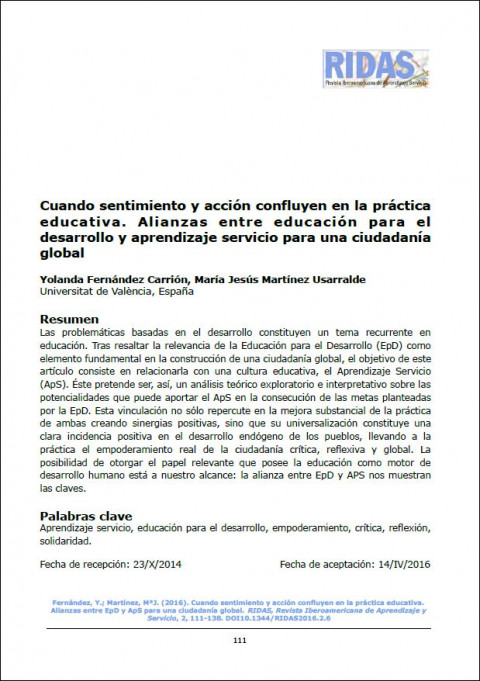 When Feeling and Action Come Together in Educational Practice. Relations Between Development Education and Learning Service for a Global Citizenship Year of publication: 2016 Author: Yolanda Fernández Carrión | Mª Jesús Martínez Usarralde The difficulties based on the development are a usual topic in education. After emphasizing the relevance of the development education as an essential element for the construction of the global citizenship, the challenge stands out by its innovative intention of trying to implicate it with service learning. This one tries to be an explorative and interpretative theoretic analyses about the potentialities which can be provided by service learning in the achievement of the objectives planned by the development education. This correlation not only affects the substantial improvement of both practices by building positive synergies but also its universalization forms a clear positive influence in the endogenous development of the village people, carrying out the real empowerment of the critical, sensible and global citizenship. The possibility of giving the main role as a human developmental engine to education is within our reach and the union between development education and service learning teaches us the keys.