
Resources
Explore a wide range of valuable resources on GCED to deepen your understanding and enhance your research, advocacy, teaching, and learning.
6 Results found
 School for all: experiences of municipal public schools with inclusion of students with disabilities, ASD, GDD and high ability/giftedness Year of publication: 2017 Author: Carla Mauch | Wagner Santana Corporate author: UNESCO Brasilia This publication is the result of a research project entitled Good Practices in Inclusive Education: the experience of Brazilian municipalities with the inclusion of students with disabilities, Autism Spectrum Disorder (ASD), Global Developmental Disorder (GDD) and of high ability/giftedness students (Boas Práticas em Educação Inclusiva: a experiência de municípios brasileiros na inclusão de alunos com deficiência, transtornos do espectro autista (TEA), transtorno global do desenvolvimento (TGD) e altas habilidades/superdotação). The study set out to identify and analyse the practices of municipal public-school networks in Brazil concerning the educational inclusion of students with disabilities, ASD and GDD, as well as gifted/talented students. The initiative arose out of a will to subsidise and strengthen processes for the formulation and implementation of policies, programmes and projects aligned with the principles of the Convention on the Rights of Persons with Disabilities (United Nations, 2006; Brazil, 2009) and the National Special Education Policy in the Perspective of Inclusive Education (Política Nacional de Educação Especial na Perspectiva da Educação Inclusiva) (Brasil. MEC/SEESP, 2008c). It is important to point out that those normative frameworks bring principles and presuppositions that have been reaffirmed in more recent documents such as the Incheon Declaration (World Education Forum, UNESCO, 2015) and the Sustainable Development Goals (SDG) (United Nations, 2015).
  Mudança climática em sala de aula: curso da UNESCO para professores secundários (fundamental II e ensino médio) sobre educação em mudança climática e desenvolvimento sustentável (EMCDS) Year of publication: 2014 Author: David Selby | Fumiyo Kagawa Corporate author: UNESCO Brasilia This course has been created with the goal of bringing climate change education outside the science classroom into the many other subject areas upon which climate change now has an impact, or will impact in the future, such as ethics, social studies, economics, political science, among others. The course materials are organized into four parts: 1. Course Framework and Overview, 2. Teachers’ Education Course daily materials, 3. Regional Resource Packs, 4. Daily Classroom Materials for teachers. These materials are all described in more detail and can be accessed from the Start Menu found on the following pages. This course is designed to enable teachers at the secondary level from diverse subject areas to introduce climate change education for sustainable development (CCESD) across the curriculum. UNESCO has identified the professional development of teachers in education for sustainable development as the top priority in recognition of the transformative role that teachers and teacher educators need to play in re-orienting education to help realize a sustainable future (UNESCO, 2005, p. 19). But good intentions for the professional development of teachers have fallen short in practice. Although taken up by enthusiasts, teacher education for sustainable development has rarely been mainstreamed, and, where there are courses, is often approached within a disciplinary as opposed to an interdisciplinary frame (Wals, A., 2009). If professional development in education for sustainable development is at an adolescent stage, teacher education in climate change education for sustainable development is in its infancy. For instance, according to a 2009 international comparative study on climate change education and sustainable development in ten countries, climate change education has peripheral status in educational research and practice, and when it is addressed it is only within science education (Læssøe,J. Schnack, K., Breiting, S. & Rolls, S., 2009). There is a clear and present need to respond to climate change challenges through systematic teacher education programmes that are not restricted to a single subject area. This teacher education course is an attempt to fill the current gap and is in line with one of UNESCO’s key objectives for climate change education for sustainable development, that is, to support teacher training on climate change for sustainable development (UNESCO, 2010, p. 9). The programme has four distinctive features: 1. It helps teachers to understand the causes, dynamics and impacts of climate change through a holistic approach. 2. Teachers are exposed to, and experience, a range of pedagogical approaches and techniques, that they can use in their own school environment. This includes engagement of themselves and their students in whole school and school-in-community approaches. 3. Teachers will develop their capacities to facilitate students’ community based learning. 4. Teachers will develop future-oriented and transformative capacities in facilitating climate change mitigation, adaptation, and disaster risk reduction learning.
  Programa Mundial para Educação em Direitos Humanos: terceira fase, plano de ação Year of publication: 2015 Corporate author: UNESCO Brasilia | UN. Office of the United Nations High Commissioner for Human Rights (UN. OHCHR) De acordo com a Resolução 24/15 do Conselho de Direitos Humanos, o Escritório do Alto Comissariado das Nações Unidas para os Direitos Humanos (ACNUDH) elaborou, no primeiro trimestre de 2014, um esboço de plano de ação para a terceira fase (2015-2019) do Programa Mundial para Educação em Direitos Humanos (PMEDH) tomando como base, entre outros, importantes instrumentos e documentos das Nações Unidas, os planos de ação da primeira (2005- 2009) e da segunda (2010-2014) fases do PMEDH e outros materiais publicados pelo ACNUDH e pelas Nações Unidas. Em abril e maio, o esboço de plano de ação foi submetido à análise dos Estados, organizações intergovernamentais relevantes, incluindo a Organização das Nações Unidas para a Educação, a Ciência e a Cultura (UNESCO), instituições nacionais de direitos humanos e sociedade civil. Em 4 de julho, o ACNUDH recebeu 30 respostas com os comentários, os quais foram levados em consideração no texto final e que constituem as Seções de II a V do presente relatório. Educação: um tesouro a descobrir, relatório para a UNESCO da Comissão Internacional sobre Educação para o Século XXI (destaques) Year of publication: 2010 Author: Jacques Delors Corporate author: UNESCO Brasilia Learning: The Treasure Within, commonly referred to as the 'Delors Report', proposes a holistic and integrated vision of education based on the paradigms of lifelong learning, and the four pillars of learning to be, to know, to do, and to live together. Respostas do Setor de Educação ao bullying homofóbico Year of publication: 2013 Corporate author: UNESCO This publication is part of a Good Policy and Practice series that addresses key themes of UNESCO’s work with the education sector including HIV and AIDS and safe, healthy educational environments for all learners. This volume, on the theme of homophobic bullying in educational institutions, builds on UNESCO’s work on gender, discrimination and violence in schools.
 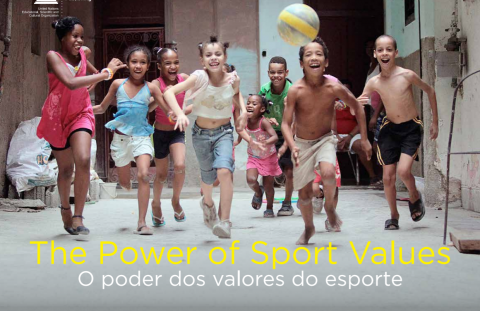 The Power of Sport Values Year of publication: 2016 Corporate author: UNESCO In the contexts of malnutrition, conflict, inactivity and unemployment, sport can act as springboard for social transformation, as a gateway to rounded development and as a facilitator for inclusive and responsible citizenship. Not only is sport a bridge between individuals and nations, it can also be an active tool for overcoming stereotypes, rising above exclusion and fostering citizenship. The Power of Sport Values is a collection of the best 15 entries of UNESCO’s photo contest on the power of sport values, selected from over 300 photos submitted by photographers from 76 countries all around the world. Be it in South Sudan, Kazakhstan, Mexico, Bangladesh or Cuba, sport provides joy, fosters inclusion and strengthens social mobilization.