
Resources
Explore a wide range of valuable resources on GCED to deepen your understanding and enhance your research, advocacy, teaching, and learning.
73 Results found
 Peace Education: Handbook for Educators Year of publication: 2015 Corporate author: International Falcon Movement-Socialist Educational International (IFM-SEI) | Council of Europe This document presents peace education tools so that children and adolescents can play a vital role, changing individual attitudes and examining the social, economic and political context to understand where conflicts come from and how to transform them. Education à la Paix: Manuel de l’éducatrice et de l’éducateur Year of publication: 2015 Corporate author: International Falcon Movement-Socialist Educational International (IFM-SEI) | Conseil de l'Europe Cet ouvrage en deux parties est basé sur les résultats de notre travail, ainsi que des outils developpés et testés par certaines de nos organisations membres: • De la matière à réflexion, des conseils et des informations pour les éducateurs·trices à la paix. Des activités éducatives que vous pouvez réaliser avec les enfants, les jeunes ou les autres chefs de groupe et les pairs éducateurs·trices. La deuxième partie comprend trois chapitres. Chacun de ces derniers se concentre sur un aspect différent de l’éducation de la paix. Comprendre le conflit introduit différentes questions sur le conflit et la guerre, la sensibilisation sur ses causes et ses conséquences. Transformer le conflit met l’accent sur la dynamique du conflit et les différentes façons dont nous pouvons traiter avec elle - de manière agressive ou constructive. Faire la paix vous invite à réfléchir et à développer des idées pour la paix et donne des outils pour la consolidation de la paix, comme la communication et le dialogue compétences. Educación por la Paz: Guía para educadores y educadoras Year of publication: 2015 Corporate author: International Falcon Movement-Socialist Educational International (IFM-SEI) | Council of Europe Este documento presenta herrameintas de ediuación para la paz de manera que niñas, niños y adolescentes puedan jugar un papel vital, cambiando las actitudes individuales y examinando el contexto social, económico y político para comprender de dónde provienen los conflictos y cómo transformarlos.
  Un voyage dans l'éducation aux médias Year of publication: 2013 Author: Paolo Celot | Susie Jones Corporate author: European Association for Viewers Interests (ENVI) Le dessin animé de EAVI « Un voyage dans l'éducation aux media » a été créé à fin d'expliquer de façon simple et amusante ce qu'est l'éducation aux medias, une notion importante que pour vivre plus librement et de participer pleinement à la société. Notre héro Jack est né grâce à la suggestion des enfants de Paolo, qui, ne comprenant pas ce que leur père faisait au travail, lui ont donné l'idée de créer un dessin animé pour expliquer à eux ce que c'est l'éducation aux medias. Un viaje a la Alfabetización Mediatica Year of publication: 2013 Author: Paolo Celot | Susie Jones Corporate author: European Association for Viewers Interests (ENVI) El videoclip "Un viaje a la Alfabetización mediática" es un dibujo animado de 7 minutos diseñado para explicar, de una manera divertida y sencilla, lo que es la alfabetización mediática y todo alrededor, y por qué es esencial para poder vivir libremente y participar plenamente en la sociedad. Nació gracias a la sugerencia de los 3 niños de Paolo, que al no poder entender lo que su padre hacia en el trabajo, se le ocurrió la idea de hacer una historieta de aventuras para explicar que es la Media Literacy.
  Sensibiliser les citoyens par l’éducation au développement : Exemples de réussites Year of publication: 2020 Author: Lur Fernandez Salinas Corporate author: PLATFORMA Le programme DEAR constitue une ligne d’action tout à fait naturelle pour les collectivités territoriales actives dans la coopération au développement et s’inscrit parfaitement dans leurs stratégies territoriales.La sensibilisation des citoyens, par l’action des municipalités et régions, reste une composante essentielle de la coresponsabilité, de la solidarité, de la connaissance et de la compréhension mutuelles nécessaires pour mobiliser et fédérer les communautés.Le présent recueil d’histoires de réussite vise à montrer les expériences concrètes, percutantes et transformatrices des collectivités territoriales et de leurs associations activement engagées dans des projets DEAR et des stratégies de coopération décentralisé
  Promoting Integration of Migrants and Refugees in and Through Education: Toolkit Year of publication: 2018 Corporate author: Education International (EI) The past years have seen large numbers of refugees moving to Europe. This, and the rise of populist movements in Europe and North America, has led unions to develop activities engaging schools, local communities, authorities, etc. to promote the rights of migrants and build inclusive schools and communities.With the support of Education International (EI), exchange visits, information sharing and peer-learning activities allowed education unions to inspire each other and explore synergies across borders. This toolkit aims to build on these experiences and facilitate education unions to develop their work in this area. It also assists unions by exploring the issues around integrating migrants and refugees in education and sharing what others have been doing in this domain. Promouvoir l'intégration des personnes migrantes et réfugiées dans et à travers l'éducation: Boite à outils Year of publication: 2018 Corporate author: Education International (EI) Beaucoup de personnes réfugiées se sont installées en Europe ces dernières années. Ceci et la montée des mouvements populistes en Europe et en Amérique du Nord ont conduit les syndicats à développer des activités engageant les écoles, les communautés locales, les autorités, etc. pour promouvoir les droits des migrant.e.s et développer des écoles et communautés inclusives.Avec le soutien de l’Internationale de l’Education (IE), les visites d’échange, le partage d’informations et les activités d’apprentissage avec leurs pairs ont permis aux syndicats de l’éducation de s’inspirer mutuellement et d’explorer les synergies transfrontalières. Cette boite à outils vise à tirer parti de ces expériences et à aider les syndicats de l’éducation à amplifier leur travail dans ce domaine. Elle aide également les syndicats en explorant les questions liées à l’intégration des personnes migrantes et réfugiées dans l’éducation et en partageant ce que les autres ont fait sur cette thématique.
 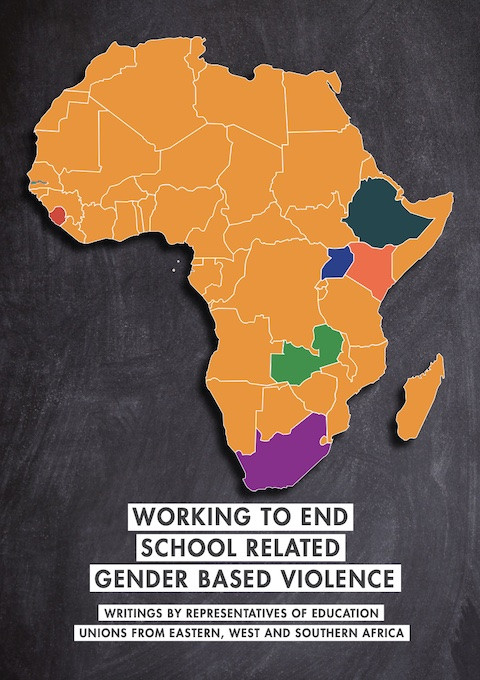 Trabajando para acabar con la violencia de género en el ámbito escolar: Ensayos por representantes de sindicatos de la educación de África Oriental, Occidental y Austral Year of publication: 2019 Author: Shamim Meer Corporate author: Gender at Work | Labour Research Service (LRS) | Global Affairs Canada (GAC) | United Nations Girls' Education Initiative (UNGEI) | Education International (EI) La Violencia de Género en el Ámbito Escolar (VGAE) es una forma de violencia que menoscaba la integridad corporal, los derechos humanos y la igualdad de género de todas las personas involucradas, pero especialmente de los niños y niñas escolares. En 2016, 7 docentes sindicales - SADTU y NAPTOSA de Sudáfrica, BETUZ y ZNUT de Zambia, UNATU de Uganda, ETA de Etiopía y KNUT de Kenia y en 2018, SLTU de Sierra Leona, GTU de Gambia y el personal de la Oficina Regional de África de la Internacional de la Educación con base en Ghana – participaron activamente en Gender at Work (G@W) – Proceso de Acción de Aprendizaje en Género (GAL, por sus siglas en inglés). El objetivo principal de este proceso GAL específico fue crear un programa piloto participativo de la IE en África, oriental, occidental y del sur enfocado en la capacidad de docentes individuales y sindicatos de docentes para abordar la VGAE. Con el apoyo de facilitadoras de Gender at Work, las y los participantes fortalecieron su comprensión de la desigualdad de género y la violencia basada en el género en el contexto escolar. A lo largo del proceso GAL, las y los participantes hablaron con el corazón, compartiendo historias inspiradoras sobre el cambio. Oeuvrer pour mettre un terme à la violence liée au genre en milieu scolaire: Écrits de représentantes et représentants de syndicats de l’enseignement en Afrique de l’est, Afrique de l’ouest et Afrique australe Year of publication: 2019 Author: Shamim Meer Corporate author: Gender at Work | Labour Research Service (LRS) | Global Affairs Canada (GAC) | United Nations Girls' Education Initiative (UNGEI) | Education International (EI) La violence liée au genre en milieu scolaire (VGMS) est un type de violence qui porte atteinte à l’intégrité physique, aux droits humains et à l’égalité entre tous les acteurs de la vie de l’école, mais avant tout à ceux de l’enfant scolarisé.En 2016, sept syndicats d’enseignants, le SADTU et la NAPTOSA d’Afrique du Sud, le BETUZ et la ZNUT de Zambie, l’UNATU d’Ouganda, l’ETA d’Éthiopie et le KNUT du Kenya, puis en 2018, le SLTU de la Sierra Leone, le GTU de Gambie, ainsi que les collaborateurs et collaboratrices du Bureau régional Afrique de l’Internationale de l’Éducation sis au Ghana, se sont activement engagés dans un programme de Gender at Work, le processus d’apprentissage par l’action en genre.Ce processus spécifique visait à créer un programme pilote participatif de l’IE en Afrique de l’Est, de l’Ouest et australe qui porterait sur la capacité individuelle des enseignants et enseignantes et sur celle de leurs syndicats à affronter la violence fondée sur le genre. Avec l’appui des animatrices de Gender at Work, les participants et participantes ont pu comprendre de façon plus approfondie l’inégalité entre les genres et la violence liée au genre en milieu scolaire. Tout au long de ce processus d’action-apprentissage, les participants et participantes ont été en mesure de parler à coeur ouvert et de partager des histoires de changement inspirantes.