
Resources
Explore a wide range of valuable resources on GCED to deepen your understanding and enhance your research, advocacy, teaching, and learning.
82 Results found
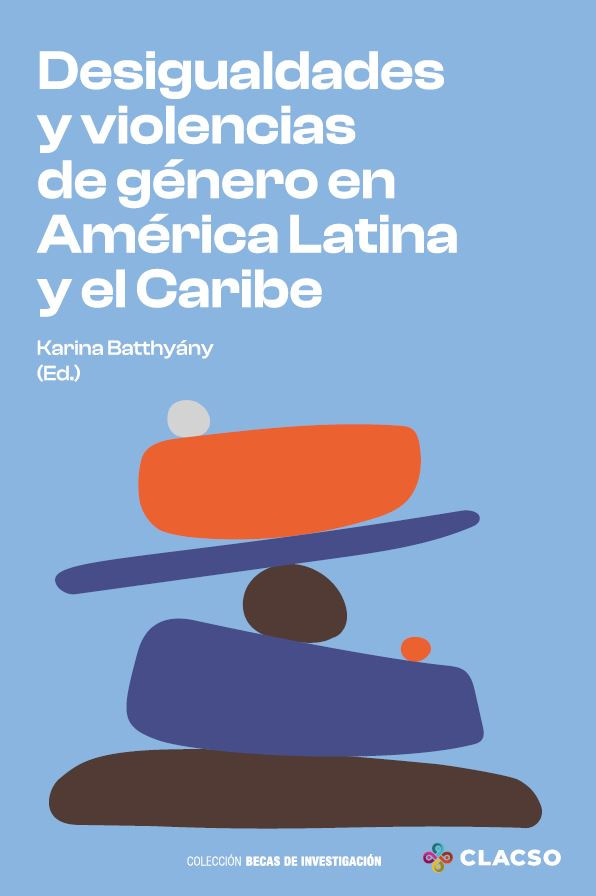 Inequalities and Gender Violence in Latin America and the Caribbean Year of publication: 2023 Author: Karina Batthyány Corporate author: Consejo Latinoamericano de Ciencias Sociales (CLACSO) The chapters of this book are the result of the powerful research work carried out within the framework of the call “Inequalities and gender violence in Latin America and the Caribbean", promoted by CLACSO. They seek, as a whole, to outline answers to these questions, through innovative methodologies that redefine conventional tools and give the texts great singularity. The point of view is, in all cases, novel and localized: territorially, but also in terms of theory and epistemology. The reading of This book manages to immerse the reader's gaze in a truly critical approach to the reality of the continent. Desigualdades y violencias de género en América Latina y el Caribe Year of publication: 2023 Author: Karina Batthyány Corporate author: Consejo Latinoamericano de Ciencias Sociales (CLACSO) Los capítulos del presente libro son fruto de los potentes trabajos de investigación realizados en el marco de la convocatoria “Desigualdades y violencias de género en América Latina y el Caribe", promovida por CLACSO. Buscan, en su conjunto, esbozar respuestas a dichos interrogantes, mediante metodologías innovadoras que resignifican herramientas convencionales y dotan a los textos de gran singularidad. El punto de vista es, en todos los casos, novedoso y localizado: territorialmente, pero también en lo que a la teoría y a la epistemología se refiere. La lectura de este libro logra sumergir la mirada de la lectora o el lector a un acercamiento verdaderamente crítico a la realidad del continente.
 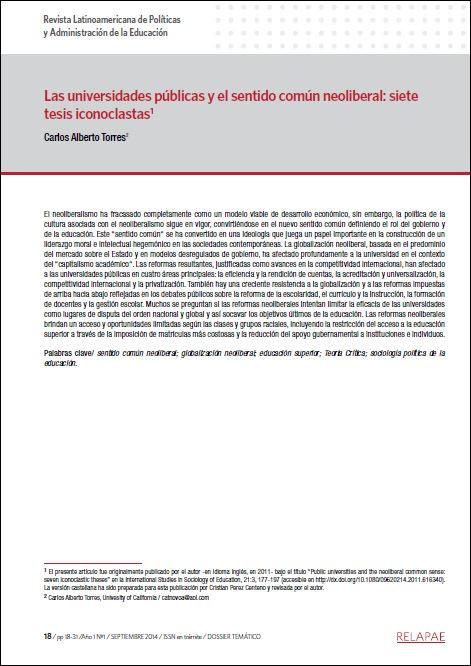 Public Universities and Neoliberal Common Sense: Seven Iconoclastic Thesis Year of publication: 2014 Author: Carlos Alberto Torres Corporate author: Universidad Nacional de Tres de Febrero (UNTREF) Neoliberalism has utterly failed as a viable model of economic development, yet the politics of culture associated with neoliberalism is still in force, becoming the new common sense shaping the role of government and education. This ‘common sense’ has become an ideology playing a major role in constructing hegemony as moral and intellectual leadership in contemporary societies. Neoliberal globalisation, predicated on the dominance of the market over the state and on deregulatory models of governance, has deeply affected the university in the context of ‘academic capitalism’. The resulting reforms, rationalised as advancing international competitiveness, have affected public universities in four primary areas: efficiency and accountability, accreditation and universalisation, international competitiveness and privatisation. There is also growing resistance to globalisation as top-down-imposed reforms reflected in the public debates about schooling reform, curriculum and instruction, teacher training and school governance. Many question whether neoliberal reforms attempt to limit the effectiveness of universities as sites of contestation of the national and global order and thus undermine the broader goals of education. Neoliberal reforms have limited access and opportunity along class and racial lines, including limiting access to higher education through the imposition of higher tuition and reduced government support to institutions and individuals. Las universidades públicas y el sentido común neoliberal: siete tesis iconoclastas Year of publication: 2014 Author: Carlos Alberto Torres Corporate author: Universidad Nacional de Tres de Febrero (UNTREF) El neoliberalismo ha fracasado completamente como un modelo viable de desarrollo económico, sin embargo, la política de la cultura asociada con el neoliberalismo sigue en vigor, convirtiéndose en el nuevo sentido común definiendo el rol del gobierno y de la educación. Este “sentido común“ se ha convertido en una ideología que juega un papel importante en la construcción de un liderazgo moral e intelectual hegemónico en las sociedades contemporáneas. La globalización neoliberal, basada en el predominio del mercado sobre el Estado y en modelos desregulados de gobierno, ha afectado profundamente a la universidad en el contexto del “capitalismo académico“. Las reformas resultantes, justificadas como avances en la competitividad internacional, han afectado a las universidades públicas en cuatro áreas principales: la eficiencia y la rendición de cuentas, la acreditación y universalización, la competitividad internacional y la privatización. También hay una creciente resistencia a la globalización y a las reformas impuestas de arriba hacia abajo reflejadas en los debates públicos sobre la reforma de la escolaridad, el currículo y la instrucción, la formación de docentes y la gestión escolar. Muchos se preguntan si las reformas neoliberales intentan limitar la eficacia de las universidades como lugares de disputa del orden nacional y global y así socavar los objetivos últimos de la educación. Las reformas neoliberales brindan un acceso y oportunidades limitadas según las clases y grupos raciales, incluyendo la restricción del acceso a la educación superior a través de la imposición de matrículas más costosas y la reducción del apoyo gubernamental a instituciones e individuos.
 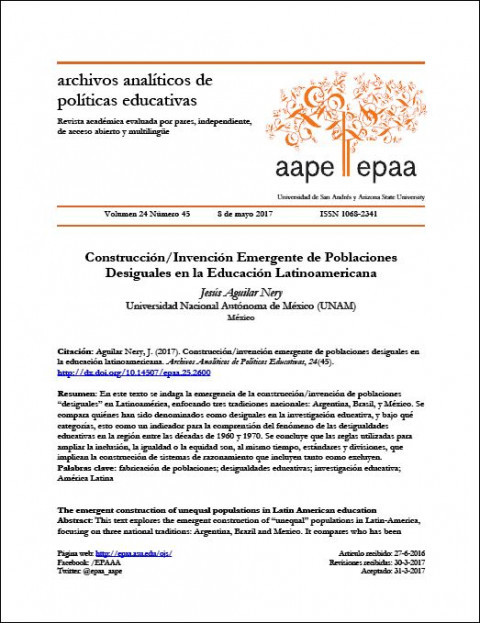 Construction / Emerging Invention of Unequal Populations in Latin American Education Year of publication: 2017 Author: Jesús Aguilar Nery Corporate author: Universidad de San Andrés | Arizona State University This text explores the emergent construction of “unequal” populations in Latin-America, focusing on three national traditions: Argentina, Brazil and Mexico. It compares who has been named as unequal in educational research and under what categories, and treats this comparison as an indicator for understanding the phenomenon of educational inequalities in the region between 1960 and 1970. It is concluded that the rules used to enforce inclusion, equality and equity are, at the same time, standards and divisions that involve the construction of systems of reasoning that also simultaneously include and exclude. Construcción/Invención Emergente de Poblaciones Desiguales en la Educación Latinoamericana Year of publication: 2017 Author: Jesús Aguilar Nery Corporate author: Universidad de San Andrés | Arizona State University En este texto se indaga la emergencia de la construcción/invención de poblaciones “desiguales” en Latinoamérica, enfocando tres tradiciones nacionales: Argentina, Brasil, y México. Se compara quiénes han sido denominados como desiguales en la investigación educativa, y bajo qué categorías, esto como un indicador para la comprensión del fenómeno de las desigualdades educativas en la región entre las décadas de 1960 y 1970. Se concluye que las reglas utilizadas para ampliar la inclusión, la igualdad o la equidad son, al mismo tiempo, estándares y divisiones, que implican la construcción de sistemas de razonamiento que incluyen tanto como excluyen.
 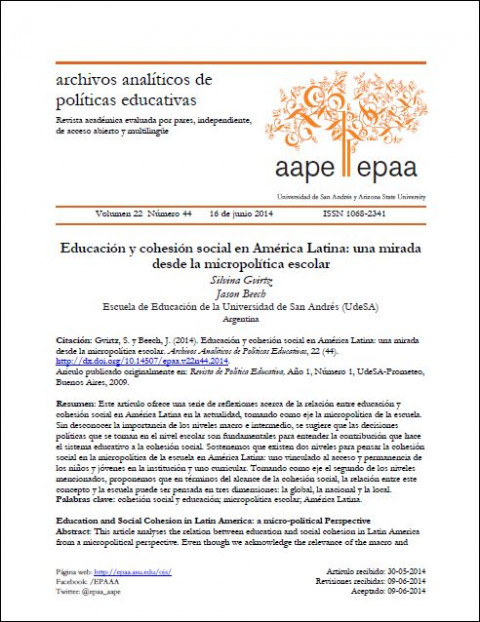 Education and Social Cohesion in Latin America: A Micro-political Perspective Year of publication: 2014 Author: Silvina Gvirtz | Jason Beech Corporate author: Universidad de San Andrés | Arizona State University This article analyses the relation between education and social cohesion in Latin America from a micropolitical perspective. Even though we acknowledge the relevance of the macro and mezzo levels, we argue that the political decisions that are made at the school level are crucial to understand the contribution of educational systems to social cohesion. We suggest that the relation between social cohesion and school micropolitics can be analysed in two dimensions: the first is related to the access and permanence of children in school, while the second is related to the curriculum. The article concentrates on the second level by analysing the relation between the curriculum and social cohesion from a local, a national, and a global perspective. Educación y Cohesión Social en América Latina: Una Mirada desde la Micropolítica Escolar Year of publication: 2014 Author: Silvina Gvirtz | Jason Beech Corporate author: Universidad de San Andrés | Arizona State University Este artículo ofrece una serie de reflexiones acerca de la relación entre educación y cohesión social en América Latina en la actualidad, tomando como eje la micropolítica de la escuela. Sin desconocer la importancia de los niveles macro e intermedio, se sugiere que las decisiones políticas que se toman en el nivel escolar son fundamentales para entender la contribución que hace el sistema educativo a la cohesión social. Sostenemos que existen dos niveles para pensar la cohesión social en la micropolítica de la escuela en América Latina: uno vinculado al acceso y permanencia de los niños y jóvenes en la institución y uno curricular. Tomando como eje el segundo de los niveles mencionados, proponemos que en términos del alcance de la cohesión social, la relación entre este concepto y la escuela puede ser pensada en tres dimensiones: la global, la nacional y la local.
 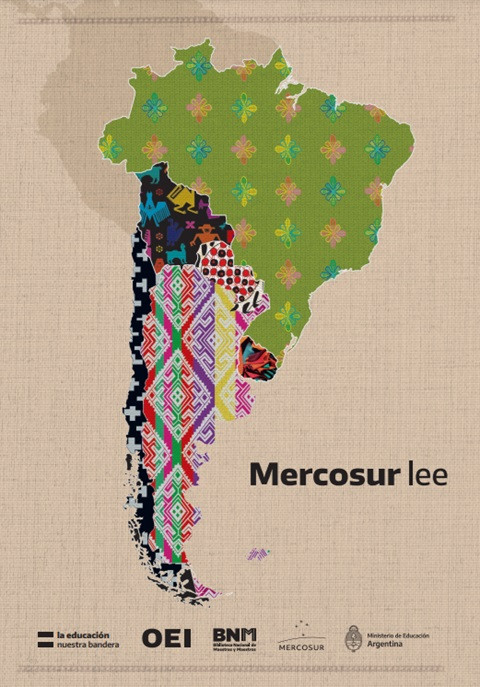 Mercosur Reads Year of publication: 2023 Corporate author: Argentina. Ministry of Education | National Library of Teachers | Organization of Ibero-American States for Education, Science and Culture (OEI) This relaunch brings together stories by prominent authors from Argentina, Brazil, Bolivia, Chile, Paraguay and Uruguay. Its purpose is to contribute to the process of regional integration, encourage knowledge of the official languages (Spanish, Portuguese and Guaraní) and the development of quality education for all. Mercosur lee Year of publication: 2023 Corporate author: Argentina. Ministry of Education | National Library of Teachers | Organización de Estados Iberoamericanos para la Educación, la Ciencia y la Cultura (OEI) Este relanzamiento reúne los relatos de destacadas y destacados autores de Argentina, Brasil, Bolivia, Chile, Paraguay y Uruguay. Su propósito es contribuir al proceso de integración regional, incentivar el conocimiento de las lenguas oficiales (español, portugués y guaraní) y el desarrollo de una educación de calidad para todas y todos.