
Resources
Explore a wide range of valuable resources on GCED to deepen your understanding and enhance your research, advocacy, teaching, and learning.
7 Results found
 Responsible AI in Africa: Challenges and Opportunities Year of publication: 2023 Corporate author: Palgrave Macmillan This open access book contributes to the discourse of Responsible Artificial Intelligence (AI) from an African perspective. It is a unique collection that brings together prominent AI scholars to discuss AI ethics from theoretical and practical African perspectives and makes a case for African values, interests, expectations and principles to underpin the design, development and deployment (DDD) of AI in Africa. The book is a first in that it pays attention to the socio-cultural contexts of Responsible AI that is sensitive to African cultures and societies. It makes an important contribution to the global AI ethics discourse that often neglects AI narratives from Africa despite growing evidence of DDD in many domains. Nine original contributions provide useful insights to advance the understanding and implementation of Responsible AI in Africa, including discussions on epistemic injustice of global AI ethics, opportunities and challenges, an examination of AI co-bots and chatbots in anAfrican work space, gender and AI, a consideration of African philosophies such as Ubuntu in the application of AI, African AI policy, and a look towards a future of Responsible AI in Africa.
  As the witnesses fall silent : 21st century Holocaust education in curriculum, policy and practice Year of publication: 2015 Corporate author: UNESCO International Bureau of Education (IBE) This UNESCO/IBE publication represents the most comprehensive collection ever produced of empirical research on Holocaust education around the world. It comes at a critical time, as the world observes the 70th anniversary of the liberation of Auschwitz. The policies and practices of Holocaust education around the world are as diverse as the countries that grapple with its history and its meaning. Educators around the globe struggle to reconcile national histories and memories with the international realities of the Holocaust and its implications for the present. These efforts take place at a time when scholarship about the Holocaust itself has made great strides. In this book, these issues are framed by some of the leading voices in the field, including Elie Wiesel and Yehuda Bauer, and then explored by many distinguished scholars who represent a wide range of expertise. (By the publisher) Comme les témoins se taire: 21e siècle Holocauste éducation dans les programmes, les politiques et la pratique Year of publication: 2015 Corporate author: UNESCO International Bureau of Education (IBE) Cette publication de l'UNESCO/BIE représente la collection la plus complète jamais produit de la recherche empirique sur l'Holocauste dans le monde entier. Il arrive à un moment critique, alors que le monde observe le 70e anniversaire de la libération d'Auschwitz. Les politiques et les pratiques de l'Holocauste dans le monde sont aussi diverses que les pays qui se débattent avec son histoire et sa signification. Les éducateurs autour de la lutte globe pour réconcilier des histoires et des mémoires nationales avec les réalités internationales de l'Holocauste et de ses implications pour le présent. Ces efforts ont lieu à un moment où la bourse de l'Holocauste lui-même a fait de grands progrès. Dans ce livre, ces questions sont encadrées par quelques-unes des principales voix dans le domaine, y compris Elie Wiesel et Yehuda Bauer, puis exploré par de nombreux spécialistes éminents qui représentent un large éventail d'expertise. (Par l'éditeur)
  ‘Going Glocal’: A Qualitative and Quantitative Analysis of Global Citizenship Education at a Dutch Liberal Arts and Sciences College (High Education; Vol. 72, No. 3) Year of publication: 2015 Author: Marcin Skald | John Friedman | Eri Park | Barbara Oomen Corporate author: Springer Nature Over the past decades, more and more institutions of higher learning have developed programs destined to educate students for global citizenship. Such efforts pose considerable challenges: conceptually, pedagogically and from the perspective of impact assessment. Conceptually, it is of utmost importance to pay attention to both structural inequalities and intercultural competencies, to emphasize both differences and similarities. In addition, there is the need to increase awareness of the dialectics between the global and the local. Pedagogically, this calls for transformative learning, with an emphasis on attitudes and skills, in addition to knowledge alone. Once objectives have been defined and translated pedagogically, such programs call for an assessment of the degree to which they have been met. In this light, this article describes the conceptualization and pedagogics of an innovative project, Going Glocal, designed at a Dutch liberal arts and sciences college on the basis of these premises and its impact on the university students concerned.
  Global Citizenship Education: Critical and International Perspectives Year of publication: 2020 Author: Abdeljalil Akkari | Kathrine Maleq Corporate author: Springer Nature | Swiss National Science Foundation This open access book takes a critical and international perspective to the mainstreaming of the Global Citizenship Concept and analyses the key issues regarding global citizenship education across the world. In that respect, it addresses a pressing need to provide further conceptual input and to open global citizenship agendas to diversity and indigeneity.Social and political changes brought by globalisation, migration and technological advances of the 21st century have generated a rise in the popularity of the utopian and philosophical idea of global citizenship. In response to the challenges of today’s globalised and interconnected world, such as inequality, human rights violations and poverty, global citizenship education has been invoked as a means of preparing youth for an inclusive and sustainable world.In recent years, the development of global citizenship education and the building of students’ global citizenship competencies have become a focal point in global agendas for education, international educational assessments and international organisations. However, the concept of global citizenship education still remains highly contested and subject to multiple interpretations, and its operationalisation in national educational policies proves to be challenging.This volume aims to contribute to the debate, question the relevancy of global citizenship education’s policy objectives and to enhance understanding of local perspectives, ideologies, conceptions and issues related to citizenship education on a local, national and global level. To this end, the book provides a comprehensive and geographically based overview of the challenges citizenship education faces in a rapidly changing global world through the lens of diversity and inclusiveness.
 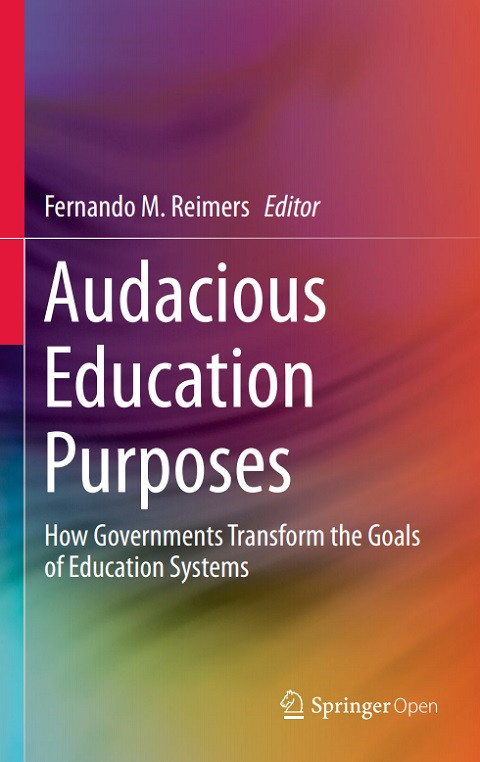 Audacious Education Purposes: How Governments Transform the Goals of Education Systems Year of publication: 2020 Author: Fernando Reimers This open access book offers a comparative study of eight ambitious national reforms that sought to create opportunities for students to gain the necessary breath of skills to thrive in a rapidly changing world. It examines how national governments transform education systems to provide students opportunities to develop such skills. It analyses comprehensive education reforms in Brazil, Finland, Japan, Mexico, Peru, Poland, Portugal and Russia and yields original and important insights on the process of educational change. The analysis of these 21st century skills reforms shows that reformers followed approaches which are based on the five perspectives: cultural, psychological, professional, institutional and political. Most reforms relied on institutional and political perspectives. They highlight the systemic nature of the process of educational change, and the need for alignment and coherence among the various elements of the system in order. They underscore the importance of addressing the interests of various stakeholders of the education system in obtaining the necessary impetus to initiate and sustain change. In contrast, as the book shows, the use of a cultural and psychological frame proved rarer, missing important opportunities to draw on systematic analysis of emerging demands for schools and on cognitive science to inform the changes in the organization of instruction. Drawing on a rich array of sources and evidence the book provides a careful account of how education reform works in practice.
 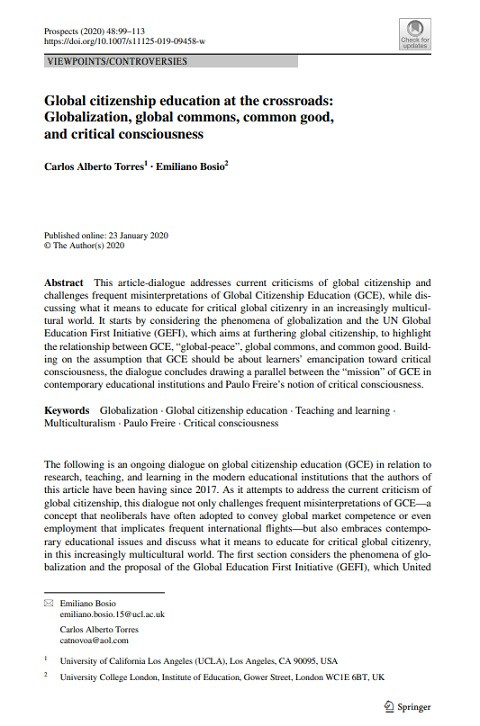 Global Citizenship Education at the Crossroads: Globalization, Global Commons, Common Good, and Critical Consciousness (Prospects; Vol.48) Year of publication: 2020 Author: Carlos Alberto Torres | Emiliano Bosio Corporate author: Springer Nature This article-dialogue addresses current criticisms of global citizenship and challenges frequent misinterpretations of Global Citizenship Education (GCE), while discussing what it means to educate for critical global citizenry in an increasingly multicultural world. It starts by considering the phenomena of globalization and the UN Global Education First Initiative (GEFI), which aims at furthering global citizenship, to highlight the relationship between GCE, “global-peace”, global commons, and common good. Building on the assumption that GCE should be about learners’ emancipation toward critical consciousness, the dialogue concludes drawing a parallel between the “mission” of GCE in contemporary educational institutions and Paulo Freire’s notion of critical consciousness.