
Resources
Explore a wide range of valuable resources on GCED to deepen your understanding and enhance your research, advocacy, teaching, and learning.
6 Results found
 SDG In the Republic of Korea: Progress Report 2023 Year of publication: 2023 Author: Woohyun Chung | Haesik Jung | Yunjae Hwang | Dawoon Jung | Hyojung Han | Dokyun Kim | Jongho Ahn | Sangyoup Lee | Soeun Ahn | Jungwook Kim | Sangyun Lee | Jiyoung Lee | Sora Yi | Jewoo Hong | Miju Kim | Junghee Cho | Kyungah Koo | Yul Kwon Corporate author: Korea R. Statistics Research Institute | Statistics Korea It has been eight years since the Sustainable Development Goals (SDG) were adopted at the UN General Assembly, and nations began to work toward achieving them. Now we are halfway through the 2030 target period. As an authorized national focal point of SDG data, the Statistics Research Institute has been publishing a 『Sustainable Development Goals in the Republic of Korea: Progress Report』 annually, in keeping with their vision of providing support for ‘eviꠓdence-based decision-making’.『SDG in the Republic of Korea: Progress Report 2023』, released this, was designed as a compass identifying goals to be prioritized in policy implementation during the remaining period until 2030 to keep pace for achieving the SDGs. It is hoped that the report will help to point out the direction for policies responding to the crises and changes we are facing amid the COVID pandemic, the climate crisis, and war, through relevant indicators. 한국의 SDG 이행보고서 2023 Year of publication: 2023 Author: Woohyun Chung | Haesik Jung | Yunjae Hwang | Dawoon Jung | Hyojung Han | Dokyun Kim | Jongho Ahn | Sangyoup Lee | Soeun Ahn | Jungwook Kim | Sangyun Lee | Jiyoung Lee | Sora Yi | Jewoo Hong | Miju Kim | Junghee Cho | Kyungah Koo | Yul Kwon Corporate author: Statistics Research Institute 지속가능발전목표(SDG)가 유엔총회에서 채택되고 그 시작을 알린 지 올해 8년 차로, 2030년 목표 시점까지 절반의 시간이 지났습니다. 통계개발원은 한국의 SDG 데이터 책임기관으로 ‘증거 기반 의사결정 지원’이라는 비전하에 『한국의 SDG 이행보고서』를 매년 발간하고 있습니다. 올해 발간된 『한국의 SDG 이행보고서 2023』은 2030년까지 남은 기간 동안 어떤 목표에 우선순위를 두어 정책을 실행해야 SDG 달성이 가능한지를 보여 주는 나침반 역할로 기획되었습니다. 코로나19, 기후위기, 전쟁 등 격변의 시대에 우리가 직면한 위기와 변화를 지표로 보여 줌으로써 관련 정책의 방향을 제시해주리라 기대합니다. 본 저작물은 통계청 통계개발원에서 2023년 작성하여 공공누리 제3유형으로 개방한 '한국의 SDGs 이행보고서 2023(작성자:정우현)'을 이용하였으며, 해당 저작물은 통계청 통계개발원 홈페이지(https://kostat.go.kr/)에서 무료로 내려받으실 수 있습니다.
 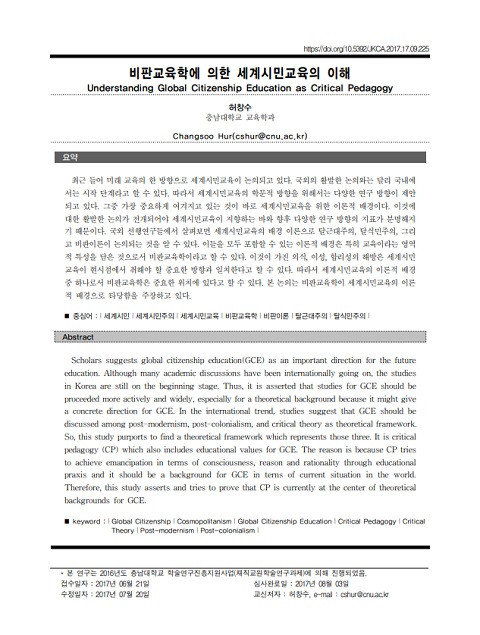 Understanding Global Citizenship Education as Critical Pedagogy (Journal of the Korea Contents Association; Vol. 17, No. 9) Year of publication: 2017 Author: Changsoo Hur Corporate author: Korea Contents Association Scholars suggests global citizenship education(GCE) as an important direction for the future education. Although many academic discussions have been internationally going on, the studies in Korea are still on the beginning stage. Thus, it is asserted that studies for GCE should be proceeded more actively and widely, especially for a theoretical background because it might give a concrete direction for GCE. In the international trend, studies suggest that GCE should be discussed among post-modernism, post-colonialism, and critical theory as theoretical framework. So, this study purports to find a theoretical framework which represents those three. It is critical pedagogy (CP) which also includes educational values for GCE. The reason is because CP tries to achieve emancipation in terms of consciousness, reason and rationality through educational praxis and it should be a background for GCE in terns of current situation in the world. Therefore, this study asserts and tries to prove that CP is currently at the center of theoretical backgrounds for GCE. 비판교육학에 의한 세계시민교육의 이해 (한국콘텐츠학회논문지; Vol. 17, No. 9) Year of publication: 2017 Author: Changsoo Hur Corporate author: Korea Contents Association 최근 들어 미래 교육의 한 방향으로 세계시민교육이 논의되고 있다. 국외의 활발한 논의와는 달리 국내에 서는 시작 단계라고 할 수 있다. 따라서 세계시민교육의 학문적 방향을 위해서는 다양한 연구 방향이 제안 되고 있다. 그중 가장 중요하게 여겨지고 있는 것이 바로 세계시민교육을 위한 이론적 배경이다. 이것에 대한 활발한 논의가 전개되어야 세계시민교육이 지향하는 바와 향후 다양한 연구 방향의 지표가 분명해지 기 때문이다. 국외 선행연구들에서 살펴보면 세계시민교육의 배경 이론으로 탈근대주의, 탈식민주의, 그리 고 비판이론이 논의되는 것을 알 수 있다. 이들을 모두 포함할 수 있는 이론적 배경은 특히 교육이라는 영역 적 특성을 담은 것으로서 비판교육학이라고 할 수 있다. 이것이 가진 의식, 이성, 합리성의 해방은 세계시민 교육이 현시점에서 취해야 할 중요한 방향과 일치한다고 할 수 있다. 따라서 세계시민교육의 이론적 배경 중 하나로서 비판교육학은 중요한 위치에 있다고 할 수 있다. 본 논의는 비판교육학이 세계시민교육의 이론 적 배경으로 타당함을 주장하고 있다.
 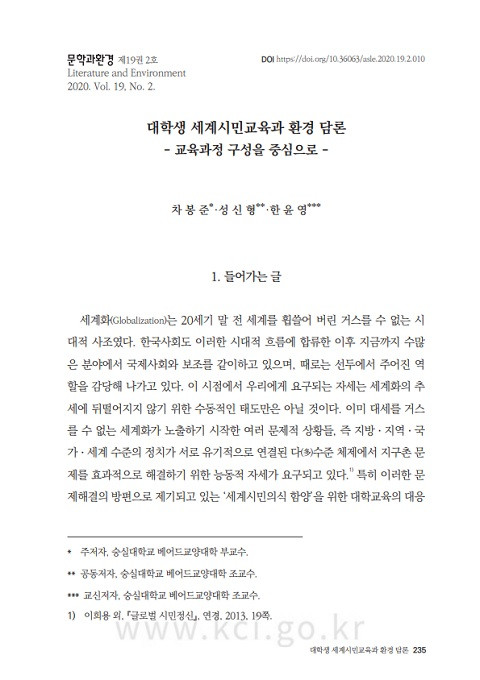 Global Citizenship Education and the Discourse Environment in the University Setting: Focused on the Organizing Process of Course of Studies (Literature and Environment; Vol. 19, No. 2) Year of publication: 2020 Author: Bongjun Cha | Shinhyung Seong | Yunyoung Han Corporate author: Association for the Study of Literature & Environment Education plays an important role on responding to the global issues caused by the globalization phenomenon during the late 20th century. One of them is the discourse of ‘Global Citizenship Education,’as many researchers focus on the educational goal and curriculum about this discourse from elementary to college education levels in Korea. This study examines the curriculum development and its operating status in each education levels based on the revised curriculum of elementary, middle and high school education since 2015. In particular, this study analyzes mainly on the organizing curriculum of environmental issues and sustainable development. In addition, this research explores college education system in order to develop this discourse as concentrating on the eight universities’ Global Citizenship Education curricula, initiated by Asia-Pacific Centre of Education for International Understanding under the auspices of UNESCO (APCEIU) in Korea. Lastly, this study suggests the importance of the discourse environment for elevating the sense of global citizenship through this study. 대학생 세계시민교육과 환경 담론: 교육과정 구성을 중심으로 (문학과환경; Vol. 19, No. 2) Year of publication: 2020 Author: 차봉준 | 성신형 | 한윤영 Corporate author: 문학과환경학회 20세기 말 전 지구적 현상으로 부각된 세계화가 노출한 여러 문제적 상황들, 즉 지방ㆍ지역ㆍ국가ㆍ세계 수준의 정치가 서로 유기적으로 연결된 지구촌 문제의 효과적 해결을 위해 교육이 담당해야 할 역할이 뚜렷해졌다. 그 중의 하나가 이른바 ‘세계시민교육’이라 명명된 담론일 것이며, 우리나라도 초ㆍ중등 교육과정에서부터 고등교육에 이르기까지 이에 대한 교육목표 설정과 교육과정 개발에 연구를 집중하고 있다. 본 연구에서는 이러한 일련의 교육과정 개발과 운영 현황을 2015년 개정 초ㆍ중등교육과정을 통해 살펴보았다. 그리고 그 가운데서도 특히 환경문제와 지속가능한 발전에 대한 교육과정의 편성 현황을 분석해 보았다. 또한 2018년 유네스코 아시아태평양국제이해교육원(APCEIU) 주관으로 개발된 국내 8개 대학의 세계시민교육 운영 현황을분석하면서, 이에서 더 나아가 이러한 교육정책과 시대적 요구에 부응하기 위한 한 방편으로 국내 대학에 보편적으로 적용할 수 있는 교육과정으로서의 세계시민교육의 모형을제시함에 목적을 두었다. 특히 이를 위해 환경담론이 어떻게 교육과정에 구성되었는지를 바탕으로 세계시민의식 고양을 위한 환경담론의 필요성을 제안하려 한다.