
Resources
Explore a wide range of valuable resources on GCED to deepen your understanding and enhance your research, advocacy, teaching, and learning.
3 Results found
 Citizenship, Identity, and Education: Examining the Public Purposes of Schools in an Age of Globalization Year of publication: 2006 Author: Fernando Reimers Corporate author: UNESCO International Bureau of Education (IBE) One of the purposes of educational institutions is to develop citizenship. In the 21st century, citizenship includes global citizenship. Addressing the challenges of globalization will require making citizenship education and the development of global values an explicit objective of efforts to improve quality throughout the world, critically examining theories and evidence about the effectiveness of various approaches to developing citizenship and global citizenship and supporting activities aligned with this public purpose. In this article, the author does not argue for an exclusive effort to focus schools on civic education, but rather for a balanced effort to elevate educational quality making it more relevant to address global challenges and opportunities, of which civic education and global education are components, much neglected at present. The author also does not suggest making civic education the only purpose of the curriculum or making it a priority to the expense of science, math, arts or physical and health education, but he thinks that helping students develop a sense of purpose, situated within broader civic and global purposes, would also facilitate high level engagement with science, mathematical and artistic pursuits.
 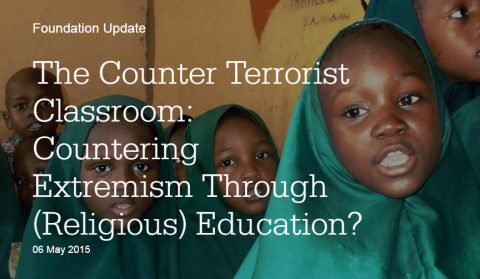 The Counter Terrorist Classroom: Countering Extremism Through (Religious) Education? Year of publication: 2015 Author: Liam Gearon The article identifies international cases– from the United States, Europe, and the United Nations– of an emergent interface of religion, education and security. This is manifest in the uses of religion in education to counter religious extremism, the notional “counter terrorist classroom”. To avoid an over-association of extremism with religion, the article provides some historical reminders that the post-Enlightenment centuries were marked by political extremism, particularly in the phenomenon that came to be known as totalitarianism. The Counter Terrorist Classroom: Countering Extremism Through (Religious) Education? Year of publication: 2015 Author: Liam Gearon Cet article identifie des cas d’interaction croissante entre les sphères du religieux, de l’éducation et le domaine sécuritaire - aux États-Unis, en Europe, et au sein des Nations Unies. Par exemple, l’intégration du religieux dans l’éducation afin de lutter contre l’extrémisme religieux, la théorique « lutte contre le terrorisme au sein des salles de classe ». Pour éviter une trop forte association entre extrémisme et religion, l’auteur procède à quelques rappels historiques et souligne le fait qu’à la fin du siècle des Lumières et jusqu’à aujourd’hui, les sociétés ont été marquées par diverses formes d’extrémisme politique, comme le montre notamment l’exemple les totalitarismes du XXe siècle.