
Resources
Explore a wide range of valuable resources on GCED to deepen your understanding and enhance your research, advocacy, teaching, and learning.
11 Results found
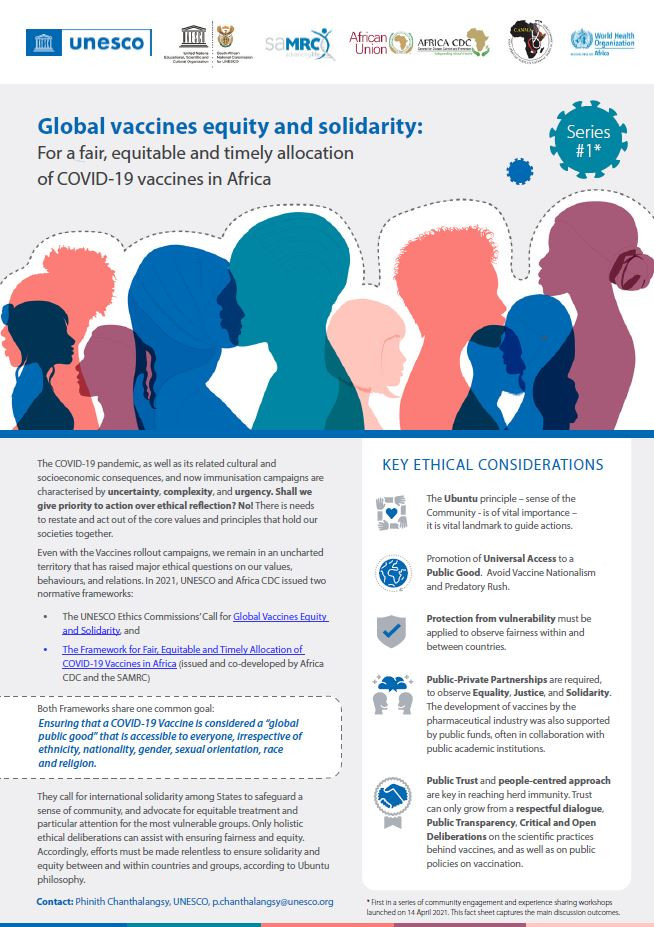 Global Vaccines Equity and Solidarity: For a Fair, Equitable and Timely Allocation of COVID-19 Vaccines in Africa; Series #1 Year of publication: 2021 Corporate author: UNESCO Harare African populations have been side-lined through the COVID-19 Vaccination roll-out process. A vaccination timeline taking Africa into 2023 would be unethical. African countries need to invest in their own structures and stop relying on colonial structures. There is a moral obligation to safeguard the population through equal distribution. This not only makes moral and ethical sense but also scientific and economic sense as a slow roll out in Africa will impact the rest of the world. First in a series of community engagement and experience sharing workshops launched on 14 April 2021. This fact sheet captures the main discussion outcomes.
  Global Priority Africa Flagships 2023: An Update from UNESCO Regional Office for Southern Africa Year of publication: 2024 Corporate author: UNESCO Harare Two years into the implementation of the Operational Strategy for Priority Africa 2022-2029 (OSPA), a new biennium has commenced through the Programme and Budget for 2024-2025. With a goal of achieving the Sustainable Development Goals (SDGs) of the United Nations’ Agenda 2030 and the African Union’s Agenda 2063 “The Africa We Want”, the OSPA remains pivotal in accelerating the achievement of SDGs amidst a growing threat of regression and stagnation on some of the SDG targets. The relentless climatic changes have resulted in droughts and cyclones whose incessant rains have caused food insecurity, waterborne diseases and loss of biodiversity. Geopolitical crisis and the remnants of the impacts of COVID-19 continue to waylay the aspirations of the continent. Gender inequality, youth unemployment, education and HIV and AIDS continue to be areas for concern. Despite this plethora of challenges, Member States remain committed to Agenda 2030 and 2063 and the strong partnership existing with UNESCO and the rest of the UN system. While the OSPA is driven to address challenges in the areas of demography and sustainable development, education and knowledge, climate change, cultural renaissance, and peace and democracy these all have far-reaching consequences beyond their focus hence addressing these contributes widely to other thematic areas. Priority Africa reinforces UNESCO’s partnerships with African governing bodies such as the African Union (AU), Regional Economic Communities (RECs), Member States as well as other UN agencies. Being also aligned with the Southern African Development Community (SADC) and UNESCO’s Joint Programme of Action (JPA) 2022-2025, the OSPA continues to demonstrate its relevance to the region.
 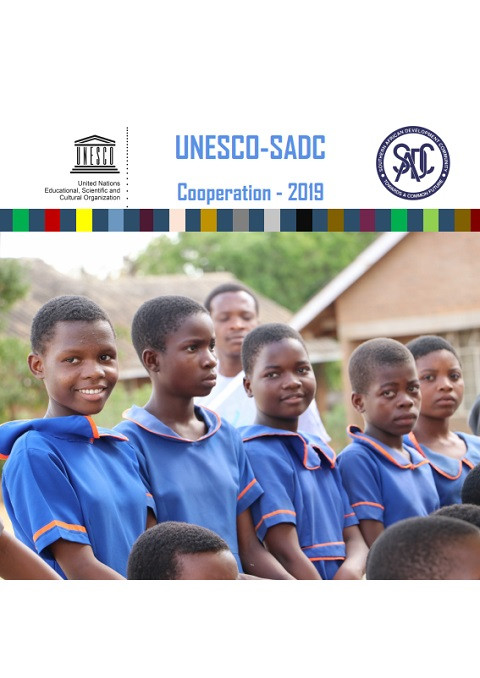 UNESCO-SADC: Cooperation 2019 Year of publication: 2020 Corporate author: UNESCO Harare UNESCO and SADC have a long standing history that culminated in the signing of a Memorandum of Understanding (MOU) in 1996. In 2017, UNESCO and SADC developed a Joint Programme of Action (JPA) which identifies concrete area of cooperation. These include education; technical and vocational education and training (TVET); youth; HIV and health education; science, technology and innovation (STI); water security, renewable energy and disaster risk management; culture; communication and information (including media for SDGs); and data for development.The purpose of this magazine is to highlight UNESCO’ work to improve education quality in the southern Africa region in partnership with SADC.
 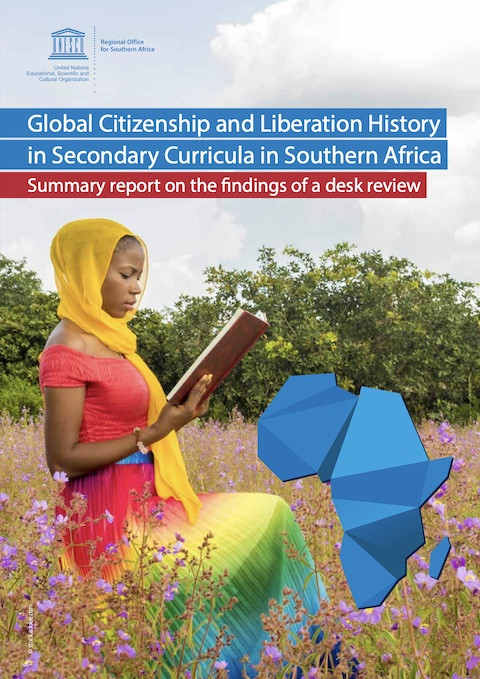 Global Citizenship and Liberation History in Secondary Curricula in Southern Africa: Summary Report on the Findings of a Desk Review Year of publication: 2021 Corporate author: UNESCO Harare This report presents key findings of a desk study on the extent of integration of Global Citizenship Education (GCED) and Southern Africa Liberation History (SALH) educationin the secondary schools curricula in Angola, Democratic Republic of Congo, Eswatini, Lesotho, Malawi, Mauritius, Mozambique, Namibia, South Africa, Seychelles, United Republic of Tanzania, Zambia and Zimbabwe. Citoyenneté mondiale et histoire de la libération dans les programmes des établissements secondaires en Afrique australe: Rapport de synthèse sur les résultats d'une étude documentaire Year of publication: 2021 Corporate author: UNESCO Harare This report presents key findings of a desk study on the extent of integration of Global Citizenship Education (GCED) and Southern Africa Liberation History (SALH) educationin the secondary schools curricula in Angola, Democratic Republic of Congo, Eswatini, Lesotho, Malawi, Mauritius, Mozambique, Namibia, South Africa, Seychelles, United Republic of Tanzania, Zambia and Zimbabwe.
  Connect With Respect: Preventing Gender-Based Violence in Schools; Classroom Programme for Learners in Upper Primary and Early Secondary School (Ages 12-15) Year of publication: 2021 Author: Helen Cahill | Sally Beadle | Michelle Davis | Anne Farrelly | Katherine Romei Corporate author: UNESCO Harare This toolkit for schools in the region addresses the growing issue of school violence, including bullying and gender-based violence. The tool from the programme Connect with Respect (CwR) guides teachers in lower secondary schools to deliver a range of activities with their students. The activities can be integrated within a range of subjects, including literacy, social studies, civics/citizenship education, health, life skills and sexuality education.
  From Angola to Zimbabwe: remarkable heritage of Southern Africa Year of publication: 2022 Corporate author: UNESCO Harare | African World Heritage Fund A celebration of Southern Africa’s rich and diverse heritageToday, Southern Africa’s diverse heritage faces a rising number of challenges which need to be addressed, including climate change, natural disasters, conflicts, urban development and tourism pressures. The region currently has 42 World Heritage sites and 24 Living Heritage elements inscribed on the UNESCO World Heritage and Intangible Cultural Heritage Lists, making it a vibrantly rich home to cultural diversity and human creativity. However, more work needs to be done to further recognize the value of Southern Africa’s multifaceted heritage and enhance its protection in the face of increasing threats.World Heritage sites in the region continue to play an essential role in the lives of the communities who live in and around them, as they constitute a source of pride, history and knowledge, a powerful driver of local economic development, and a vital resource for reconciliation, social integration and sustainable peace. Similarly, Southern Africa’s living heritage elements provide communities with a strong sense of identity and help create a favorable environment for nurturing cultural diversity and human creativity.Inviting you on a journey of discovery from Angola’s Mbanza Kongo to Zimbabwe’s Mbende Jerusarema dance, this publication provides a new outlook on the exceptional heritage that can be found in the countries of the Southern African Development Community region and emphasizes the need for its long-term protection and safeguarding as a shared responsibility.
  Introducing the Our Rights, Our Lives, Our Future (O3) Programme 2018-2022 Year of publication: 2019 Corporate author: UNESCO Harare Comprehensive sexuality education is a curriculum-based process of teaching and learning about the cognitive, emotional, physical, and social aspects of sexuality. It aims to equip children and young people with the knowledge, skills, attitudes, and values that will empower them to protect their health, well-being, and dignity, as well as to develop respectful social relationships and consider the well-being of others affected by their choices. Importantly, it also helps them to understand and act upon their rights throughout their lives.
  Report of the Sub-Saharan Africa Regional GCED Network Meeting: Perspectives, Strategies and Actions for GCED Year of publication: 2017 Author: Gertie Steukers | Carolyn Medel-Añonuevo | Abdoul Wahab Coulibaly Corporate author: UNESCO Harare | APCEIU An increasingly globalized world has raised questions about what constitutes meaningful citizenship as well as about its global dimensions. Global Citizenship Education (GCED) aims to empower learners to assume active roles to face and resolve global challenges and to become proactive contributors to a more peaceful, tolerant, inclusive and secure world.Education is the most important tool for equipping young people, our future generation of leaders, with the knowledge, skills and attitudes to tackle prejudice and hostility, and to build more peaceful, tolerant and equitable societies. While there are different understandings and manifestations of GCED in different countries, GCED in its various forms is fast becoming an important and necessary component of education systems in sub-Saharan Africa and across the world.The commitment of actors around the world to promoting GCED has contributed highly to the development of GCED, including raising awareness and catalysing action. Furthermore, this has led to the incorporation of GCED in the Sustainable Development Goals (SDGs) through Target 4.7, which captures the clear call for an education that addresses the needs of the twenty-first century, empowering learners to act towards a more peaceful, just, inclusive and sustainable world.GCED reflects the aim of education to go beyond just access and ‘ensure inclusive and equitable quality education and promote lifelong opportunities for all’ in the next fifteen years.UNESCO Regional Office for Southern Africa (ROSA) and the Asia-Pacific Centre of Education for International Understanding (APCEIU) invited partners across Africa for the 2017 Sub-Saharan Africa GCED Regional Network Meeting on 6–7 April 2017 in Johannesburg. The meeting was designed to jumpstart the formation of the Africa Regional GCED Network, map different GCED programmes in the region, and explore areas of possible collaboration in light of solidifying regional action on GCED.
  Global Citizenship Education in Southern Africa: Learning to Live Together - the Role of Teachers; Report of a Networking Meeting Year of publication: 2019 Corporate author: UNESCO Harare | APCEIU This is a report on the second GCED networking meeting held from 28 to 29 October 2019 in Johannesburg, South Africa. It took stock of GCED in the region and discussed how GCED is and could be integrated in curricula and teacher education in the Southern African context to strengthen and expand the existing networks of GCED stakeholders and partners.