
Resources
Explore a wide range of valuable resources on GCED to deepen your understanding and enhance your research, advocacy, teaching, and learning.
6 Results found
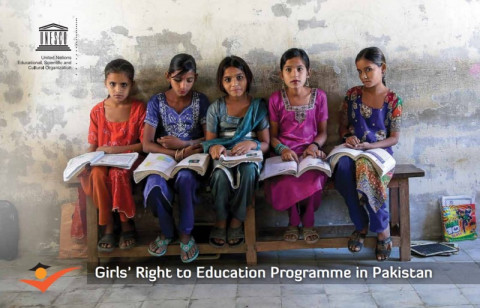 Girls' Right to Education Programme in Pakistan Year of publication: 2018 Corporate author: UNESCO Islamabad The programme is in progress in 14 very marginalized districts of the country selected in consultation with concerned education counterparts. Basic indicators for education, such as literacy rate, enrolment and retention of girls, and level of learning outcomes in primary grades are quite low in each selected district. Each province and area based project has three integrated components: (a) improving girls’ access through social mobilization and advocacy, (b) improving retention through improvement in school physical and learning environments – activation of parents-teachers committees (PTCs), school management committees (SMCs) and teachers training in multi-grade teaching and activity-based learning and, (c) capacity building of education officials at district, provincial and national level to create an enabling environment for girls’ education. All projects are implemented through local civil society organizations (CSOs) as implementing partners in consultation with national, provincial and area education departments. The programme is making significant progress in transforming the parental and community perception towards girls' education. Over seven thousand out of school girls have been enrolled in the target areas and retention is ensured through the provision of school facilities and improvement in overall learning environment.
  Joint E-9 Statement on Education Beyond 2015: Islamabad Statement Year of publication: 2014 Corporate author: UNESCO This statement is adopted by the participants of the 10th E-9 Ministerial Review Meeting held in Islamabad, Pakistan, on November 27-28, 2014. They have taken stock of the progress made since 2000 and challenges remaining in the nine countries in achieving the six Education for All (EFA) goals, and reflected on the priorities and prospects for each country to sustain and further advance educational development beyond 2015. Their deliberations were based on a careful examination of the National EFA 2015 Reviews of the countries concerned, the Muscat Agreement adopted at the Global Education for All Meeting (Muscat, Oman, 12-14 May 2014), the Outcome Document of the United Nations General Assembly Open Working Group on Sustainable Development Goals, and took into account the Aichi-Nagoya Declaration on Education for Sustainable Development as well as the changing global environment that shapes the cooperation among the E-9 countries. Joint E-9 Déclaration sur l'éducation Au-delà de 2015: Déclaration Islamabad Year of publication: 2014 Corporate author: Organisation des Nations Unies pour l'éducation, la science et la culture (UNESCO) Cette déclaration est adoptée par les participants de la 10e E-9 Réunion Ministérielle tenue à Islamabad, au Pakistan, le 27-28 Novembre 2014. Ils ont fait le point sur les progrès réalisés depuis 2000 et des défis restant dans les neuf pays dans la réalisation des six éducation pour tous (EPT), et réfléchi sur les priorités et les perspectives de chaque pays pour soutenir et faire progresser le développement de l'éducation au-delà de 2015. Leurs délibérations se sont fondées sur un examen attentif des nationaux EPT 2015 Avis sur les pays concernés, le Muscat Accord adopté à l'éducation globale pour tous Réunion (Muscat, Oman, 12-14 mai 2014), le document final du groupe de travail à composition Assemblée Générale des Nations Unies sur les objectifs de développement durable, et a pris en compte la Déclaration d'Aichi-Nagoya sur l'éducation pour développement durable, ainsi que l'évolution du contexte mondial qui façonne la coopération entre les pays E-9. 九个人口大国关于2015年后教育的联合声明 : 伊斯兰堡声明 Year of publication: 2014 Corporate author: 联合国教科文组织 (UNESCO) This statement is adopted by the participants of the 10th E-9 Ministerial Review Meeting held in Islamabad, Pakistan, on November 27-28, 2014. They have taken stock of the progress made since 2000 and challenges remaining in the nine countries in achieving the six Education for All (EFA) goals, and reflected on the priorities and prospects for each country to sustain and further advance educational development beyond 2015. Their deliberations were based on a careful examination of the National EFA 2015 Reviews of the countries concerned, the Muscat Agreement adopted at the Global Education for All Meeting (Muscat, Oman, 12-14 May 2014), the Outcome Document of the United Nations General Assembly Open Working Group on Sustainable Development Goals, and took into account the Aichi-Nagoya Declaration on Education for Sustainable Development as well as the changing global environment that shapes the cooperation among the E-9 countries. البيان المشترك للبلدان التسعة ذات الأعداد الضخمة فيما يخص التعليم في مرحلة ما بعد عام 2015 Year of publication: 2014 Corporate author: منظمة الأمم المتحدة للتربية والعلم والثقافة (UNESCO) This statement is adopted by the participants of the 10th E-9 Ministerial Review Meeting held in Islamabad, Pakistan, on November 27-28, 2014. They have taken stock of the progress made since 2000 and challenges remaining in the nine countries in achieving the six Education for All (EFA) goals, and reflected on the priorities and prospects for each country to sustain and further advance educational development beyond 2015. Their deliberations were based on a careful examination of the National EFA 2015 Reviews of the countries concerned, the Muscat Agreement adopted at the Global Education for All Meeting (Muscat, Oman, 12-14 May 2014), the Outcome Document of the United Nations General Assembly Open Working Group on Sustainable Development Goals, and took into account the Aichi-Nagoya Declaration on Education for Sustainable Development as well as the changing global environment that shapes the cooperation among the E-9 countries. Declaración Conjunta del Grupo E-9 sobre la Educación Después de 2015: Declaración de Islamabad Year of publication: 2014 Corporate author: Organización de las Naciones Unidas para la Educación, la Ciencia y la Cultura (UNESCO) This statement is adopted by the participants of the 10th E-9 Ministerial Review Meeting held in Islamabad, Pakistan, on November 27-28, 2014. They have taken stock of the progress made since 2000 and challenges remaining in the nine countries in achieving the six Education for All (EFA) goals, and reflected on the priorities and prospects for each country to sustain and further advance educational development beyond 2015. Their deliberations were based on a careful examination of the National EFA 2015 Reviews of the countries concerned, the Muscat Agreement adopted at the Global Education for All Meeting (Muscat, Oman, 12-14 May 2014), the Outcome Document of the United Nations General Assembly Open Working Group on Sustainable Development Goals, and took into account the Aichi-Nagoya Declaration on Education for Sustainable Development as well as the changing global environment that shapes the cooperation among the E-9 countries.