
Resources
Explore a wide range of valuable resources on GCED to deepen your understanding and enhance your research, advocacy, teaching, and learning.
9 Results found
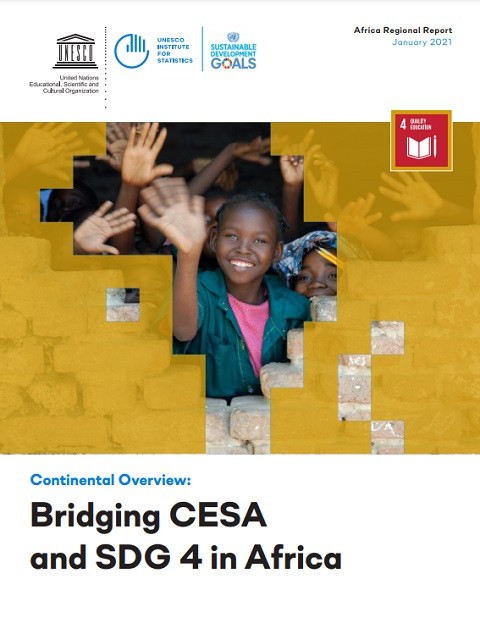 Continental Overview: Bridging CESA and SDG 4 in Africa; Africa Regional Report Year of publication: 2021 Corporate author: UNESCO Institute for Statistics (UIS) Monitoring progress toward Sustainable Development Goal 4 for education (SDG 4) is crucial to ensuring that children around the world have access to a quality education where they can learn and gain the skills they need to meet their full potential. SDG 4 indicators are organized with a view to global, thematic, regional and national targets.This report by the UNESCO Institute for Statistics (UIS) is the first in a series intended to bring a regional focus to SDG 4 monitoring, highlight the work being done in the regions and compare SDG 4 targets with those established by regional bodies.This new series of regional reports serve two purposes. Firstly, to map regional and SDG 4 targets to provide an overview of the symmetries between the two. Continental Overview: Bridging CESA and SDG 4 in Africa looks at how the strategic objectives of the Continental Education Strategy for Africa (CESA) compares with SDG 4 targets. Secondly, it analyses progress towards these objectives by African sub-regions.
 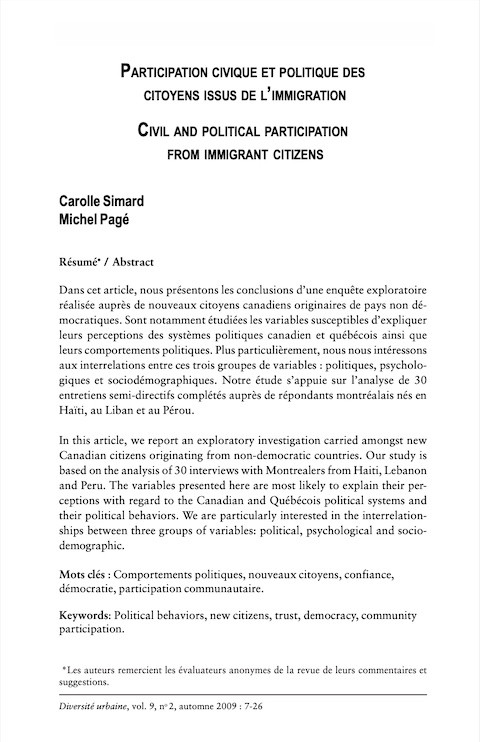 Civil and Political Participation From Immigrant Citizens (Diversité urbaine; vol. 9, no. 2) Year of publication: 2016 Author: Carolle Simard | Michel Pagé Corporate author: Groupe de recherche diversité urbaine (GRDU) | Centre d’études ethniques des universités montréalaises (CEETUM) In this article, we report an exploratory investigation carried amongst new Canadian citizens originating from non-democratic countries. Our study is based on the analysis of 30 interviews with Montrealers from Haiti, Lebanon and Peru. The variables presented here are most likely to explain their per- ceptions with regard to the Canadian and Québécois political systems and their political behaviors. We are particularly interested in the interrelation- ships between three groups of variables: political, psychological and socio- demographic. Participation civique et politique des citoyens issus de l’immigration (Diversité urbaine; vol. 9, no. 2) Year of publication: 2016 Author: Carolle Simard | Michel Pagé Corporate author: Groupe de recherche diversité urbaine (GRDU) | Centre d’études ethniques des universités montréalaises (CEETUM) Dans cet article, nous présentons les conclusions d’une enquête exploratoire réalisée auprès de nouveaux citoyens canadiens originaires de pays non dé- mocratiques. Sont notamment étudiées les variables susceptibles d’expliquer leurs perceptions des systèmes politiques canadien et québécois ainsi que leurs comportements politiques. Plus particulièrement, nous nous intéressons aux interrelations entre ces trois groupes de variables : politiques, psycholo- giques et sociodémographiques. Notre étude s’appuie sur l’analyse de 30 entretiens semi-directifs complétés auprès de répondants montréalais nés en Haïti, au Liban et au Pérou.
 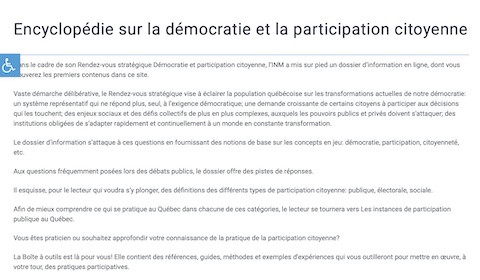 Encyclopedia on Democracy and Citizen Participation Author: Malorie Flon | Émilie Béorofei Corporate author: Institut du Nouveau Monde (INM) As part of its Strategic Meeting on Democracy and Citizen Participation, the INM has set up an online information pack, the first contents of which you will find on this site.A vast deliberative process, the Strategic Rendezvous aims to enlighten the people of Quebec on the current transformations of our democracy: a representative system that no longer responds, on its own, to the democratic requirement; a growing demand from certain citizens to participate in decisions that affect them; increasingly complex social issues and collective challenges, which public and private authorities must tackle; institutions forced to adapt quickly and continuously to a constantly changing world.The Briefing Kit tackles these questions by providing basic notions of the concepts involved: democracy, participation, citizenship, etc. To questions frequently asked during public debates, the dossier offers some possible answers. It outlines, for the reader who wants to dive into it, definitions of the different types of citizen participation: public, electoral, social. In order to better understand what is practiced in Quebec in each of these categories, the reader will turn to The authorities of public participation in Quebec.Are you a practitioner or would you like to deepen your knowledge of the practice of citizen participation? The Toolbox is here for you! It contains references, guides, methods and examples of experiences that will equip you to implement, in turn, participatory practices. Encyclopédie sur la démocratie et la participation citoyenne Author: Malorie Flon | Émilie Béorofei Corporate author: Institut du Nouveau Monde (INM) Dans le cadre de son Rendez-vous stratégique Démocratie et participation citoyenne, l’INM a mis sur pied un dossier d’information en ligne, dont vous trouverez les premiers contenus dans ce site.Vaste démarche délibérative, le Rendez-vous stratégique vise à éclairer la population québécoise sur les transformations actuelles de notre démocratie: un système représentatif qui ne répond plus, seul, à l’exigence démocratique; une demande croissante de certains citoyens à participer aux décisions qui les touchent; des enjeux sociaux et des défis collectifs de plus en plus complexes, auxquels les pouvoirs publics et privés doivent s’attaquer; des institutions obligées de s’adapter rapidement et continuellement à un monde en constante transformation. Le dossier d’information s’attaque à ces questions en fournissant des notions de base sur les concepts en jeu: démocratie, participation, citoyenneté, etc. Aux questions fréquemment posées lors des débats publics, le dossier offre des pistes de réponses. Il esquisse, pour le lecteur qui voudra s’y plonger, des définitions des différents types de participation citoyenne: publique, électorale, sociale. Afin de mieux comprendre ce qui se pratique au Québec dans chacune de ces catégories, le lecteur se tournera vers Les instances de participation publique au Québec. Vous êtes praticien ou souhaitez approfondir votre connaissance de la pratique de la participation citoyenne? La Boîte à outils est là pour vous! Elle contient des références, guides, méthodes et exemples d’expériences qui vous outilleront pour mettre en œuvre, à votre tour, des pratiques participatives.
 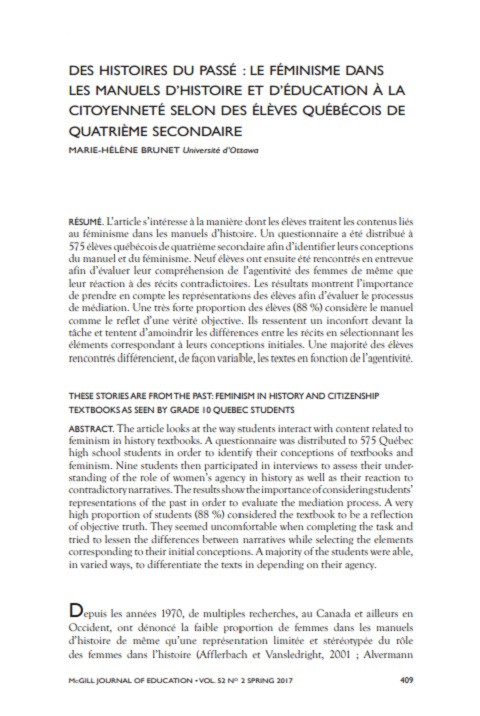 Des histoires du passé: Le féminisme dans les manuels d’histoire et d’éducation à la citoyenneté selon des élèves québécois de quatrième secondaire (Revue des sciences de l'éducation de McGill; Vol. 52, No. 2) Year of publication: 2017 Author: Marie-Hélène Brunet Corporate author: McGill University. Faculty of Education L’article s’intéresse à la manière dont les élèves traitent les contenus liés au féminisme dans les manuels d’histoire. Un questionnaire a été distribué à 575 élèves québécois de quatrième secondaire afin d’identifier leurs conceptions du manuel et du féminisme. Neuf élèves ont ensuite été rencontrés en entrevue afin d’évaluer leur compréhension de l’agentivité des femmes de même que leur réaction à des récits contradictoires. Les résultats montrent l’importance de prendre en compte les représentations des élèves afin d’évaluer le processus de médiation. Une très forte proportion des élèves (88 %) considère le manuel comme le reflet d’une vérité objective. Ils ressentent un inconfort devant la tâche et tentent d’amoindrir les différences entre les récits en sélectionnant les éléments correspondant à leurs conceptions initiales. Une majorité des élèves rencontrés différencient, de façon variable, les textes en fonction de l’agentivité.
  Citoyen·ne·s, mais pas encore adultes ? Les injonctions à la responsabilité et à la citoyenneté dans les rituels d’accession à la majorité en Suisse Year of publication: 2018 Author: Maxime Felder | Laurence Ossipow | Isabelle Csupor Corporate author: Lien social et Politiques En Suisse, les communes ritualisent le passage à la majorité civile et civique en organisant des promotions dites civiques ou citoyennes. À l’aube de leurs 18 ans, les jeunes reçoivent une invitation des autorités communales à laquelle environ un tiers répond favorablement. Dans les six communes que nous avons étudiées durant trois ans, les autorités invitent les jeunes à participer à une séance du conseil communal, les convient à un repas ou un apéritif, leur organisent une nuit de jeux en plein air, ou encore une soirée de témoignages et de spectacles. Quelle que soit la forme que prennent ces événements, ils font place à des discours dans lesquels des élu·e·s rappellent aux jeunes majeur·e·s les nouvelles responsabilités et les choix qui les attendent à l’orée de l’âge adulte, et les enjoignent à devenir de «bonnes» et «bons» citoyen·ne·s. Ces événements offrent ainsi une opportunité d’étudier empiriquement la «fabrication» (Bénéï, 2005; Gagné et Neveu, 2009) de la citoyenneté juvénile. Dans un premier temps, nous décrirons très brièvement l’approcheméthodologique et les dispositifs mis en place par les six communes étudiées. Puis, nous ferons une analyse des discours qui, outre l’appel au vote, incitent à se battre pour des droits qui permettent à la démocratie de perdurer, mais ne s’arrêtent pas à cette définition restreinte de la citoyenneté. Enfin, nous nous concentrerons sur trois tensions que révèle le croisement de ces injonctions à la citoyenneté, avec ce qu’en disent les jeunes participant·e·s. Citizens but Not Adults? Injunction to Be Responsible and Citizens in Official Coming of Age Rituals in Switzerland Year of publication: 2018 Author: Maxime Felder | Laurence Ossipow | Isabelle Csupor Corporate author: Lien social et Politiques Swiss municipalities organize ceremonies for their residents reaching the official age of full citizenship. In the six studied municipalities, local authorities invite them to a municipal council’s meeting, offer them a dinner or an aperitif, or organize them a show and a debate with role models. Speeches are central to these ceremonies, and authority representatives encourage their audience to be “good” citizens. Call to vote is the leitmotiv, but discourses reveal broader definitions of citizenship, insisting sometimes on a local commitment and volunteering, and sometimes on the necessity to fight climate change and inequalities. Comparing officials’ speeches to statements of young people participating in these events reveals “tensions”. Indeed, authority representatives address young citizens without considering them as fully adult, and they do not consider themselves as such neither. However, some of them are already involved in forms of vernacular citizenship, and are progressively leaving the municipality to study, work or travel. Ultimately, these ceremonies allow officials to stage their interest in the youth, which they consider as both uncompleted and essential to the renewal of democracy. These Stories are From the Past: Feminism in History and Citizenship Textbooks as Seen by Grade 10 Quebec Students (McGill Journal of Education; Vol. 52, No. 2) Year of publication: 2017 Author: Marie-Hélène Brunet Corporate author: McGill University. Faculty of Education The article looks at the way students interact with content related to feminism in history textbooks. A questionnaire was distributed to 575 Québec high school students in order to identify their conceptions of textbooks and feminism. Nine students then participated in interviews to assess their understanding of the role of women’s agency in history as well as their reaction to contradictory narratives. The results show the importance of considering students’ representations of the past in order to evaluate the mediation process. A very high proportion of students (88 %) considered the textbook to be a reflection of objective truth. They seemed uncomfortable when completing the task and tried to lessen the differences between narratives while selecting the elements corresponding to their initial conceptions. A majority of the students were able, in varied ways, to differentiate the texts in depending on their agency.