
Resources
Explore a wide range of valuable resources on GCED to deepen your understanding and enhance your research, advocacy, teaching, and learning.
32 Results found
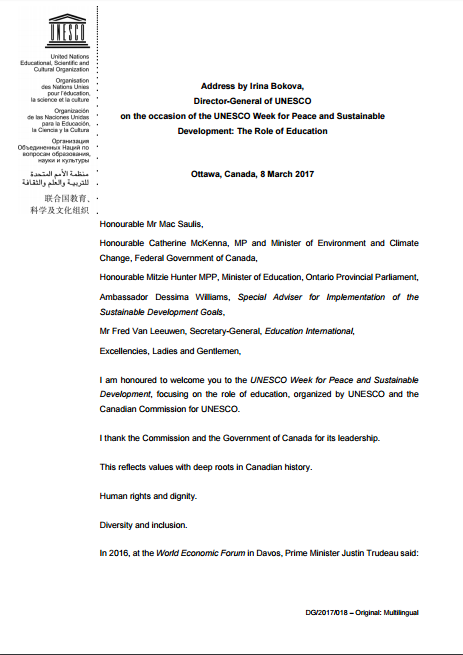 Address by Irina Bokova, Director-General of UNESCO, on the occasion of the UNESCO Week for Peace and Sustainable Development: The Role of Education; Ottawa, Canada, 8 March 2017 Year of publication: 2017 Corporate author: UNESCO. Director-General, 2009-2017 (Bokova, I.G.) This address was presented by Irina Bokova, Director-General of UNESCO on the occasion of the UNESCO Week for Peace and Sustainable Development. She highlights on the role of education.
  Commission Canadienne des Droits de la Personne Corporate author: Commission Canadienne des Droits de la Personne La Commission canadienne des droits de la personne est l'organisme de surveillance des droits de la personne à l'échelon fédéral. La Commission est indépendante du gouvernement et agit dans l'intérêt public. Elle contribue à ce que chaque personne au Canada soit traitée équitablement, peu importe son identité. Elle est responsable de représenter l'intérêt public et de demander des comptes au gouvernement du Canada quant aux enjeux de droits de la personne. Sur cette page, vous trouverez des ressources pour mettre en place une politique inclusive dans vos secteurs de travail notamment sur la prévention du racisme, de l'intolérance religieuse et des droits aux travailleurs en situation de handicap The Canadian Human Rights Commission is Canada's human rights watchdog. We work for the people of Canada and operate independently from the Government. The Commission helps ensure that everyone in Canada is treated fairly, no matter who they are. We are responsible for representing the public interest and holding the Government of Canada to account on matters related to human rights. On this page, you'll find resources to help you implement an inclusive policy in your areas of work, including the prevention of racism, religious intolerance and the rights of workers with disabilities.
 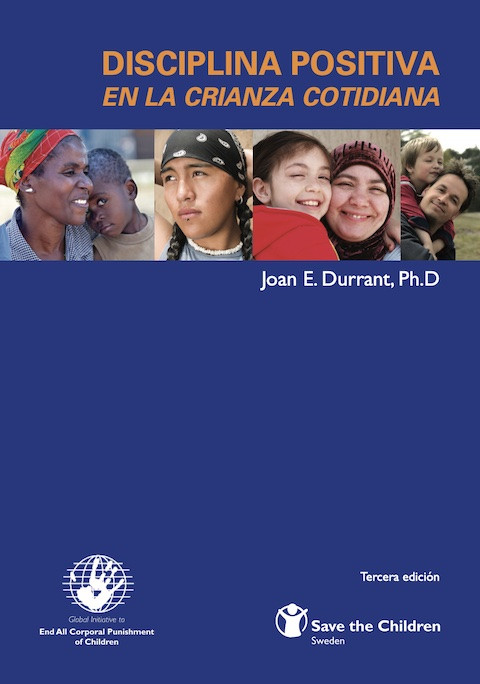 Disciplina positiva en la crianza cotidiana (Tecera edición) Year of publication: 2013 Author: Joan E. Durrant Corporate author: Save the Children Sweden Este documento es un respuesta al informe mundial sobre la violencia con la niñez en el año 2006, un estudio que determinó que el maltrato ocurre en los hogares de los niños y las nñas en todos los paises del mundo. Es un libro dirigido a padres y futuros padres de niños de todas las edades. Aborda temas que surgen desde el nacimiento y el final de la adolescencia.
 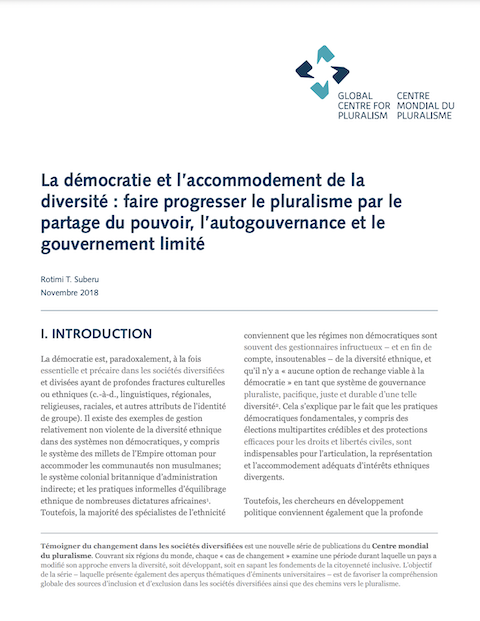 Democracy and the Accommodation of Diversity: Advancing Pluralism Through Power Sharing, Self-Governance and Limited Government Year of publication: 2018 Author: Rotimi Suberu Corporate author: Global Centre for Pluralism (Canada) Democracy is, paradoxically, both essential and precarious in diverse and divided societies with deep cultural or ethnic (i.e., linguistic, regional, religious, racial, and other attributes of identity) divides. group). There are examples of relatively non-violent management of ethnic diversity in undemocratic systems, including the Ottoman Empire's millet system to accommodate non-Muslim communities; the British colonial system of indirect administration; and the informal ethnic balancing practices of many African dictatorships. However, the majority of ethnicity scholars agree that undemocratic regimes are often unsuccessful - and ultimately, unsustainable - managers of ethnic diversity, and that there are "no viable alternatives. democracy ”as a pluralist, peaceful, just and sustainable system of governance of such diversity. This is because basic democratic practices, including credible multiparty elections and effective protections for civil rights and freedoms, are essential for the proper articulation, representation and accommodation of competing ethnic interests. La démocratie et l’accommodement de la diversité : Faire progresser le pluralisme par le partage du pouvoir, l’autogouvernance et le gouvernement limité Year of publication: 2018 Author: Rotimi Suberu Corporate author: Global Centre for Pluralism (Canada) La démocratie est, paradoxalement, à la fois essentielle et précaire dans les sociétés diversifiées et divisées ayant de profondes fractures culturelles ou ethniques (c.-à-d., linguistiques, régionales, religieuses, raciales, et autres attributs de l’identité de groupe). Il existe des exemples de gestion relativement non violente de la diversité ethnique dans des systèmes non démocratiques, y compris le système des millets de l’Empire ottoman pour accommoder les communautés non musulmanes; le système colonial britannique d’administration indirecte; et les pratiques informelles d’équilibrage ethnique de nombreuses dictatures africaines1. Toutefois, la majorité des spécialistes de l’ethnicité conviennent que les régimes non démocratiques sont souvent des gestionnaires infructueux – et en fin de compte, insoutenables – de la diversité ethnique, et qu’il n’y a « aucune option de rechange viable à la démocratie » en tant que système de gouvernance pluraliste, pacifique, juste et durable d’une telle diversité2. Cela s’explique par le fait que les pratiques démocratiques fondamentales, y compris des élections multipartites crédibles et des protections efficaces pour les droits et libertés civiles, sont indispensables pour l’articulation, la représentation et l’accommodement adéquats d’intérêts ethniques divergents.
  Une expérience d’éducation à la citoyenneté: La Commission jeunesse de Gatineau; Rapport de recherche produit dans le cadre du projet de recherche collaborative sur les pratiques d’éducation citoyenne en milieux communautaires et associatifs Year of publication: 2019 Author: Stéphanie Gaudet | Mariève Forest | Caroline Caron Corporate author: Conseil de recherches en sciences humaines du Canada | Centre interdisciplinaire de recherche sur la citoyenneté et les minorités (CIRCEM) | Université d'Ottawa Notre équipe de recherche collaborative pose l'hypothèse qu'une partie de la réponse aux enjeux d’apathie politique, de cynisme et de radicalisation se trouve dans une éducation citoyenne vivante et engageante. Alors que les représentants de milieux communautaires et municipaux participant à des initiatives d’éducation à la citoyenneté auprès de jeunes peuvent témoigner de l’importance que prennent ces expériences dans la vie de ces personnes, peu de chercheurs se sont penchés sur cette dynamique jusqu’à présent. Cette recherche collaborative vise à comprendre la portée éducative, citoyenne et démocratique de l’expérience participative des jeunes qui prennent part à des initiatives d’éducation à la citoyenneté. Six initiatives ayant cours en dehors des cursus scolaires ont été retenues dans cette étude, dont la Commission jeunesse de Gatineau (CJG). Ce rapport porte précisément sur les résultats d’observations ethnographiques et d’entretiens réalisés auprès de la CJG au cours de l’année 2017- 2018. Les questions de recherche que nous avons retenues sont les suivantes : Comment la CJG conçoit-elle la citoyenneté des jeunes? Quelles qualités citoyennes sont développées? Quelles approches éducatives sont mises de l’avant? Quelle est la portée démocratique des activités réalisées? La CJG est une instance municipale qui rassemble des jeunes, qui les incite à réfléchir et à discuter des dimensions de la vie municipale les touchant particulièrement et qui les amène à prendre des décisions à ce sujet. Plus largement, la CJG se présente comme une « école municipale de participation citoyenne. » Elle se dit également « une instance représentative reconnue en matière de jeunesse, où le sentiment d’appartenance à l’école et à la ville est un levier de l’engagement des adolescents. »
  The Butterfly Effect on Social Networks Year of publication: 2021 Corporate author: Canada Learning Code This video shows the dangers of the internet and social networks through the story of 12-year-old Amira in the form of a comic strip. L'effet papillon sur les réseaux sociaux Year of publication: 2021 Corporate author: Canada Learning Code Cette vidéo montre les dangers d'internet et des réseaux sociaux à travers l'histoire d'Amira 12 ans sous la forme d'une bande dessinée.
  Digital Citizenship: Guide for Parents Year of publication: 2017 Corporate author: Gouvernement of Canada | MediaSmarts The Digital Citizenship Guide for Parents is designed to prepare parents and guardians for the conversations they should have with their children when they first start using digital devices. Guide de civilité en ligne à l’intention des parents Year of publication: 2017 Corporate author: Gouvernement of Canada | MediaSmarts Le Guide de civilité en ligne à l’intention des parents vise à préparer les parents et les gardiens aux conversations qu’ils devraient avoir avec leurs enfants lorsque ces derniers commencent à utiliser des appareils numériques.