
Resources
Explore a wide range of valuable resources on GCED to deepen your understanding and enhance your research, advocacy, teaching, and learning.
3 Results found
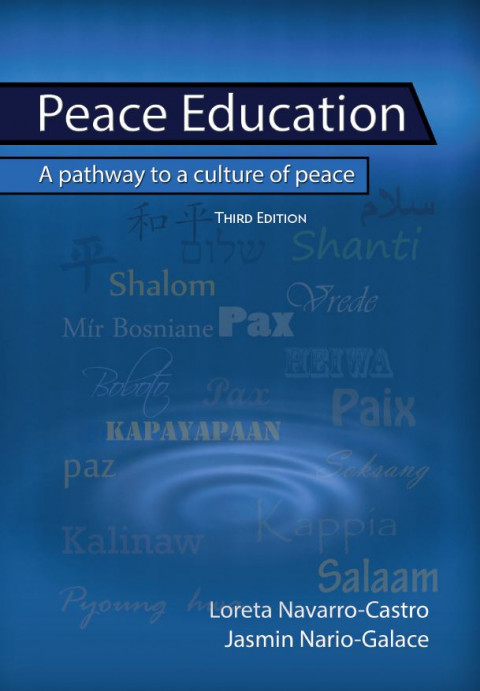 Peace Education: A Pathway to a Culture of Peace; Third Edition Year of publication: 2019 Author: Loreta Navarro-Castro | Jasmin Nario-Galace Corporate author: Miriam College. Center for Peace Education This book is based on author's study and research as well as on experiences as teachers and trainers. By writing about what the authors have come to know and experienced. It is their hope that the ideas contained in this book will circulate widely and promote enthusiasm for both education and action for peace.This book is organized into three sections. Part I aims to develop a holistic understanding of peace and peace education; Part II discusses key peace education themes; Part III focuses on the peaceable learning environment. A "vision for the future" is presented in conclusion.
  Gain or Drain: Understanding Public Private Partnerships in Education Year of publication: 2013 Corporate author: Asia South Pacific Association for Basic and Adult Education (ASPBAE) As a facilitating tool for education campaign coalitions and other education campaigners to begin to build deeper appreciation and understanding of the issue, this Primer specifically seeks to:• Contribute to achieving clarity on the origin, scope and context of PPPs in education• Provide a simple guideline in assessing PPP initiatives to measure how they relate to realising the right to education• Help education campaign coalitions and networks deepen their analyses and define their operational positions for policy engagement on PPP initiatives.
 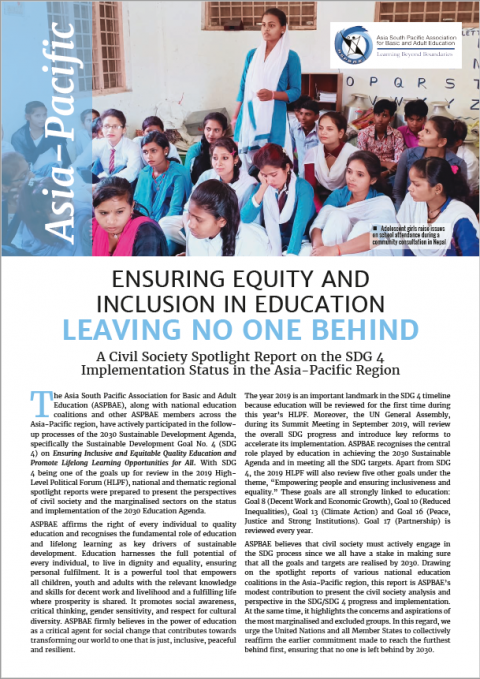 Asia-Pacific Spotlight Report on SDG 4 Year of publication: 2019 Corporate author: Asia South Pacific Association for Basic and Adult Education (ASPBAE) ASPBAE believes that civil society must actively engage in the SDG process since we all have a stake in making sure that all the goals and targets are realised by 2030. Drawing on the spotlight reports of various national education coalitions in the Asia-Pacific region, this report is ASPBAE’s modest contribution to present the civil society analysis and perspective in the SDG/SDG 4 progress and implementation. At the same time, it highlights the concerns and aspirations of the most marginalised and excluded groups. In this regard, we urge the United Nations and all Member States to collectively reaffirm the earlier commitment made to reach the furthest behind first, ensuring that no one is left behind by 2030.