
Resources
Explore a wide range of valuable resources on GCED to deepen your understanding and enhance your research, advocacy, teaching, and learning.
10 Results found
 Climate Change Adaptation Policy, 10 years: Tracking Adaptation and Suggesting the Way Forward (Ⅲ) Year of publication: 2021 Author: YoungiI Song | Jiyoung Shin | Jinhan Park | Songmi Park | Mirae Kim Corporate author: Korea Environment Institute (KEI) This study suggested the direction of preparing and wrote the climate change adaptation gap report by sector. This study defined the adaptation gap as the degree of implementation compared to the adaptation goal and evaluated the effect of reducing climate change risk.This study prepared a climate change adaptation gap report through the process of selecting representative indicators, setting adaptation goals, and analyzing national climate change adaptation policies for five sectors: forest/ecosystem, agriculture and fisheries, water, health, and territory/coast.Through the writing of the climate change adaptation gap report, We identified the insufficient climate change adaptation measures and suggested the policy directions to effectively reduce climate change risk and ensure the effectiveness of future climate change adaptation policies.As a result, we emphasized the climate change adaptation efforts are needed, such as establishing climate change adaptation policies directly related to climate change risk, building the data to understand the effectiveness of climate change adaptation measures, and setting goals for climate change adaptation. 기후변화 적응정책 10년: 현주소 진단과 개선방안 모색을 중심으로 (Ⅲ) Year of publication: 2021 Author: 송영일 | 신지영 | 박진한 | 박송미 | 김미래 Corporate author: 한국환경연구원 IPCC 제5차 평가보고서(2013년) 발간 이후 8년만인 올해 발간된 제6차 평가보고서에서는 전 세계 평균기온이 산업혁명 이전보다 1.09℃ 증가한 것으로 발표하였는데, 이는 제5차 보고서 발간 당시 발표한 0.78℃에 비하여 0.31℃가 증가한 것입니다. 전 세계적으로 온실가스 발생을 감축하기 위해 꾸준히 노력해 왔음에도 불구하고 지난 8년 정도의 시간 동안 이와 같은 기온상승이 있었습니다. 이는 기후변화가 우리의 생각보다 빨리 진행되고 있으며 이미 배출된 온실가스만으로도 기후변화가 지속적으로 발생할 수 있다는 사실을 뒷받침합니다. 신 기후체제의 근간이 되는 파리협정에서는 감축과 함께 적응을 중요한 기후변화 대응방안으로 평가하고 있습니다.우리나라에서는 기후변화의 부정적 영향에 대비하고 기후탄력성을 키워 기후 안전 사회를 이루기 위하여 2010년부터 적응정책을 이행하고 있습니다. 지난 10년간 적응정책 이행 과정에서 발생한 성과와 한계를 진단하고 이를 토대로 개선방안을 제시하기 위하여 총 3년에 걸쳐 본 과제가 수행되었습니다. 3년 차인 2021년에는 제도적 측면의 평가와 기후변화 리스크 저감 효과 측면에서 적응정책을 살펴보았습니다. 본 연구에서 도출한 해외주요 국가들과의 적응정책 비교·분석 결과 및 적응목표와 이행 정도에 대한 갭(gap) 분석 결과는 적응정책을 개선하고 실효성을 높이는 데 이바지할 것으로 기대합니다. * 본 저작물은 한국환경연구원에서 '2021'년에 작성하여 공공누리 제'4'유형으로 개방한 ‘기후변화 적응정책 10년: 현주소 진단과 개선방안 모색을 중심으로 (Ⅲ)(작성자: 송영일 외)’를 이용하였으며 해당 저작물은 한국환경연구원 홈페이지(http://www.kei.re.kr)’에서 무료로 다운받으실 수 있습니다.
  Diagnosing and Enhancing Environmental Literacy of Citizens to Raise Green Awareness Year of publication: 2021 Author: Jeongyoon Yeom | Namsoo Kim | Haengwoon Jeong | Woohyeon Jeong Corporate author: Korea Environment Institute (KEI) 1. Research purposeA nationwide consensus on the understanding on and necessity of the environmental policy is needed in order to successfully achieve the policy objectives.The necessity of environmental education is being highlighted but in reality, there is a lack of objectives and specific indicators to verify its effect.The goal of environmental education should be the expansion of environmental literacy and indicators to measure this should be developed. 2. Research scopeSummarize the concept of environmental literacy and develop the scales for adultsMeasure the level of environmental literacy of citizensConfirm the predictors and consequences of environmental literacyUnderstand citizen types via cluster analysis 시민 인식의 녹색 전환을 위한 환경 리터러시 진단 및 강화 방안 Year of publication: 2021 Author: 염정윤 | 김남수 | 정행운 | 정우현 Corporate author: 한국환경연구원 1. 연구의 필요성 및 목적 환경 정책이 성공적으로 정책 목표를 달성하기 위해서는 정책 이해와 필요성에 대한 범국민적 공감대가 필수 환경교육의 중요성을 강조하고 있지만 실질적으로 교육의 효과를 확인할 수 있는 객관적이고 구체적인 지표가 부재함 환경교육의 목표를 환경 리터러시의 증대로 설정하고 이를 측정할 지표 개발이 필요2. 연구의 범위 환경 리터러시 개념 정리 및 성인 대상의 측정 도구 개발 일반 시민의 환경 리터러시 수준 측정 환경 리터러시의 예측 요인과 결과 요인 확인 군집 분석을 통한 시민 유형 파악* 본 저작물은 한국환경연구원에서 '2021'년에 작성하여 공공누리 제'4'유형으로 개방한 ‘시민 인식의 녹색 전환을 위한 환경 리터러시 진단 및 강화 방안(작성자: 염정윤)’을 이용하였으며 해당 저작물은 한국환경연구원 홈페이지(http://www.kei.re.kr)’에서 무료로 다운받으실 수 있습니다.
  Reviewing the Korean Sustainable Development Strategy and Policy in Response to COVID-19 Year of publication: 2021 Author: Soeun Ahn | Dokyun Kim | Hongrim Lee | Yoonseon Park | Jaehyuk Lee | Jungseok Lee | Hanwoom Hong | Woohyun Jung | Baeseok Jeon | Garim Jeon Corporate author: Korea Environment Institute (KEI) Through the ‘Sustainable Development Goals (SDGs)’, the United Nations (UN) has established tasks, including 17 policy goals and 169 targets, that civilization must resolve by 2030. It is recommended that each country build its own implementation mechanism, which sets its own policy goals and targets, tailored to its respective national context. South Korea established the ‘National Sustainable Development Goals (K-SDGs)’ in 2018, consisting of 17 policy goals and 122 targets. In 2020, the country prepared the Fourth Basic Plan for Sustainable Development (2021-2040). The K-SDGs were revised and supplemented in consideration of recent changes in conditions.This study aims to develop a national K-SDGs strategy by examining factors that threaten sustainable development, with a focus on the COVID-19 pandemic. 코로나19 대응 환경부문 국가 지속가능발전 전략개발 Year of publication: 2021 Author: 안소은 | 김도균 | 이홍림 | 박윤선 | 이재혁 | 이정석 | 홍한움 | 정우현 | 전배석 | 전가림 Corporate author: 한국환경연구원 본 보고서는 2021년 한국환경연구원(KEI)이 기획과제로 수행한 ‘포스트 코로나19 사회의 지속가능발전을 위한 환경정책 연구’의 지속가능 전략연구본부 세부과제 연구내용을 담고 있으며 세부과제 연구내용은 크게 ‘코로나19의 국가 지속가능발전목표(K-SDGs) 영향평가를 토대로 한 정책제언과 전략개발 (제1부)’과 ‘언택트 시대 시민참여를 통한 마을 지속가능발전 실천과제 도출과 시민참여 개선방향 제시 (제2부)’로 구분하였다. 종합결론에서는 제1부와 제2부의 연구결과를 종합하고 K-SDGs를 연결고리로 삼아 전문가 설문 조사 분석결과와 마을 지속가능발전 실천과제를 비교·해석하고 시사점을 도출하였다. * 본 저작물은 한국환경연구원에서 '2021'년에 작성하여 공공누리 제'4'유형으로 개방한 ‘코로나19 대응 환경부문 국가 지속가능발전 전략개발(작성자: 안소은 외)’를 이용하였으며 해당 저작물은 한국환경연구원 홈페이지(http://www.kei.re.kr)’에서 무료로 다운받으실 수 있습니다.
 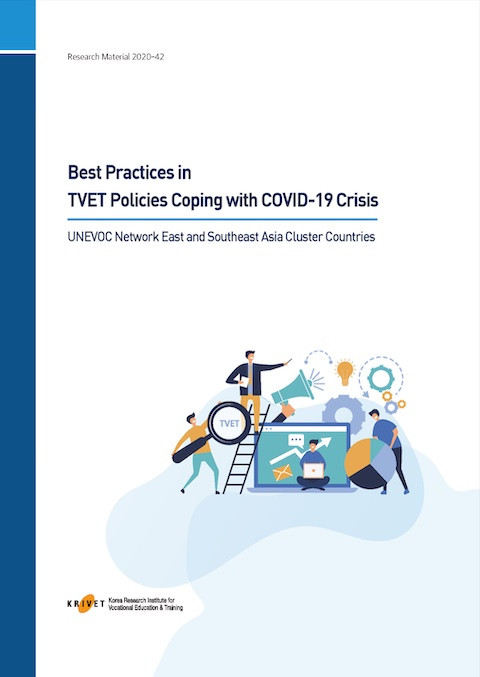 Best Practices in TVET Policies Coping with COVID-19 Crisis: UNEVOC Network East and Southeast Asia Cluster Countries Year of publication: 2020 Author: Jihee Choi | Hanbyul Lee | Kunjoo Lim | Hyunsik Choi | Jongtaek Han Corporate author: UNESCO International Centre for Technical and Vocational Education and Training (UNEVOC) | Korea Research Institute for Vocational Education and Training (KRIVET) This book presents the best practices with regard to TVET policies to cope with COVID-19 crisis. It includes 8 cases of manuscripts from 6 countries in total. The topics covered range from the national TVET policies responding to COVID-19 crisis to open and digital learning, migrant female workers, and TVET strategies to deal with youth unemployment. UNESCO-UNEVOC 동아시아 동남아시아 클러스터: TVET 정책 우수사례집 Year of publication: 2020 Author: 최지희 | 이한별 | 임건주 | 최현식 | 한종택 Corporate author: UNESCO International Centre for Technical and Vocational Education and Training (UNEVOC) | 한국직업능력개발원 본 자료는 COVID-19시대에 대응하는 국가전략에 관한 동남아지역 우수사례를 소개하고 있다. 총 6개국의 8개 사례를 포함하고 있으며, COVID-19에 대한 TVET의 대응에서 원격 및 디지털 학습, 청년실업, 이주 여성 근로자 문제 등 다양한 주제에 대해 각국의 정책까지 다양한 사례를 다루고 있다. 본 저작물은 ‘한국직업능력연구원’에서 ‘2020’년 작성하여 공공누리 4유형으로 개방한 ‘ UNESCO-UNEVOC 동아시아 동남아시아 클러스터: TVET 정책 우수사례집 (작성자: 최지희; 이한별; 임건주; 최현식; 한종택) ’을 이용하였으며, 해당 저작물은 ‘한국직업능력연구원(www.krivet.re.kr)’에서 무료로 다운받으실 수 있습니다.
  Responding to Covid-19: Online Classes in Korea - A Challenge Toward the Future of Education Year of publication: 2020 Corporate author: Korea R. Ministry of Education Korea is effectively responding to the outbreak of COVID-19 by adopting a whole-of-government approach, under the leadership of the Central Disaster and Safety Countermeasures Headquarters to prevent and contain the pandemic with the principle of “openness, transparency and democratic process.” The nationwide introduction of the online classes to respond to COVID-19 was a huge challenge and a path that we have never trodden before. The Ministry of Education of the Republic of Korea introduced Korean education with the world in response to COVID-19 and shared experiences and challenges of distance learning and online education. COVID-19 is a universal challenge which requires joint response, and the global community should be committed to strong solidarity and close cooperation to overcome this crisis and take a leap forward to a brighter future. 코로나19 대응: 한국의 온라인개학 - 미래교육을 위한 도전 Year of publication: 2020 Corporate author: Korea R. Ministry of Education 대한민국 교육부가 한국의 온라인 개학을 통한 교육분야의 코로나19 대응을 해외에 소개하고 경험을 공유하기 위해 발간한 자료로 원격교육과 온라인 교육의 사례와 미래교육이 당면한 도전과제에 대해서 다루고 있다. 코로나19는 세계가 함께 극복해 나가야 할 공동 과제로서 모든 국가가 상호 연대와 협력을 통해 난관을 극복하고 도약할 수 있을 것이라고 전망한다.