
Resources
Explore a wide range of valuable resources on GCED to deepen your understanding and enhance your research, advocacy, teaching, and learning.
22 Results found
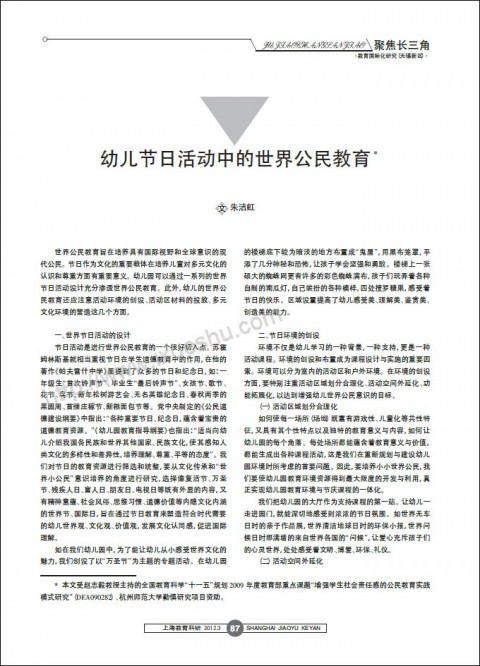 Global Citizenship Education in Children's Festivals Year of publication: 2012 Author: zhu jiehong Global citizenship education aims at cultivating modern citizens with an international outlook and global awareness. As an important carrier of culture, festivals play an important role in cultivating children's understanding and respect for multiculturalism. Kindergarten can fully pass the idea of global citizenship education through a series of world festival activities. In addition, global citizenship education of young children should pay attention to the creation of the activity environment, the use of materials in the activity area, and the creation of a multicultural environment. 幼儿节日活动中的世界公民教育 Year of publication: 2012 Author: zhu jiehong 世界公民教育旨在培养具有国际视野和全球意识的现代公民。节日作为文化的重要载体在培养儿童对多元文化的认识和尊重方面有重要意义。幼儿园可以通过一系列的世界节日活动设计充分渗透世界公民教育。此外,幼儿的世界公民教育还应注意活动环境的创设、活动区材料的投放、多元文化环境的营造这几个方面。
  World Development Report 2018 and Its Policy Implications for Education Development in China Year of publication: 2018 Author: Liu Ji 2018 comprehensively describes a crisis that is looming worldwide: Schooling does not equalize learning. Drawing on key insights from the report, this study provides a high—level summary and relates the findings to common and critical issues that China is today. Specifically, this study highlights five important policy implications for education development in China: Education quality monitoring, adaptive policies, evidence-based decision, expanding human capital investments, and building stronger ties with international organizations. 如何应对全球学习危机——世界银行((2018世界发展报告》述评 Year of publication: 2018 Author: Liu Ji 作为世界银行最重要的旗舰报告,《世界发展报告》四十年来首次以教育为题,深入探讨如何应对全球学习危机、提高教育质量、优化人力资本结构、应对人类发展重要难题。从政策理念上看,世行教育策略的革新代表着世行在人力资本政策上较大的方向性改变:由关注教育投入转向教育产出和学习结果。同时,《2018世界发展报告》总结了适用于各教育阶段的大量实证研究和国际成功政策经验,对全球教育政策具有风向标的重要意义、对我国发展新时期的教育与人才策略有积极启示。本文通过对报告结论详细梳理,结合我国国情提出五点政策建议。
 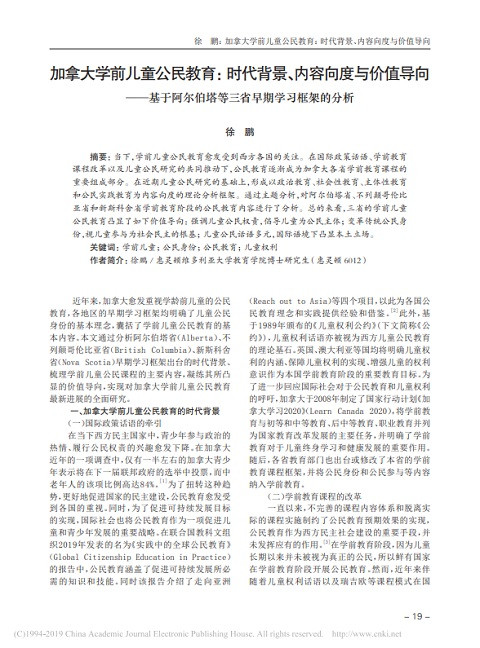 Young Children’s Citizenship Education in Canada: Background, Content and Values; Based on the Analysis of Early Learning Guidelines in Alberta, British Columbia and Nova Scotia Year of publication: 2019 Author: Xu Peng Corporate author: Primary and Secondary Education in Foreign Countries Citizenship education for young children has been growingly emphasized by western countries. With the influence of global policy discourses, curriculum reform in early childhood education and studies of young children’s citizenship, citizenship education has become a key aspect in Canadian early childhood curriculum. Based on recent studies, this research forms a theoretical framework for citizenship education, which covers four dimensions of citizenship (political education, social education, subjectivity education and civic practice education). The early learning frameworks in Alberta, British Columbia and Nova Scotia are analyzed through thematic analysis. In general, citizenship education for young children in these three provinces reveal the following features: emphasizing young children’s rights and responsibilities, and advocating young children’s subject positions as citizens; the traditional citizenship is being changed and young children’s participation is highlighted as the root of democracy; young children’s citizenship lies in multiple discursive fields with indigenous perspective emerging. 加拿大学前儿童公民教育: 时代背景、内容向度与价值导向; 基于阿尔伯塔等三省早期学习框架的分析 Year of publication: 2019 Author: Xu Peng Corporate author: Primary and Secondary Education in Foreign Countries 当下,学前儿童公民教育愈发受到西方各国的关注。在国际政策话语、学前教育 课程改革以及儿童公民研究的共同推动下,公民教育逐渐成为加拿大各省学前教育课程的 重要组成部分。在近期儿童公民研究的基础上,形成以政治教育、社会性教育、主体性教育 和公民实践教育为内容向度的理论分析框架。通过主题分析,对阿尔伯塔省、不列颠哥伦比 亚省和新斯科舍省学前教育阶段的公民教育内容进行了分析。总的来看,三省的学前儿童 公民教育凸显了如下价值导向:强调儿童公民权责,倡导儿童为公民主体;变革传统公民身 份,视儿童参与为社会民主的根基;儿童公民话语多元,国际语境下凸显本土立场。
 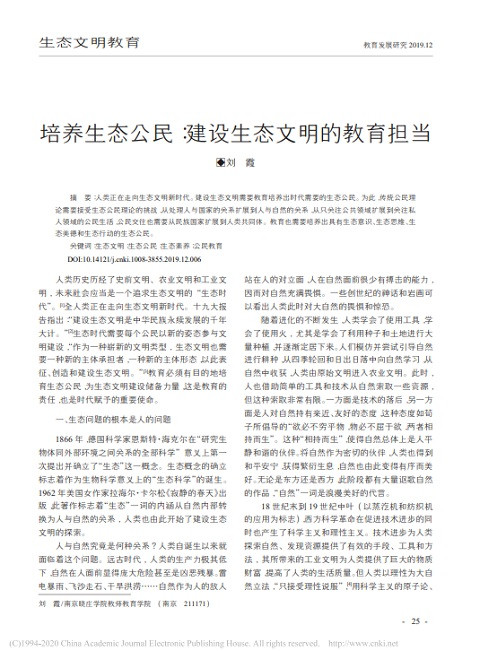 Cultivating Ecological Citizens: Education for Building Ecological Civilization (Research in Educational Development; No. 12) Year of publication: 2019 Author: Liu Xia Corporate author: Shanghai Academy of Educational Sciences | Shanghai Higher Education Mankind is heading for a new era of ecological civilization. The construction of ecological civilization requires education to cultivate the ecological citizens of the times. This requires the traditional citizenship theory to accept the challenge of Eco-Citizenship theory, from dealing with the relationship between people and the state to the relationship between man and nature, from focusing only on the public sphere to the private sphere of citizen life, citizen exchanges also need to expand from the nation-state to the human community. Education needs to cultivate eco-citizens with ecological awareness, ecological thinking, ecological virtues, and ecological action with ecological literacy. 培养生态公民:建设生态文明的教育担当 (生态文明教育; No. 12) Year of publication: 2019 Author: Liu Xia Corporate author: Shanghai Academy of Educational Sciences | Shanghai Higher Education 人类正在走向生态文明新时代。建设生态文明需要教育培养出时代需要的生态公民。为此,传统公民理 论需要接受生态公民理论的挑战,从处理人与国家的关系扩展到人与自然的关系,从只关注公共领域扩展到关注私 人领域的公民生活,公民交往也需要从民族国家扩展到人类共同体。教育也需要培养出具有生态意识、生态思维、生 态美德和生态行动的生态公民。
  The International Experience and Enlightenment of Global Citizenship Education In the New Century (Journal of Shanghai Education Research) Year of publication: 2019 Author: Wuxi | Thomas Tse Corporate author: Shanghai Educational Research Since the beginning of the new century, international or regional organizations such as UNESCO and Oxfam have been actively carrying out teaching practices related to global citizenship education, highlighting similar orientation characteristics and providing important reference value for the implementation of global citizenship education in formal education. They emphasize cognition, skill, value and action as the training direction, take diversity, criticalness and action as the core topic, learn objective from simple description to critical analysis, and take integrated systematic teaching as the main practice mode. 新世纪以来全球公民教育的国际经验与启示 (上海教育科研) Year of publication: 2019 Author: Wuxi | Thomas Tse Corporate author: Shanghai Educational Research 新世纪以来,联合国教科文组织、乐施会等国际或地区组织正在积极开展有关全球公民 教育的教学实践,突显出相似的取向特征,对全球公民教育在正式教育中的实施具有重要借鉴价值。它 们强调以认知、技能、价值与行动为培养方向,以多样性、批判性和行动力为核心议题,学习目标从简单 描述向批判性分析进阶,并以全校融合的系统化教学为主要实践模式。