
Resources
Explore a wide range of valuable resources on GCED to deepen your understanding and enhance your research, advocacy, teaching, and learning.
14 Results found
 Digital Empowerment of Girls Year of publication: 2018 Corporate author: Plan International Despite the accumulated efforts and commitments of the past 20 years, today’s women and girls continue to face gender-based barriers that prevent them from accessing and utilising technology and digital tools at the same level as boys and men.Girls are 5 times less likely to consider a career in tech than boys.Equality of education is essential to redress the digital gender gap – which is sadly growing – but it’s not the only method.We must make tech safe, affordable and accessible to girls – wherever they live. We must tackle the ingrained gender norms that prevent girls from seeing digital roles as accessible career paths.Rather than making assumptions about what girls want and need from technology, we must work with them to create solutions for the issues that affect them by enabling them to learn digital skills.Technology can be a powerful tool for girls’ voices to become even louder and reach even further.This briefing paper provides recommendations for closing the digital gender gap that will enable girls to participate in and contribute to our increasingly digital future.Despite the accumulated efforts and commitments of the past 20 years, today’s women and girls continue to face gender-based barriers that prevent them from accessing and utilising technology and digital tools at the same level as boys and men.Promoting girls’ digital literacy and closing the digital gender gap will play an important role in achieving gender equality and promoting the rights of girls and women worldwide.Plan International strives to build a world in which girls have the tools and the power to shape their own futures and influence decision making and policy processes at local and global levels. Technology is not a prerequisite for being a change agent or a leader, but it can be a powerful tool for girls’ voices to become even louder and reach even further. Similarly, social media can be used as a vehicle to spread inspirational stories of female leaders and connect activists and changemakers across the world.Digital technologies have a strong potential to empower girls and women economically and socially. Girls feel safer and more connected when they have a mobile phone, and they use mobile phones to save time and money and access educational opportunities. Yet girls and women are, on average, less likely than men to own a mobile phone, use mobile data, social media apps or SMS. There is also a stark gender disparity in access to the Internet, which limits the ability of girls and women to benefit from many innovations of the digital economy, such as digital payments and mobile money. The gender disparity in access to technology is compounded by a significant gender divide in terms of career and academic aspirations related to ICTs.Advancing digital equality for girlsThis briefing paper argues that promoting girls’ digital literacy and closing the digital gender gap will play an important role in achieving gender equality and promoting the rights of girls and women worldwide. Indeed, bridging the digital gender divide is essential in ensuring girls and women are not left behind in an increasingly digital future.The paper also argues that actions promoting girls’ digital empowerment should be guided by the principle of engaging girls and women as active, capable partners in our work, not merely passive recipients or targets. Rather than making assumptions about what girls want and need from technology, it is important to work together with girls to strengthen and develop their use and creation of technology and digital tools.
  Reimagining Climate Education and Youth Leadership: Survey Report Year of publication: 2021 Author: Lucia Rost | Jessica Cooke | Isobel Fergus Corporate author: Plan International Climate change is a social, intergenerational, gender, and racial injustice. Plan International aims to support children and youth to meaningfully and safely engage in climate policy processes and to reduce the barriers preventing them from engaging in and influencing climate policy and advocacy.With this in mind, Plan International conducted a global online survey to capture the opinions and experiences of young people on climate change education and their participation in climate policy processes. The survey was available in seven languages and was open to 15 to 24-year- olds in all 77 countries where Plan International operates. Over 1,800 adolescents and youth, between the ages of 15 to 24, from 37 countries, participated: more than half (54 per cent) were 15 to 18 years old and 72 per cent were girls. Reimagining Climate Education and Youth Leadership: Survey Report Year of publication: 2021 Author: Lucia Rost | Jessica Cooke | Isobel Fergus Corporate author: Plan International El cambio climático es una injusticia social, intergeneracional, racial y de género. Plan International tiene como objetivo ayudar a las niñas, niños y jóvenes a involucrarse de manera significativa y segura en los procesos de formulación de políticas climáticas, así como eliminar los obstáculos que les impiden participar e influir en las políticas y las actividades de promoción relacionadas con el cambio climático. Plan International realizó una encuesta on line a nivel mundial para recopilar las opiniones y las experiencias de jóvenes sobre la educación en materia de cambio climático y su participación en los procesos de formulación de políticas climáticas. La encuesta se ofreció en siete idiomas y estuvo abierta a jóvenes de 15 a 24 años en los 77 países donde trabaja Plan International. En esta encuesta, participaron más de 1800 adolescentes y jóvenes, con edades comprendidas entre los 15 y los 24 años, y procedentes de 37 países: más de la mitad de las personas (54 %) tenían entre 15 y 18 años, y el 72 % eran niñas. Réinventer l’éducation au climat et le leadership des jeunes : Rapport d’enquête Year of publication: 2021 Author: Lucia Rost | Jessica Cooke | Isobel Fergus Corporate author: Plan International Le changement climatique est une injustice sociale, intergénérationnelle, de genre et raciale. Plan International vise à aider les enfants et les jeunes à participer de manière significative et en toute sécurité aux processus de politique climatique et à réduire les obstacles qui les empêchent de participer et d’influencer la politique et le plaidoyer climatiques.Dans ce cadre, Plan International a mené une enquête mondiale en ligne pour recueillir les opinions et les expériences des jeunes sur l’éducation au changement climatique et leur participation aux processus politiques climatiques. L’enquête était disponible en sept langues et était ouverte aux jeunes de 15 à 24 ans dans les 77 pays où Plan International intervient. Plus de 1800 adolescent.e.s et jeunes, âgés de 15 à 24 ans, originaires de 37 pays, y ont participé : plus de la moitié (54 %) avaient entre 15 et 18 ans et 72 % étaient des filles.
  HARNESSING THE POWER OF DATA FOR GENDER EQUALITY: Introducing the 2019 EM2030 SDG Gender Index Year of publication: 2019 Corporate author: Equal Measures 2030 In the 2019 Global Report “Harnessing the power of data for gender equality: Introducing the 2019 EM2030 SDG Gender Index”, the Equal Measures 2030 (EM2030) introduces the 2019 SDG Gender Index. The index is a comprehensive tool available to explore the state of gender equality across 129 countries (covering 95% of the world’s girls and women), 14 of the 17 Sustainable Development Goals (SDGs), and 51 targets linked to issues inherent in the SDGs. The 2019 SDG Gender Index finds that, with just 11 years to go until 2030, nearly 40% of the world’s girls and women – 1.4 billion – live in countries failing on gender equality. Another 1.4 billion live in countries that “barely pass”. Even the highest-scoring countries have more to do, particularly on complex issues such as climate change, gender budgeting and public services, equal representation in powerful positions, gender pay gaps, and gender-based violence. No country in the world has reached the “last mile” on gender equality. 2019 Global Report overview: Section 1: A foreword from Equal Measures 2030’s partners: The African Women’s Development and Communication Network (FEMNET), The Asian-Pacific Resource & Research Centre for Women (ARROW), Bill & Melinda Gates Foundation, the Committee for Latin America and the Caribbean for the Defense of Women’s Rights (CLADEM), Data2X, International Women’s Health Coalition (IWHC), KPMG, ONE Campaign, Plan International, Women Deliver. Section 2: Key findings from the 2019 SDG Gender Index. Section 3: Introducing the 2019 SDG Gender Index, the approach, what makes this index unique and how the findings should be interpreted. Section 4: Key global findings, patterns and comparisons of index scores between and within the different regions: Asia and the Pacific, Europe and North America, Latin America and the Caribbean, the Middle East and North Africa, Sub-Saharan Africa. Section 5: Regional overviews of index scores and gender equality context, and thematic deep drives on 1) inequalities in girls’ education, 2) women in science and technology research positions, 3) girls’ and women’s physical safety, 4) legal barriers for women, 5) women in government. Section 6: Leaving no one behind: multiple and intersecting forms of discrimination of girls and women. Section 7: Recommendations for action.
  [Technical Report] Climate Change and Girls' Education: Barriers, Gender Norms and Pathways to Resilience Year of publication: 2023 Corporate author: Plan International This is the technical report of the Climate Change and Girls' Education: Barriers, Gender Norms and Pathways to Resilience for further detail on the findings and research itself. [Rapport technique] Changement climatique et éducation des filles: entraves, normes sexistes et chemins vers la resilience Year of publication: 2023 Corporate author: Plan International This is the technical report of the Climate Change and Girls' Education: Barriers, Gender Norms and Pathways to Resilience for further detail on the findings and research itself. [Reporte técnico] Cambio climático y educación de las niñas: barreras, normas de género, y rutas hacia la resiliencia Year of publication: 2023 Corporate author: Plan International This is the technical report of the Climate Change and Girls' Education: Barriers, Gender Norms and Pathways to Resilience for further detail on the findings and research itself.
 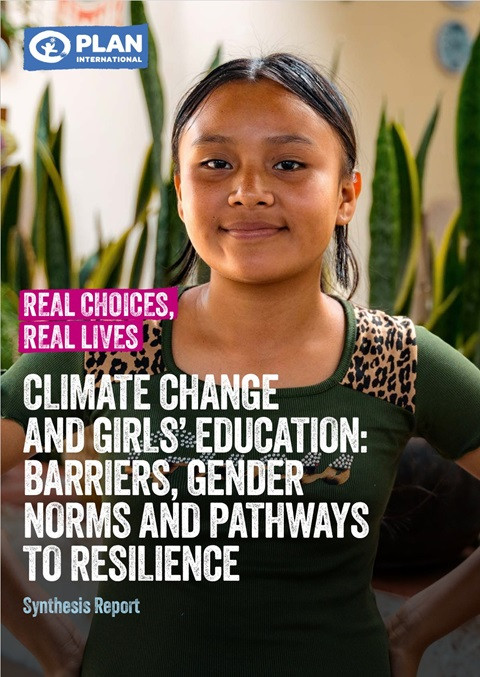 [Synthesis Report] Climate Change and Girls' Education: Barriers, Gender Norms and Pathways to Resilience Year of publication: 2023 Corporate author: Plan International This research explores the relationship between climate change and girls' education: what are the direct and indirect impacts of climate change on girls' access to school and completion of their education? How do these impacts intersect with existing gender barriers to education? And how does your education help girls respond and adapt to climate change in their communities? A synthesis report and summary are also available, along with the technical report for more details on the conclusions and the research itself. [Rapport de synthèse] Changement climatique et éducation des filles: entraves, normes sexistes et chemins vers la resilience Year of publication: 2023 Corporate author: Plan International This research explores the relationship between climate change and girls' education: what are the direct and indirect impacts of climate change on girls' access to school and completion of their education? How do these impacts intersect with existing gender barriers to education? And how does your education help girls respond and adapt to climate change in their communities? A synthesis report and summary are also available, along with the technical report for more details on the conclusions and the research itself.