
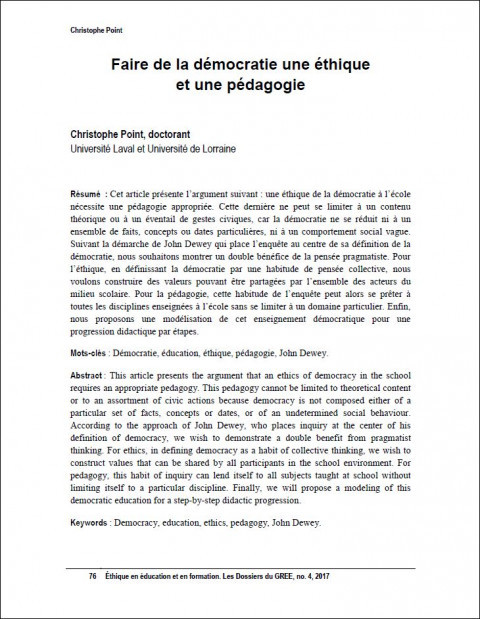
Making Democracy an Ethic and a Pedagogy
- Autor
- Christophe Point
- Autor Corporativo
- Éthique en éducation et en formation
- ISBN
- ISSN 2561-1488
- Colección
- p. 76-91
- Idioma del recurso
- francés
- Año de publicación
- 2017
- Nivel de Educación
- Educación primariaEducación secundariaEducación superior
- Región
- Europa y América del Norte
- Lugar de publicación
- Montréal
This article presents the argument that an ethics of democracy in the school requires an appropriate pedagogy. This pedagogy cannot be limited to theoretical content or to an assortment of civic actions because democracy is not composed either of a particular set of facts, concepts or dates, or of an undetermined social behaviour. According to the approach of John Dewey, who places inquiry at the center of his definition of democracy, we wish to demonstrate a double benefit from pragmatist thinking. For ethics, in defining democracy as a habit of collective thinking, we wish to construct values that can be shared by all participants in the school environment. For pedagogy, this habit of inquiry can lend itself to all subjects taught at school without limiting itself to a particular discipline. Finally, we will propose a modeling of this democratic education for a step-by-step didactic progression.
Recursos Relacionados
-
 IIEP-UNESCO 12th Medium-Term Strategy: 2026–2029
 -
 Advancing Intergenerational Learning: Identifying Challenges and Opportunities for Older Adults; Integrated Case Study Report
 -
 Digital Empowerment for Lifelong Learning and Transformative Andragogy (DELTA) for Adult Educators: Introduction to the DELTA Framework and Resources
 -
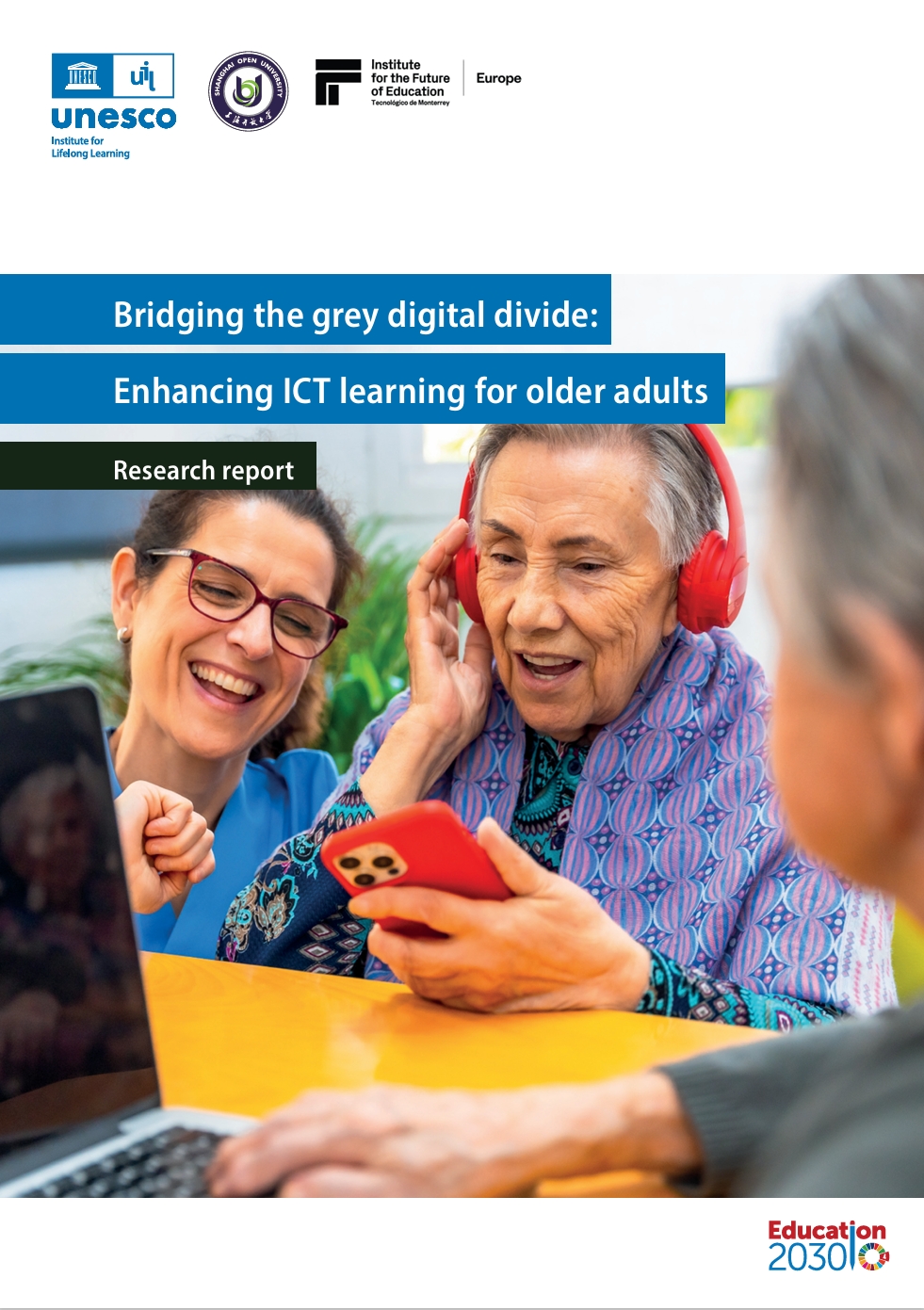 Bridging the Grey Digital Divide: Enhancing ICT Learning for Older Adults; Research Report