
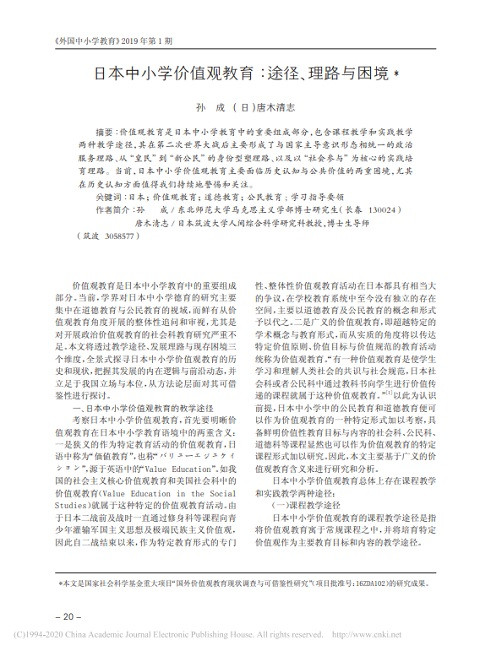
Values Education in Primary and Secondary School of Japan: Approach, Orderliness and Dilemma (Primary & Secondary Schooling Abroad; No. 1)
- Autor
- Sun ChengKaraki Kiyoshi
- Autor Corporativo
- Shanghai Normal University
- ISBN
- ISSN 1007-8495
- Colección
- p. 20-29
- Idioma del recurso
- chino
- Año de publicación
- 2019
- Tipo de Recurso
- Research papers / journal articles
- Nivel de Educación
- Educación primariaEducación secundaria
- Región
- Asia y el Pacífico
- Lugar de publicación
- Shanghai
Values education is an important part of primary and secondary education in Japan. It has two teaching approaches: curriculum teaching and practical teaching. After the Second World War, it has formed a political service orderliness which is unified with the national dominant ideology, a cultivating orderliness which is from the “Imperial People” to the “New Citizen”, a practical orderliness which is developing around the “Social Participation”. At present, Japan’s values education in primary and secondary schools mainly faces the dual dilemma of historical cognition and public value, especially in the aspect of historical cognition, which deserves our constant vigilance and attention.
Recursos Relacionados
-
 IIEP-UNESCO 12th Medium-Term Strategy: 2026–2029
 -
 Advancing Intergenerational Learning: Identifying Challenges and Opportunities for Older Adults; Integrated Case Study Report
 -
 Digital Empowerment for Lifelong Learning and Transformative Andragogy (DELTA) for Adult Educators: Introduction to the DELTA Framework and Resources
 -
 Bridging the Grey Digital Divide: Enhancing ICT Learning for Older Adults; Research Report