
Recursos
Exploren una amplia gama de recursos valiosos en GCED para profundizar su comprensión y promover su búsqueda, incidencia, enseñanza y aprendizaje.
21 resultados encontrados
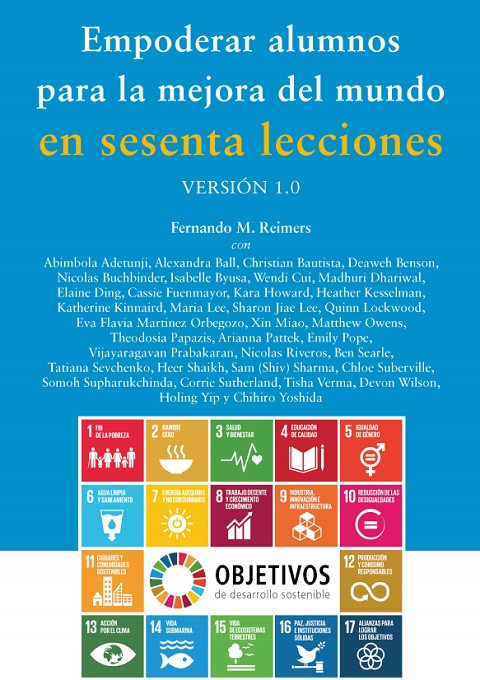 Empoderar alumnos para la mejora del mundo en 60 lecciones: versión 1.0 Año de publicación: 2017 Autor: Fernando Reimers Autor corporativo: Centro de Cooperación Regional para la Educación de Adultos en América Latina y el Caribe (CREFAL) En este libro se presentan herramientas para crear y adaptar currículos de Educación para la Ciudadanía Global, así como u prototipo de 60 lecciones para todos los grados, desde primero hasta 12.
  Schooling Disrupted, Schooling Rethought: How the Covid-19 Pandemic is Changing Education Año de publicación: 2020 Autor: Fernando Reimers | Andreas Schleicher Autor corporativo: Organisation for Economic Co-operation and Development (OECD) This report looks at how the Covid-19 pandemic is changing education and is based on a survey conducted between 25 April and 7 May 2020 that received responses from government officials, education administrators, teachers, and school administrators in 59 countries.
  Audacious Education Purposes: How Governments Transform the Goals of Education Systems Año de publicación: 2020 Autor: Fernando Reimers This open access book offers a comparative study of eight ambitious national reforms that sought to create opportunities for students to gain the necessary breath of skills to thrive in a rapidly changing world. It examines how national governments transform education systems to provide students opportunities to develop such skills. It analyses comprehensive education reforms in Brazil, Finland, Japan, Mexico, Peru, Poland, Portugal and Russia and yields original and important insights on the process of educational change. The analysis of these 21st century skills reforms shows that reformers followed approaches which are based on the five perspectives: cultural, psychological, professional, institutional and political. Most reforms relied on institutional and political perspectives. They highlight the systemic nature of the process of educational change, and the need for alignment and coherence among the various elements of the system in order. They underscore the importance of addressing the interests of various stakeholders of the education system in obtaining the necessary impetus to initiate and sustain change. In contrast, as the book shows, the use of a cultural and psychological frame proved rarer, missing important opportunities to draw on systematic analysis of emerging demands for schools and on cognitive science to inform the changes in the organization of instruction. Drawing on a rich array of sources and evidence the book provides a careful account of how education reform works in practice.
  A Framework to Guide an Education Response to the COVID-19 Pandemic of 2020 Año de publicación: 2020 Autor: Fernando Reimers | Andreas Schleicher Autor corporativo: Organisation for Economic Co-operation and Development (OECD) This report aims at supporting education decision making to develop and implement effective education responses to the COVID-19 Pandemic. The report explains why the necessary social isolation measures will disrupt school-based education for several months in most countries around the world. Absent an intentional and effective strategy to protect opportunity to learn during this period, this disruption will cause severe learning losses for students.The report proposes that leaders of education systems and organizations develop plans for the continuation of education through alternate modalities, during the period of necessary social isolation. It offers a framework of areas to be covered by such plans. Un cadre pour guider une réponse éducative à la Covid-19 en cas de pandémie de 2020 Año de publicación: 2020 Autor: Fernando Reimers | Andreas Schleicher Autor corporativo: Organisation for Economic Co-operation and Development (OECD) Ce rapport vise à appuyer la décision de l'éducation faisant de développer et mettre en œuvre des réponses éducatives efficaces au Covid-19 en cas de pandémie. Le rapport explique pourquoi les mesures d'isolement social nécessaires perturberont l'éducation en milieu scolaire pendant plusieurs mois dans la plupart des pays à travers le monde. En l'absence d'une stratégie délibérée et efficace pour protéger l'occasion d'apprendre au cours de cette période, cette perturbation entraîne des pertes sévères d'apprentissage pour les étudiants.Le rapport propose que les dirigeants des systèmes d'éducation et les organisations à élaborer des plans pour la poursuite de l'éducation des modalités alternatives, au cours de la période d'isolement social nécessaire. Il offre un cadre de zones à couvrir par ces plans.
  Empowering Teachers to Build a Better World: How Six Nations Support Teachers for 21st Century Education; Springer Briefs in Education Año de publicación: 2020 Autor: Fernando Reimers This open access book presents a comparative study on how large-scale professional development programs for teachers are designed and implemented. Around the world, governments and educators are recognizing the need to educate students in a broad range of higher order cognitive skills and socio-emotional competencies, and providing effective opportunities for teachers to develop the expertise needed to teach these skills is a crucial aspect of effective implementation of curricula which include those goals. This study examines how large-scale efforts to empower teachers for deeper instruction have been designed, how they have been implemented, and their outcomes. To do so, it investigates six programs from England, Colombia, Mexico, India, and the United States. Though all six are intended to broaden and deepen students’ curricular aspirations, each takes this expansion of curricular goals in a different direction.The ambitious education reforms studied here explicitly focus on building teachers’ capacity to teach on a broader set of goals. Through a discerning analysis of program documents, evaluations, and interviews with senior leaders and participants in the programs, the book identifies the various theories of action used in these programs, examines how they were implemented, and discusses what they achieved. As such, it offers an indispensable resource for education leaders interested in designing and implementing professional development programs for teachers that are aligned with ambitious instructional goals.
  [Summary] Teaching and Learning for the Twenty-first Century: Educational Goals, Policies, and Curricula From Six Nations Año de publicación: 2016 Autor: Fernando Reimers | Connie K. Chung Autor corporativo: Global Education Innovation Initiative The book aims to foster discussions on how national education policies support students to prepare for life, work and civic participation in the 21st century. It examines six countries—Chile, China, India, Mexico, Singapore, and the United States—exploring how each one defines, supports, and cultivates those competencies that students will need in order to succeed in the current century. [Resumen] Enseñanza y aprendizaje en el siglo XXI : Metas, políticas educativas y currículo en seis países Año de publicación: 2016 Autor: Fernando Reimers | Connie K. Chung Autor corporativo: Global Education Innovation Initiative Este libro pretende promover discusiones sobre cómo las políticas educativas nacionales ayudan a los estudiantes a prepararse para la vida, el trabajo y la participación ciudadana en el siglo XXI. Revisa además cómo los objetivos educativos, los retos y las oportunidades que se perciben, reflejan los contextos histórico, político, y cultural de los sistemas educativos, los cuales a su vez varían en tamaño, mecanismos de gobernanza y condiciones demográficas, entre otros factores.
  Supporting the Continuation of Teaching and Learning during the COVID-19 Pandemic: Annotated Resources for Online Learning Año de publicación: 2020 Autor: Fernando Reimers | Andreas Schleicher | Jaime Saavedra | Saku Tuominen Autor corporativo: Organisation for Economic Co-operation and Development (OECD) | Global Education Innovation Initiative | HundrED This resource discusses the second module of a series which presents the results of a comparative analysis of emerging educational needs and responses as the pandemic unfolds across countries around the world. The overall goal of this series is to facilitate the rapid design process and implementation of adaptive responses to the emerging education challenges, and to protect young people’s educational opportunities during and following the pandemic. This second module presents a first set of online educational resources to support the continuity of teaching and learning during the 2019-20 COVID-19 Pandemic with education leaders around the world. The resources were compiled from responses to the same survey used to produce the first module: A framework to guide an education response to the COVID-19 Pandemic, and additional online sources were included to enhance the list in order to support the continuity of learning for students who have access to the internet and digital devices.
  Empowering Global Citizens: A World Course Año de publicación: 2016 Autor: Fernando Reimers | Vidur Chopra | Connie K. Chung | Julia Higdon | E. B. O'Donnell The world is changing rapidly and shcools must evolve to prepare young people to invent the future. Reinventing education requires thinking anew about how to help students develop competencies that will empower them as architects of their own lives and contributing members of their communities. Drawing on a synthesis of research and practice in global citizenship education, this book presents The World Course - a rigorous and coherent curriculum to foster student agency, empathy, and deep knowledge and skills to recognize the biggest global challenges and opportunities of our times, and to advance sustainability, human rights, and peace. Integrating current thinking on twenty-first-centry competencies and deeper learning, and deploying pedagogies that cultivate student responsibility, imagination, and creativity, such as project-based learning and design thinking, this book is a blueprint to reinvent education to empower global citizens.