
Recursos
Exploren una amplia gama de recursos valiosos en GCED para profundizar su comprensión y promover su búsqueda, incidencia, enseñanza y aprendizaje.
8 resultados encontrados
 Curricular guidelines and citizenship attitudes in Latin American students: a comparative analysis Año de publicación: 2015 Autor: Martín Bascopé | Macarena Bonhomme | Cristián Cox | Juan Carlos Castillo | Daniel Miranda Autor corporativo: Revista Latinoamericana de Ciencias Sociales, Niñez y Juventud Curricular guidelines have become progressively relevant for educating future active citizens. In such a context, it becomes crucial to explore the relationship between the curricular guidelines and how citizenship education is currently acquired by students in Latin American countries. Therefore, the aim of this paper is to comparatively evaluate the institutional view of citizenship expressed in each curriculum and students’ attitudes on civic issues. The exploratory factor analysis and curricular descriptive statistical analysis are based in two valuable and complementary sources, respectively: The Latin American module of the International Civic and Citizenship Study (ICCS) and the Regional System of Citizenship Skills (Sredecc). By making a systematic comparison of both sources, this study reveals that several curricular aspects are consistent with students’ citizenship attitudes and beliefs, and suggests some guidelines for improving and expanding citizenship education in Latin America, considering the importance of education for the formation of an active citizenship. Directives curriculaires et les attitudes de citoyenneté chez les étudiants latino-américains: une analyse comparative Año de publicación: 2015 Autor: Martín Bascopé | Macarena Bonhomme | Cristián Cox | Juan Carlos Castillo | Daniel Miranda Autor corporativo: Revista Latinoamericana de Ciencias Sociales, Niñez y Juventud Les directives curriculaires sont devenues progressivement pertinentes pour la formation des futurs citoyens actifs. Dans un tel contexte, il devient crucial d'explorer la relation entre les directives sur les programmes et la façon dont l'éducation à la citoyenneté est actuellement acquise par les étudiants dans les pays d'Amérique latine. Par conséquent, le but de cet article est d'évaluer comparativement la vision institutionnelle de la citoyenneté exprimée dans chaque programme et les attitudes des élèves sur les questions civiques. L'analyse factorielle exploratoire et l'analyse statistique descriptive scolaires reposent sur deux sources précieuses et complémentaires, respectivement: Le module latino-américain de l'Étude Internationale Civique et la Citoyenneté (EICC) et le Système Régional de la Citoyenneté des Compétences. En faisant une comparaison systématique des deux sources, cette étude révèle que plusieurs aspects scolaires sont compatibles avec les attitudes et les croyances de la citoyenneté des élèves, et suggère quelques lignes directrices pour l'amélioration et l'expansion de l'éducation à la citoyenneté en Amérique latine, compte tenu de l'importance de l'éducation pour la formation d'un la citoyenneté active. National curricular guidelines and citizenship education in schools in Latin American countries Año de publicación: 2013 Autor: Martín Bascopé | Macarena Bonhomme | Cristián Cox | Juan Carlos Castillo | Daniel Miranda Autor corporativo: Centro de Estudios de Políticas y Prácticas en Educación (CEPPE) The aim of this study is to contrast two different sources of information regarding citizenship education in Latin America: curricular guidelines, and students’ civic attitudes and practices. When analyzing curricular guidelines, we consider the official national documents of the respective Ministries of Education, whereas regarding civic practices and attitudes, we analyze the results of the 2009 ICCS study. By using quantitative methods, we contrast the curricular emphasis and students’ results for each of the six countries considered. Our findings show that several curricular absences are associated with students’ low achievement in civic and citizenship knowledge and attitudes. Therefore, these results provide some guidelines for improving the official curricular documents and developing more empirical research on less-covered civic topics. Finally we encourage further research on classroom practices, especially on the topics highlighted in this research, such as authoritarianism, peaceful coexistence, national and regional identity, and accountability. Inside classroom research is very important to have a complete view of civic/citizenship curricular guidelines and practices, considering the limitations implied by looking at the intended curriculum (official documents) rather than the one implemented. Citizenship education in Latin America: priorities of school curricula (IBE working papers on curriculum issues no. 14) Año de publicación: 2014 Autor: Cristián Cox | Martín Bascopé | Juan Carlos Castillo | Daniel Miranda | Macarena Bonhomme Autor corporativo: UNESCO International Bureau of Education (IBE) This work focuses on the curricula of six Latin American countries – Colombia, Chile, the Dominican Republic, Guatemala, Mexico and Paraguay – which at the close of the past decade agreed to be part of the project Regional System of Evaluation and Development of Citizenship Competencies (SREDECC). With the support of the Inter-American Development Bank, SREDECC developed the Latin American module of the International Civic and Citizenship Study (ICCS- 2009) undertaken by the International Association for the Evaluation of Educational Achievement (IEA), in addition to encouraging the participation of the countries in that study (Cox 2010; Schulz, Ainley, Friedman and Lietz 2011).This document comprises four parts. The first section takes stock of the state of democratic belief in the region, drawing upon the most significant opinion studies of the past decade, so as to offer broader meaning bases for curriculum analysis and, more generally, for educational work in the field of citizenship. The second section describes the organizational (or structural) characteristics of the curricula of the six countries and presents a framework of categories for their comparative analysis. The subsequent section describes and analyses the contents of the six curricula examined and how they deal with the values, institutions and citizenship relations in their civic (political) and civil (coexistence) dimensions. On the basis of the most significant findings, the closing section includes some reflections regarding curriculum development with regard to citizenship. Éducation à la Citoyenneté en Amérique latine: les priorités de programmes scolaires(BIE papiers de travail sur les questions de curriculum no.14) Año de publicación: 2014 Autor: Cristián Cox | Martín Bascopé | Juan Carlos Castillo | Daniel Miranda | Macarena Bonhomme Autor corporativo: UNESCO International Bureau of Education (IBE) Ce travail se concentre sur les programmes de six pays d'Amérique latine - Colombie, le Chili, la République dominicaine, le Guatemala, le Mexique et le Paraguay - qui à la fin de la dernière décennie aCECpté de faire partie du projet de système régional d'évaluation et de développement des compétences citoyennes (SREDECC). Avec le soutien de la Banque interaméricaine de développement, SREDECC latino-américaine a développé le module de l'Étude internationale civique et la citoyenneté (ICCS- 2009) Pratiqué par l'Association internationale pour l'évaluation du rendement scolaire (AIE), en plus d'encourager la participation des clubs de pays dans cette étude (Cox 2010, Schulz, Ainley, Friedman et Lietz 2011). Ce document comprend quatre parties. La première section fait le point sur l'état de croyance démocratique dans la région, en tirant sur les études d'évaluation les plus importants de la dernière décennie, de manière à offrir la base de sens plus large pour l'analyse des programmes et, plus généralement, pour le travail éducatif dans le domaine de la citoyenneté . La deuxième section décrit les caractéristiques organisationnelles (ou structurelles) des programmes d'études des six clubs de pays et présente un cadre de catégories pour leur analyse comparative. La section suivante décrit le contenu et les analyses des six programmes examinés et comment ils traitent avec les valeurs, les institutions et les relations de citoyenneté dans leurs civiques (politiques) et civiles (coexistence) dimensions. Sur la base des conclusions les plus importantes, la section de fermeture comprend quelques réflexions concernant le développement de curriculum vitae à l'égard de la citoyenneté. Educación ciudadana en América Latina: prioridades de los currículos escolares (IBE working papers on curriculum issues no. 14) Año de publicación: 2014 Autor: Cristián Cox | Martín Bascopé | Juan Carlos Castillo | Daniel Miranda | Macarena Bonhomme Autor corporativo: UNESCO International Bureau of Education (IBE) This work focuses on the curricula of six Latin American countries – Colombia, Chile, the Dominican Republic, Guatemala, Mexico and Paraguay – which at the close of the past decade agreed to be part of the project Regional System of Evaluation and Development of Citizenship Competencies (SREDECC). With the support of the Inter-American Development Bank, SREDECC developed the Latin American module of the International Civic and Citizenship Study (ICCS- 2009) undertaken by the International Association for the Evaluation of Educational Achievement (IEA), in addition to encouraging the participation of the countries in that study (Cox 2010; Schulz, Ainley, Friedman and Lietz 2011).This document comprises four parts. The first section takes stock of the state of democratic belief in the region, drawing upon the most significant opinion studies of the past decade, so as to offer broader meaning bases for curriculum analysis and, more generally, for educational work in the field of citizenship. The second section describes the organizational (or structural) characteristics of the curricula of the six countries and presents a framework of categories for their comparative analysis. The subsequent section describes and analyses the contents of the six curricula examined and how they deal with the values, institutions and citizenship relations in their civic (political) and civil (coexistence) dimensions. On the basis of the most significant findings, the closing section includes some reflections regarding curriculum development with regard to citizenship.
 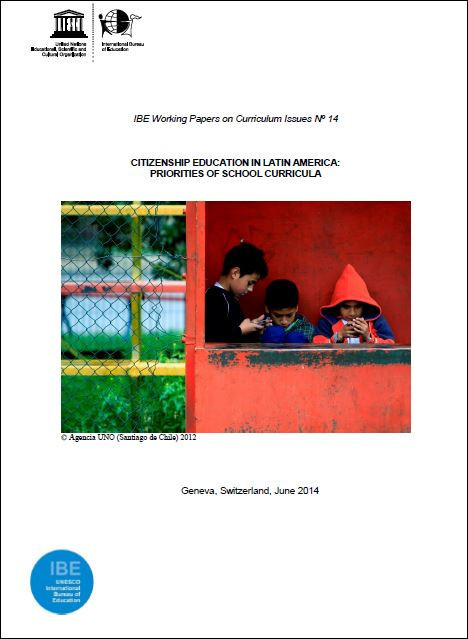 Citizenship education in Latin America: Priorities of School Curricula Año de publicación: 2014 Autor: Cristián Cox | Martín Bascopé | Juan Carlos Castillo | Daniel Miranda | Macarena Bonhomme Autor corporativo: UNESCO International Bureau of Education (IBE) This work focuses on the curricula of six Latin American countries – Colombia, Chile, the Dominican Republic, Guatemala, Mexico and Paraguay – which at the close of the past decade agreed to be part of the project Regional System of Evaluation and Development of Citizenship Competencies (SREDECC). With the support of the Inter-American Development Bank, SREDECC developed the Latin American module of the International Civic and Citizenship Study (ICCS- 2009) undertaken by the International Association for the Evaluation of Educational Achievement (IEA), in addition to encouraging the participation of the countries in that study (Cox 2010; Schulz, Ainley, Friedman and Lietz 2011). This document comprises four parts. The first section takes stock of the state of democratic belief in the region, drawing upon the most significant opinion studies of the past decade, so as to offer broader meaning bases for curriculum analysis and, more generally, for educational work in the field of citizenship. The second section describes the organizational (or structural) characteristics of the curricula of the six countries and presents a framework of categories for their comparative analysis. The subsequent section describes and analyses the contents of the six curricula examined and how they deal with the values, institutions and citizenship relations in their civic (political) and civil (coexistence) dimensions. On the basis of the most significant findings, the closing section includes some reflections regarding curriculum development with regard to citizenship. Educación Ciudadana en América Latina: Prioridades de los Currículos Escolares Año de publicación: 2014 Autor: Cristián Cox | Martín Bascopé | Juan Carlos Castillo | Daniel Miranda | Macarena Bonhomme Autor corporativo: UNESCO International Bureau of Education (IBE) El documento se organiza en cuatro partes. En la primera se da cuenta del estado de la creencia democrática en la región, recurriendo a evidencia de los estudios de opinión más importantes de la última década, de modo de ofrecer contexto y bases de significado amplios al análisis curricular, así como, más en general, al trabajo educativo en el área de ciudadanía. En la segunda sección se describe las características organizativas (o de estructura) de los currículos de los seis países y se presenta un esquema de categorías para el análisis comparado de los mismos. La sección siguiente describe y analiza los contenidos de los seis currículos examinados y su tratamiento de los valores, las instituciones y las relaciones de ciudadanía, en su dimensión cívica (política) y civil (convivencia). A partir de los hallazgos más importantes, la sección de cierre ofrece unas reflexiones orientadas al desarrollo curricular en el área.