
Recursos
Exploren una amplia gama de recursos valiosos en GCED para profundizar su comprensión y promover su búsqueda, incidencia, enseñanza y aprendizaje.
2 resultados encontrados
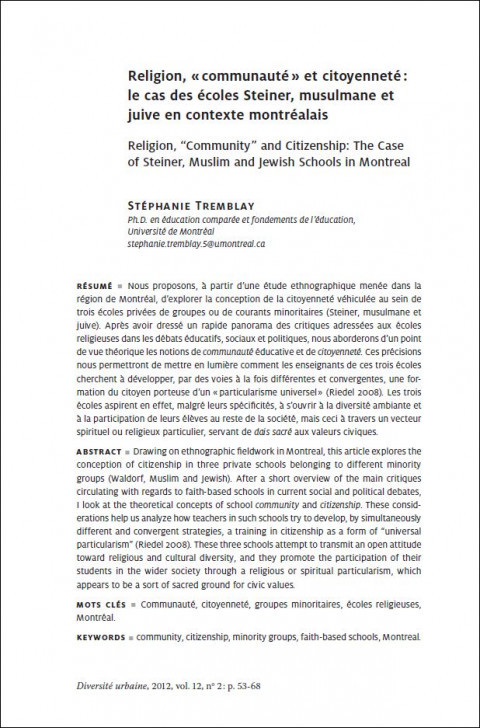 Religion, “Community” and Citizenship: The Case of Steiner, Muslim and Jewish Schools in Montreal Año de publicación: 2012 Autor: Stéphanie Tremblay Autor corporativo: Diversité urbaine Drawing on ethnographic fieldwork in Montreal, this article explores the conception of citizenship in three private schools belonging to different minority groups (Waldorf, Muslim and Jewish). After a short overview of the main critiques circulating with regards to faith-based schools in current social and political debates, I look at the theoretical concepts of school community and citizenship. These considerations help us analyze how teachers in such schools try to develop, by simultaneously different and convergent strategies, a training in citizenship as a form of “universal particularism” (Riedel 2008). These three schools attempt to transmit an open attitude toward religious and cultural diversity, and they promote the participation of their students in the wider society through a religious or spiritual particularism, which appears to be a sort of sacred ground for civic values. Religion, « communauté » et citoyenneté : le cas des écoles Steiner, musulmane et juive en contexte montréalais Año de publicación: 2012 Autor: Stéphanie Tremblay Autor corporativo: Diversité urbaine Nous proposons, à partir d’une étude ethnographique menée dans la région de Montréal, d’explorer la conception de la citoyenneté véhiculée au sein de trois écoles privées de groupes ou de courants minoritaires (Steiner, musulmane et juive). Après avoir dressé un rapide panorama des critiques adressées aux écoles religieuses dans les débats éducatifs, sociaux et politiques, nous aborderons d’un point de vue théorique les notions de communauté éducative et de citoyenneté. Ces précisions nous permettront de mettre en lumière comment les enseignants de ces trois écoles cherchent à développer, par des voies à la fois différentes et convergentes, une formation du citoyen porteuse d’un « particularisme universel » (Riedel 2008). Les trois écoles aspirent en effet, malgré leurs spécificités, à s’ouvrir à la diversité ambiante et à la participation de leurs élèves au reste de la société, mais ceci à travers un vecteur spirituel ou religieux particulier, servant de dais sacré aux valeurs civiques.