
Recursos
Exploren una amplia gama de recursos valiosos en GCED para profundizar su comprensión y promover su búsqueda, incidencia, enseñanza y aprendizaje.
190 resultados encontrados
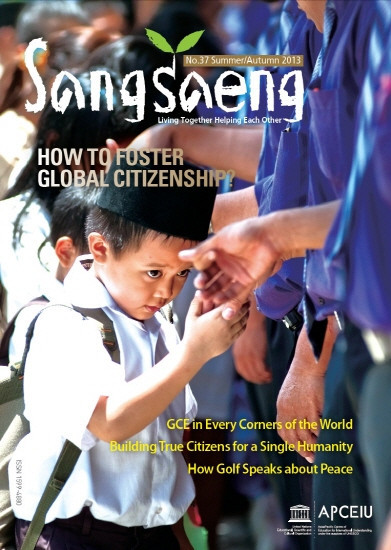 Building true citizens for a single humanity (SangSaeng no. 37 summer autumn 2013) Año de publicación: 2013 Autor corporativo: APCEIU SangSaeng No. 37- How to Foster Global Citizenship? has been published. In order to help our readers better grasp the concept of global citizenship and provide useful information and new ideas, this issue deals with various aspects of global citizenship education.3 Director’s Message4 Special ColumnBuilding True Citizens for a Single Humanity8 Focus: How to Foster Global Citizenship?8 Eliminating World Challenges through Global Citizenship Education 13 Developing Global Citizens with a Global Perspective18 Living in a New World Starts with Education23 GCE in Every Corners of the World28 Best Practices28 Hands-on Hand Print for Environmental Sustainability32 Bhutan Teachers Learn New Models of Education35 Comic Relief: Song of the City36 Special ReportPaving the Way Together for Global Citizenship Education40 InterviewBuilding a Global Community out of the Ashes of Poverty42 LetterCapturing Moments of Living in Harmony44 Peace in My MemoryHow Golf Speaks about Peace47 Understanding the Asia-Pacific RegionDiscovering Locks beyond the Function of Opening and Closing50 APCEIU in Action
 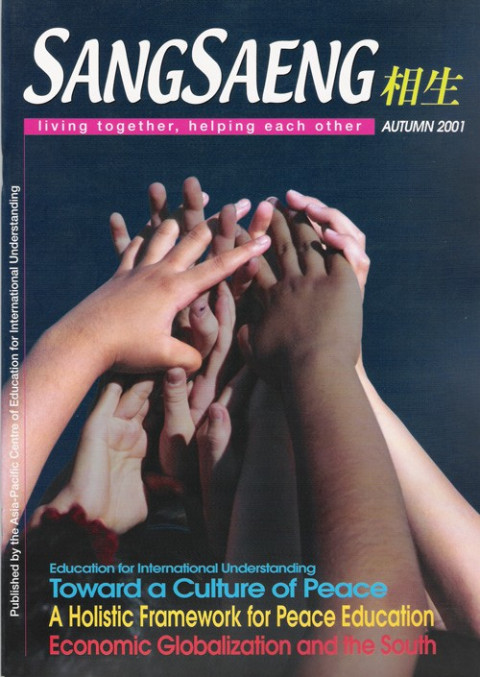 Education for international understanding: toward a culture of peace (SangSaeng vol1. autumn 2001) Año de publicación: 2001 Autor: Swee-Hin Toh Autor corporativo: APCEIU Over the past several decades of political, economic, social and cultural changes and developments throughout the world, the idea of education for international understanding (EIU) has evolved through the work of innumerable educators, researchers, institutions and organizations. Initially, the focus in school and tertiary programs tended to emphasize the need to increase the level of knowledge about other nations, societies and cultures as a key means to promote better, more “peaceful” international (economic and political) and intercultural relations. Especially in universities of the “North,” area studies of different regions and countries expanded and found their way into school-based curricula. In part, EIU was deemed important and helpful in the development of human resources needed to implement foreign aid programs. It was also a response to the increased internationalization of campuses due to the growing numbers of foreign/overseas students. By the 60s, however, a variety of social and political forces and movements were beginning to impact on this earlier focus of EIU. First, it was no longer viewed only in terms of understanding the relations between “nations” or “societies” across political and economic boundaries. EIU would need also to look closely at local and internal issues, and at problems of one’s own society that might significantly influence the direction and nature of international relations. Furthermore, conceptual perspectives on EIU began to reflect a spectrum of frameworks of understanding and analysis, from “conservative” and “liberal” to more “critical” paradigms. Underpinning the critical approaches was a questioning of the power inequities characterizing the international order of nation-states, and the need to overcome such gaps if the original vision of “world peace” was to be fulfilled. Third, the evolving theory and practice of EIU took on a host of societal, international and increasingly global issues deemed urgent at all levels of life.
  Education for international understanding: a river flowing from the mountains (SangSaeng vol5. autumn 2002) Año de publicación: 2002 Autor: Swee-Hin Toh Autor corporativo: APCEIU EIU (Education for International Understanding) is a concept that has diverse sources and tributaries, much like a river that begins in the mountains and flows to the sea or ocean, enriched by innumerable ideas, perspectives and practices along its journey. However, unlike a river in one community or nation, this is a river that flows across the world encompassing the breadth and depth of civilizations, peoples and mother Earth. Although by designation EIU appears to have a “modern genealogy,” it is vital to recognize and to search for its roots in the ancient wisdoms of all civilizations, especially through the values and principles of well-being, dignity and good or virtuous relationships between and among all peoples, communities and societies. EIU has been catalyzed and developed by multiple individuals, organizations, agencies and movements, including educators, researchers, national/multilateral organizations (e.g. UN agencies), NGOs, people’s organizations (POs) and other civil society movements and advocates. EIU is simultaneously practiced in all modes of education (formal, non-formal and informal), but a challenge is to attain synergy across all the modes for optimal outcomes and sustainability.
 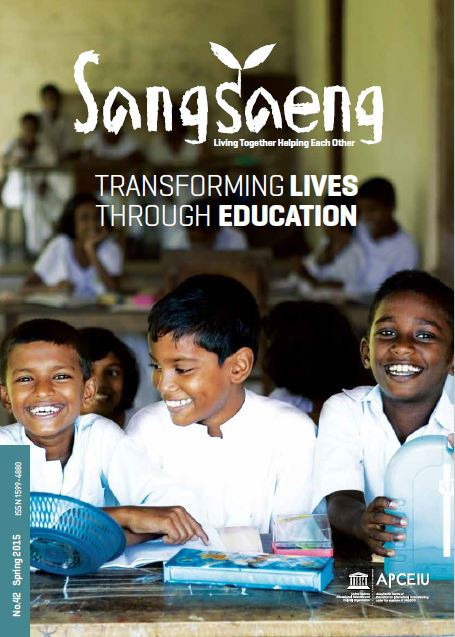 Transforming lives through education (SangSaeng no. 42 spring 2015) Año de publicación: 2015 Autor corporativo: APCEIU The 42nd issue of SangSaeng, ‘Transforming Lives Through Education’, has been published. This spring edition has been released prior to the World Education Forum 2015 to provide the context for the post-2015 education agenda. It contains compelling articles that underline the importance of Global Citizenship Education in building a more sustainable and peaceful society. 3 Director’s Message4 Special Column Every Child Deserves a Child-Friendly World8 Focus: Transforming Lives Through Education 8 Emergence of Global Citizenship Education in the Post-2015 Education Agenda13 Re-Visioning Education Beyond 201518 Global Citizenship Education for the 21st Century23 Young People Are Ready to Lead: The Education We Want26 Interview Education Beyond 201531 Special ReportGlobal UNESCO Clearinghouse on Global Citizenship Education Hosted by APCEIU34 Best Practices34 Citizenship Education in a Community Setting38 Pangaea42 Letter Unity in Diversity44 Peace in My MemoryPresenting a Message of Peace Through Music47 Understanding the Asia-Pacific Region Timeless Festivity of the Ancient World: Hidirellez50 APCEIU in Action
  Video sketch: Global Youth Advocacy Workshop on GCED Año de publicación: 2015 Autor corporativo: APCEIU APCEIU produced a video on the Global Youth Advocacy Workshop on GCED held in Busan, Republic of Korea, from 30 March to 4 April 2015. The workshop invited 45 youth participants from 34 countries around the world, who are actively engaged with and committed to advocating and educating youth for GCED in their local contexts.This short video sketch of the workshop provides an overview of the activities carried out during the workshop and also includes the interviews of the participants, who shared their expectations, impressions, and reflections on the workshop.The workshop was co-organized by APCEIU, UN Secretary General’s Global Education First Initiative (GEFI), and the UNESCO Mahatma Gandhi Institute of Education for Peace and Sustainable Development (MGIEP); and sponsored by Educate A Child and the Geum-jeong District of Busan Metropolitan City.
 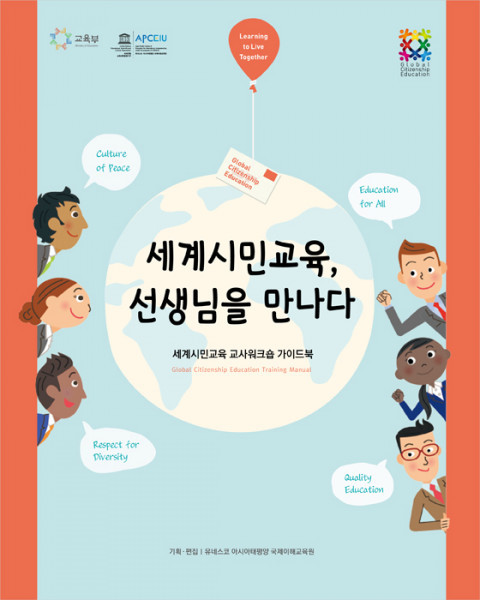 GCED Meets Teachers: GCED Teacher Workshop Guidebook Año de publicación: 2015 Autor corporativo: APCEIU APCEIU published the GCED teacher workshop guidebook “GCED meets teachers.” This guidebook will be used at GCED workshops for teachers of 17 metropolitan and provincial offices of education carried out by GCED Lead teachers. The contents include the concept and the background of GCED, main contents, implementing methods at school. This GCED workshop manual provides teachers with opportunities to search for the ways to implement GCED at the schools, experience learning methods, and understand the main issues and themes of GCED through workshops. This guidebook is composed of 7 workshop sessions(refer to list below). Teachers and teacher educators planning GCED workshop can use this guidebook which includes the contents of the sessions, consultation to help plan and implement workshops based on participation and communication of the participants. “Global Citizenship Education meets teachers” GuidebookSession 1. Importance of World Education Forum and Global Citizenship EducationSession 2. Concept of GCED and its backgroundSession 3. Learning the contents and the theme of GCEDSession 4. Understanding the complexity and interrelationship of the issuesSession 5. Discussion class for cooperative communicationSession 6. Implementing GCED through Project Based LearningSession 7. Setting GCED action plans
  Global youth advocacy workshop on GCED: final report Año de publicación: 2015 Autor corporativo: APCEIU The United Nations Secretary-General's Global Education First Initiative (GEFI) recognizes Global Citizenship Education (GCED) as one of its three priorities. UNSG GEFI has generated momentum for GCED which has since been in the target of the education goal in the Muscat Agreement 2014 and in the proposed Sustainable Development Goals (SDGs) of the Open Working Group. The proposed SDGs will provide the basis for further intergovernmental negotiations on the post 2014 development agenda.In support of UNSG GEFI, UNESCO held its Second Global Forum on Global Citizenship Education on Building Peaceful and Sustainable Societies: Preparing for Post-2015 from 28 to 30 January 2015 in Paris, France. The forum aimed to identify GCED related inputs to the emerging Framework for Action on Education for the post 2015 development agenda, as well as key dimensions of GCED in relation to peace. Furthermore, it had a concurrent session dedicated to youth on Driving the GCED Agenda Forward: Acting with and for Young People to assemble the perspectives, ideas, and priorities of youth on GCED. Against this background, the Global Youth Advocacy Workshop on GCED, co-organized by GEFI, the Asia-Pacific Centre of Education for International Understanding (APCEIU) and UNESCO's Mahatma Gandhi Institute of Education for Peace and Sustainable Development (MGIEP) aimed to build the capacity of dynamic youth leaders from countries around the world to advocate for GCED. The participants of the workshop were selected on the basis of their previous experiences, present engagement, and future commitment in educating youth at the local and national levels. The objectives of the workshop were: 1. To build a common understanding of GCED and its key priority areas by building on the dialogue initiated at the Paris GCED Forum.2. To allow the participating youth leaders to elaborate an advocacy strategy suitable for implementation at the local and national levels to advance the GCED agenda beyond 2015.3. To establish a wider network of youth advocates on GCED to advance the agenda globally.
  Global citizenship education: goals and challenges in the new millennium Año de publicación: 2013 Autor: Soonyong Pak Autor corporativo: APCEIU The research report examines what issues are at stake in delivering global citizenship education, a new emerging education initiative. Revisiting the conceptual and operational framework of global citizenship education, readers can have a broad picture on the current status of global citizenship education and a way forward towards effective implementation of it.
 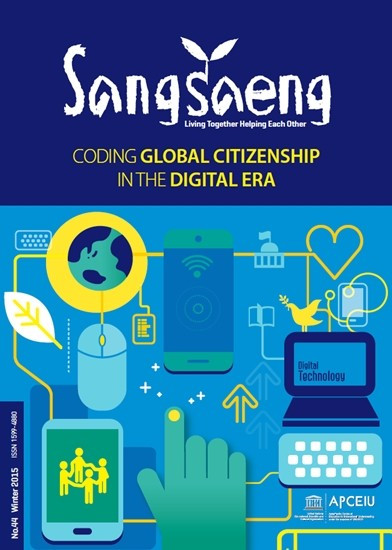 Coding global citizenship in the digital era (SangSaeng no. 44 winter 2015) Año de publicación: 2015 Autor corporativo: APCEIU Summary:The 44th issue of SangSaeng, “Coding Global Citizenship in the Digital Era,” has been released. The advancement of digital technology has connected the world, accelerating globalization. In this global digital age, Global Citizenship Education (GCED) is drawing enormous attention. Recognizing its significance, this Winter edition brings out the topic of GCED for digital citizens through the lens of education policymakers, children and youth, and corporations. In particular, the articles suggest actively participating in and contributing to the information society through ethical, safe, and responsible use of digital technology as the core competency for global citizens in the digital era.8 Striking a Balance Between Digital Opportunities & Related Risks12 Young People as Active Citizens in the Digital Age16 Empowering Children to Become Creative Digital Leaders20 Fostering Inclusive Innovation for a Better World38 Interview38 Understanding Culture through Media and Language40 Embracing Diversity to Live Together42 Peace in My MemoryTo achieve Peace, Must Understand Peace46 Understanding the Asia-Pacific RegionGlimpse into Ancient Healing Ritual of Ulik Mayang50 APCEIU in Action
 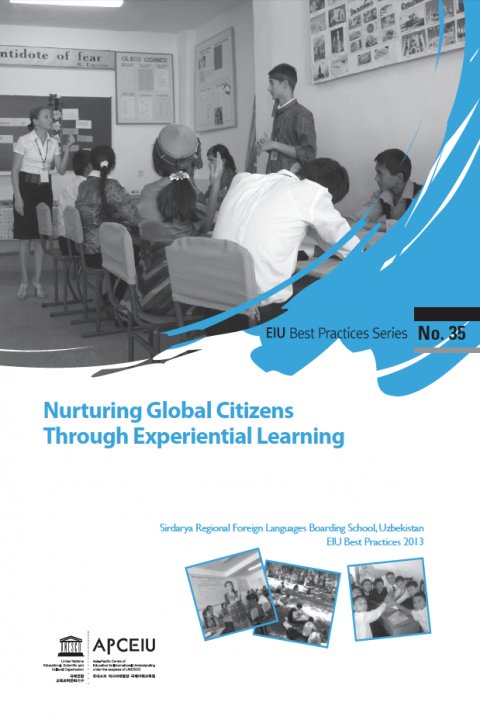 EIU Best Practice Series No. 35: Nurturing global citizens through experiential learning Año de publicación: 2013 Autor: Ildar Yusupov | Feruza Ahmedova Autor corporativo: APCEIU The following case is set in Uzbekistan where evidently diverse social groups live in harmony despite their differences. Among the schools in the country, the Sirdarya Regional Foreign Languages Boarding School in Gulistan City is arguably an exceptionally unique school due to the close engagement of parents with the boarding school’s EIU-themed activities. Activities range from extra-curricular activities including artwork and sports, to classroom-based activities such as role plays and international awareness events. Each activity is carefully designed to arouse the interest of the students in EIU-related themes such as tolerance, understanding and sustainable development. In the process, the students become highly motivated to take leading roles as responsible global citizens in creating a more peaceful world.