
Recursos
Exploren una amplia gama de recursos valiosos en GCED para profundizar su comprensión y promover su búsqueda, incidencia, enseñanza y aprendizaje.
248 resultados encontrados
 2020 Online SSAEM Conference: Teaching Across Borders; Final Report (November 24-30, 2020) Año de publicación: 2020 Autor corporativo: APCEIU | Korea R. Ministry of Education 2020 Online SSAEM (Sharing Stories of Asia-Pacific Education Movements) Conference is a space for examining and sharing the educational outcomes of the participating teachers and schools of the Programme. This Conference, which has been held annually since 2014, aims to provide an excellent opportunity for the Programme participants and stakeholders to showcase the impact of the Programme and to explore methods on strengthening cooperation for further development of the Programme.
  GCED Meets Teachers: GCED Teacher Workshop Guidebook Año de publicación: 2015 Autor corporativo: APCEIU APCEIU published the GCED teacher workshop guidebook “GCED meets teachers.” This guidebook will be used at GCED workshops for teachers of 17 metropolitan and provincial offices of education carried out by GCED Lead teachers. The contents include the concept and the background of GCED, main contents, implementing methods at school. This GCED workshop manual provides teachers with opportunities to search for the ways to implement GCED at the schools, experience learning methods, and understand the main issues and themes of GCED through workshops. This guidebook is composed of 7 workshop sessions(refer to list below). Teachers and teacher educators planning GCED workshop can use this guidebook which includes the contents of the sessions, consultation to help plan and implement workshops based on participation and communication of the participants. “Global Citizenship Education meets teachers” GuidebookSession 1. Importance of World Education Forum and Global Citizenship EducationSession 2. Concept of GCED and its backgroundSession 3. Learning the contents and the theme of GCEDSession 4. Understanding the complexity and interrelationship of the issuesSession 5. Discussion class for cooperative communicationSession 6. Implementing GCED through Project Based LearningSession 7. Setting GCED action plans Éducation à la citoyenneté mondiale, rencontrer l'enseignant Año de publicación: 2015 Autor corporativo: APCEIU APCECI publié le manuel de formation de l'ECM pour les enseignants intitulé «L’éducation à la citoyenneté mondiale: Guide de l'enseignant ».Ce guide est conçu comme un manuel pour les formateurs d'enseignants à planifier et à mettre en œuvre l'atelier d'ECM. Il comprend des informations de base sur ECM, thèmes clés, les concepts et les questions d'ECM et pédagogies transformatrices, les méthodes d'apprentissage, et la planification de l'action pour les classes d'ECM.Ce guide est composé de 7 séances de l'atelier comme ci-dessous. Les enseignants et les formateurs d'enseignants planifient des ateliers d'ECM peut concevoir et mettre en œuvre un atelier de 15 heures au niveau de base.«L'éducation à la citoyenneté mondiale: Guide des enseignants»Session 1. Forum mondial sur l'éducation (WEF) et L'éducation à la citoyenneté Mondiale (ECM) (ECM)Session 2. ECM: Concepts et Arrière-plansSession 3. thèmes et contenu ECM clésSession 4. Comprendre la complexité et de l'interdépendance des questionsSession 5. pédagogies: classe de discussion pour les communications coopérativesSession 6. pédagogies: ECM à travers (apprentissage axé sur les projets) PBLSession de planification 7. Action
 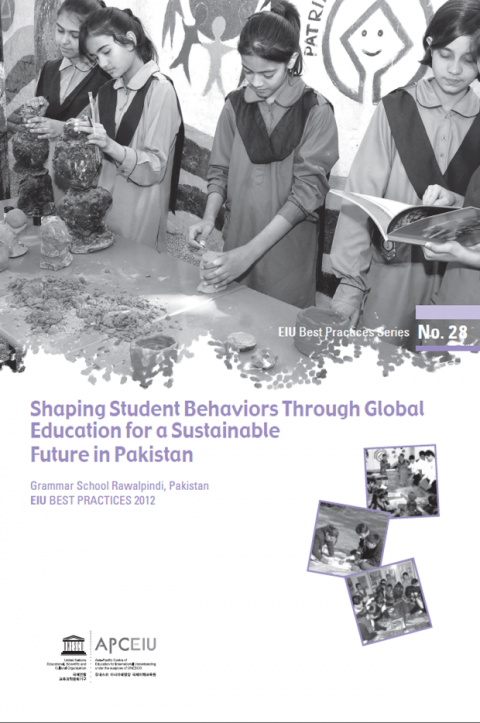 EIU Best Practice Series No. 28: Shaping student behaviors through global education for a sustainable future in Pakistan Año de publicación: 2012 Autor: Nasreen Iqbal Autor corporativo: APCEIU Issue No. 28 introduces a Global Education programme with its various activities from Grammar School Rawalpindi in Pakistan. It aims to enable and empower young people to become responsible and humane citizens to achieve a peaceful and sustainable future. It is targeted at all levels of students, including preschool level, to increase their awareness of social and civic values. The programme mainly focuses on EIU while equipping learners with conflict resolution skills, cultural and national identities and global citizenship. Also, it incorporates issues such as universal values, human rights, health, sustainable development, gender, multiculturalism, respect for minority groups, identity and self-worth, tolerance, etc. into the school ethos and curriculum so that the students will be able to perform positive changes on national as well as on international level. Façonner le comportement des élèves par le biais de l'éducation mondiale pour un avenir durable au Pakistan (ECI Série des Meilleures Pratiques no.28) Año de publicación: 2012 Autor: Nasreen Iqbal Autor corporativo: APCEIU Question n ° 28 introduit un programme d’Éducation Mondiale avec ses diverses activités de Grammar School Rawalpindi au Pakistan. Il vise à permettre et permettre aux jeunes de devenir des citoyens responsables et humains pour parvenir à un avenir pacifique et durable. Il est destiné à tous les niveaux des élèves, y compris le niveau préscolaire, afin d'accroître leur prise de conscience des valeurs sociales et civiques. Le programme se concentre principalement sur ECI tout aux apprenants des compétences de résolution des conflits, des identités culturelles et nationales et la citoyenneté mondiale. En outre, il intègre des questions telles que les valeurs universelles, les droits de l'homme, la santé, le développement durable, l'égalité, le multiculturalisme, le respect pour les groupes minoritaires, l'identité et l'estime de soi, la tolérance, etc. dans l'ethos et le curriculum de sorte que les étudiants seront en mesure école pour effectuer des changements positifs sur le national et au niveau international.
  Envisioning the Future of Assessment in Transformative Education: A Synthesis Report of the Expert Meeting on Evaluation and Assessment for Transformative Education: Towards and Beyond 2030 Año de publicación: 2025 Autor: Esther Care Autor corporativo: APCEIU Transformative education calls for learning that nurtures not only knowledge, but also the values, attitudes, and behaviours essential for inclusive, just, and sustainable societies. Recent global discussions, including UNESCO’s Reimagining Our Futures Together: A New Social Contract for Education and the Recommendation on Education for Peace and Human Rights, International Understanding, Cooperation, Fundamental Freedoms, Global Citizenship and Sustainable Development, emphasise learning that fosters critical thinking, empathy, cooperation, and action-oriented engagement.Within this vision, assessment needs to evolve from primarily measuring achievement to supporting a process of learning that actively enables and evidences learners’ reflection, growth, and empowerment. Traditional approaches, which prioritise standardisation and summative outcomes, are insufficient for capturing the complex competencies at the heart of transformative education, such as socio-emotional development, critical reflection, ethical reasoning, and responsible action. These limitations raise fundamental questions about not only how transformative learning outcomes can be assessed across diverse systems and contexts, but also what purposes assessment should serve.To examine these issues, APCEIU convened the Expert Meeting on Evaluation and Assessment for Transformative Education: Towards and Beyond 2030, held in Seoul, Republic of Korea, on 2–3 July 2025. The meeting brought together global experts, researchers, and policymakers to discuss current challenges, share emerging practices, and consider strategic directions for reimagining assessment in support of transformative education.Building on these rich discussions, this report synthesises the key reflections and forward-looking perspectives shared during the meeting. Part I presents analytical insights and strategic considerations for advancing assessment in transformative education, while Part II documents the meeting proceedings, including presentations and collaborative discussions. 2020 온라인 쌤(SSAEM) 컨퍼런스: 최종보고서 Año de publicación: 2020 Autor corporativo: APCEIU | Korea R. Ministry of Education 2020 온라인 SSAEM 컨퍼런스는 교육교류사업 참가교사들의 사업 참가 이후 후속활동 성과를 공유하는 장으로 운영되었다. 2012년도 부터 9년간 교육교류사업에 참가한 약 1,200명의 국내·외 교사들의 다양한 후속활동 결과물을 공유하고, 향후 네트워크 구축을 위한 온라인 소통 공간을 제공하였다.
  Developing Online Educational Materials for Global Education in Korea: Project Report Año de publicación: 2020 Autor corporativo: APCEIU | Korea R. Ministry of Education This project aims to enhance the intercultural understanding of Korean teachers and students by utilizing global education and Global Citizenship Education(GCED) materials produced by partner countries’ teachers. Simultaneously, for the teachers from partner countries, the project is expected to enhance their educational competency, global competency, and online teaching competency required in this pandemic era. The project also aims to establish an online teaching and learning model by using online educational materials in Korean classrooms and accumulate and expand educational achievements in response to the spread of online exchange. 초청교사 온라인 교수자료 제작: 최종 보고서 Año de publicación: 2020 Autor corporativo: APCEIU | Korea R. Ministry of Education 본 프로젝트는 대상국 교사가 제작한 글로벌·세계시민교육 자료 활용을 통해, 국내 학교 교원 및 학생의 다문화 감수성을 제고하는 것을 목표로 한다. 동시에 강의자로 참여하는 대상국 교사의 교육 역량과 글로벌 역량, 그리고 언택트 시대에 요구되는 온라인 강의 역량을 향상시키고자 한다. 또한 외국 교사가 제작한 온라인 교수자료를 국내 교육 현장에 활용하여 이를 토대로 온라인 교수-학습 체제를 구축하고, 온라인 교류 확산 추세에 대응하며 교육성과를 축적·확산하고자 한다.
  EIU Best Practices Series No.31: A Step towards Change: Incorporating EIU in Classrooms and Beyond Año de publicación: 2013 Autor corporativo: APCEIU This monograph is one of APCEIU's EIU Best Practices Series, which aims to encourage educators, scholars, and activists to implement and share local initiatives on EIU. The Series No.31 introduces a case study in which Bhutanese school carried out activities and curriculum development to successfully promote EIU and ESD for students and teachers. While the school’s curriculum already embodies a degree of EIU, the school strived to be more creative in upholding the existing content by exploring newer issues of media ethics, human rights, culture, and environmental conservation for fruitful engagement. This in turn allowed the target audience to learn the values of EIU/ESD for a culture of peace.