
Recursos
Exploren una amplia gama de recursos valiosos en GCED para profundizar su comprensión y promover su búsqueda, incidencia, enseñanza y aprendizaje.
190 resultados encontrados
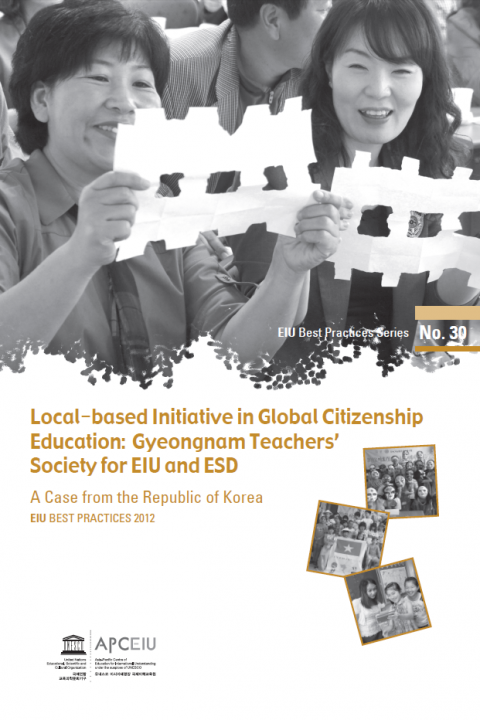 EIU Best Practice Series No.30: Local-based initiative in global citizenship education: Gyeongnam teachers’ society for EIU and ESD Año de publicación: 2012 Autor: Byeongseob Choi Autor corporativo: APCEIU Issue No. 30 introduces a case in the Republic of Korea on the local-based initiatives of school teachers to promote EIU and ESD in their local community. The case illustrates the taken steps and efforts made by the respective teachers when elaborating innovative approaches to promote EIU and ESD, led by the intention to create a more open and locally relevant educational setting for students as well as teachers in response to the growing globalization. Especially the Gyeongnam Province, where the teachers are based, is experiencing a rapid demographic change due to the high influx of foreigners, which calls upon the educators to prepare their students to effectively cope with these changes and become global citizens.
 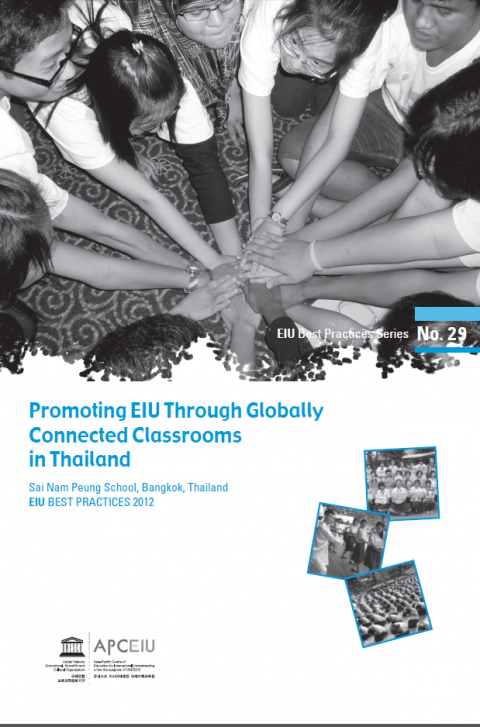 EIU Best Practice Series No. 29: Promoting EIU through globally connected classrooms in Thailand Año de publicación: 2012 Autor: Ajarn Kanchaphat Chaoplaina Autor corporativo: APCEIU This issue presents a multilateral project in Thailand, which interconnected students from Thailand, United Kingdom, Korea, Indonesia, Malaysia, Taiwan, and Vietnam to share their values and thoughts on EIU issues. Through the portals of connection, students from different regions were able to collaborate in doing group works and activities, which were focused on sharing ideas on students’ interest and every day experiences. This case highlights the specific practice that encouraged students to actively learn from one another and understand the cultural diversity, which optimized the outcome of the students’ capacity in communication skills, language skills, and personal development as global citizens. In addition to strengthening the network among participating schools, the impact of the multilateral project extended to teachers while they were engaged in exchanging pedagogical methods and knowledge to support and inspire each other.
 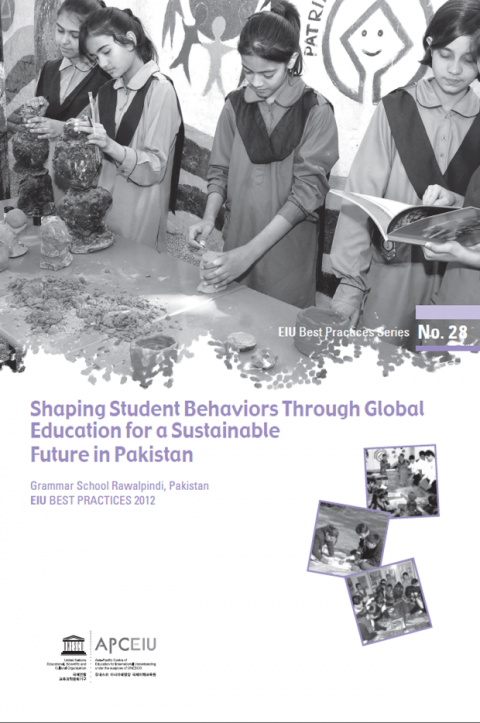 EIU Best Practice Series No. 28: Shaping student behaviors through global education for a sustainable future in Pakistan Año de publicación: 2012 Autor: Nasreen Iqbal Autor corporativo: APCEIU Issue No. 28 introduces a Global Education programme with its various activities from Grammar School Rawalpindi in Pakistan. It aims to enable and empower young people to become responsible and humane citizens to achieve a peaceful and sustainable future. It is targeted at all levels of students, including preschool level, to increase their awareness of social and civic values. The programme mainly focuses on EIU while equipping learners with conflict resolution skills, cultural and national identities and global citizenship. Also, it incorporates issues such as universal values, human rights, health, sustainable development, gender, multiculturalism, respect for minority groups, identity and self-worth, tolerance, etc. into the school ethos and curriculum so that the students will be able to perform positive changes on national as well as on international level.
 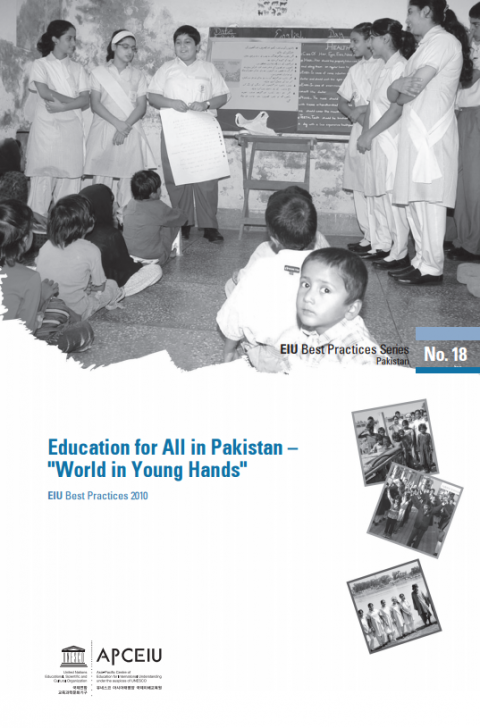 EIU Best Practices Series No.18: Education for All in Pakistan - "world in young hands" Año de publicación: 2010 Autor: Ayesha Saqib Autor corporativo: APCEIU The programme provides a student-participatory approach to face local problems that stem from ignorance and have roots in poverty. Bridging the school with the local community, Social Action Program (SAP) aims to inspire students with keen awareness on problems that threaten our community as well as to equip them with necessary tools to deal with challenges they may face. Through practices, SAP integrates EIU into curriculum that emphasizes maintaining peace and harmony among different folds of religions, ethnicity, and sects, dissipating the elements of hate and intolerance. The major areas of concern are Literacy for All, Sustainable Development, Cultural Diversity, and Peace Education.
 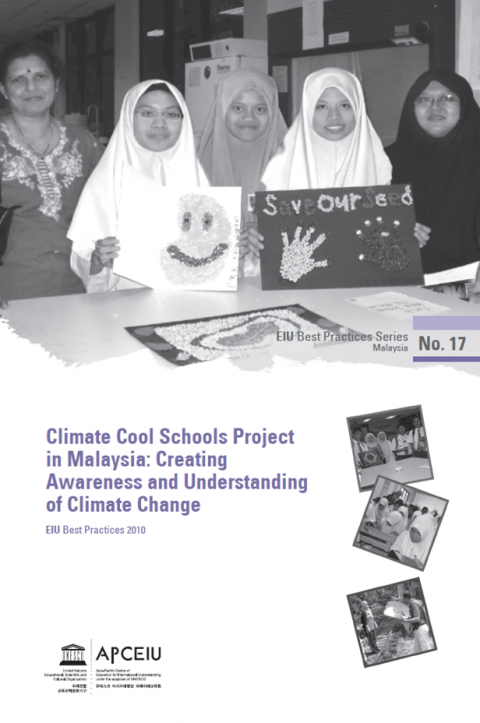 EIU Best Practice Series No. 17: Climate cool schools project in Malaysia: creating awareness and understanding of climate change Año de publicación: 2010 Autor: Maria Salih Autor corporativo: APCEIU The Climate Cool Schools (CCS)-Global Platform project is a multilateral learning portal for students in Malaysia, the UK, and Hong Kong to work together to explore local and global climate change issues. The learning portal enables these students to learn from each other about what actions are possible, and to find a voice to advocate wider actions at the local and global levels. The project was initiated in late 2007 and in early 2008 embarked on a two year trial basis with the British Council (BC), Sultan Idris Education University (SIEU), and the Perak State Education Department (JPN, Perak) as the partners. This project is a follow-up from the ZeroCarbonCity project launched in 2005 by the British Council.
 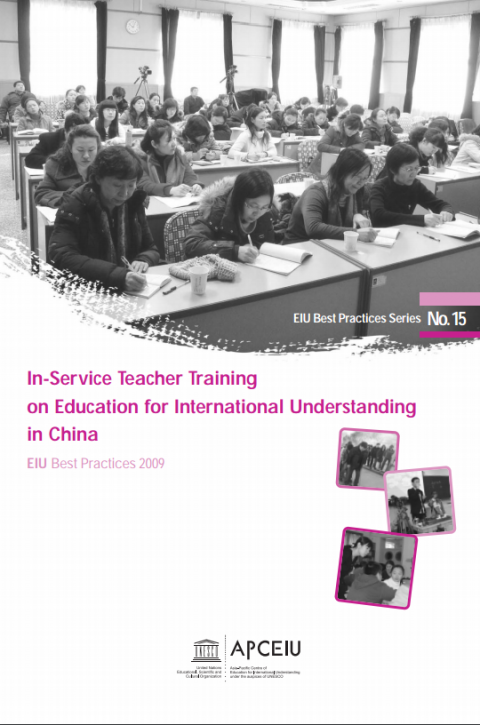 EIU Best Practices Series No.15: In-service teacher training on education for international understanding in China Año de publicación: 2009 Autor: Yu Xin Autor corporativo: APCEIU This document introduces an effective and systematic in-service teacher training programme on Education for International Understanding (EIU) in Beijing, China. In order for this training to take place, the Beijing Institute of Education (BIE) has been working to develop a school-based curriculum on EIU to be implemented in local schools. Through this effort, the in-service teacher training programme on EIU motivated and strengthened the capacity of teachers to incorporate EIU curriculum into various subjects they teach in schools. As a result of this practice, schools in which EIU have been implemented, raised the level of global awareness among their teachers and students. This effort to promote EIU in Beijing is an excellent model for policy makers, curriculum developers and educators to learn the effective strategies to promote EIU in schools.
 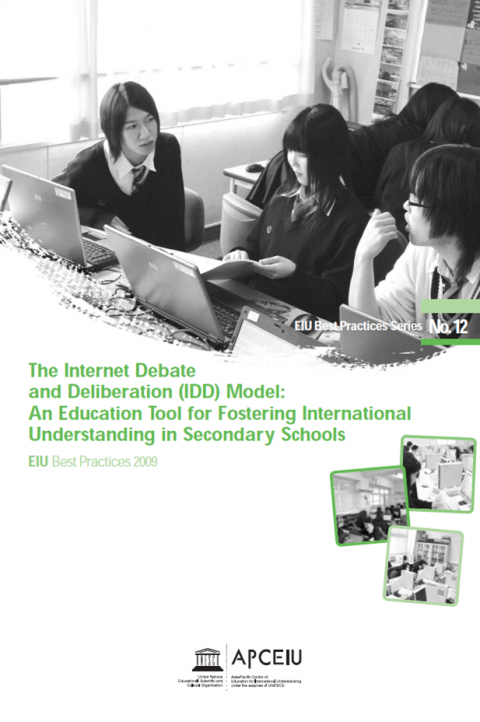 EIU Best Practice Series No. 12: The Internet Debate and Deliberation (IDD) Model: An Education Tool for Fostering International Understanding in Secondary Schools Año de publicación: 2009 Autor: Rose Sabanal Autor corporativo: APCEIU This document introduces a case of the internet-based debate and deliberation with an aim to strengthen critical and integrated thinking among high school students from various countries. The case demonstrates that the school in case has been making a devoted effort to develop effective methods of communication among young people with different cultural backgrounds and perspectives, eventually leading to the development of educational content that will enable young learners to critically reflect on highly contending issues of EIU.
 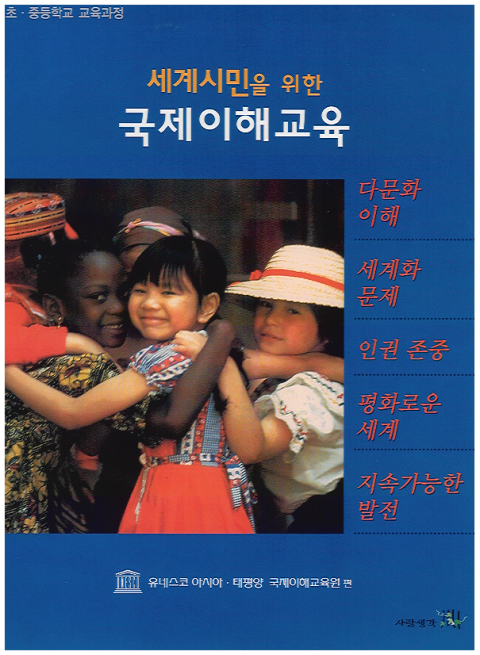 세계시민을 위한 국제이해교육 Año de publicación: 2003 Autor corporativo: APCEIU International Commission on Education for the Twenty-first Century of UNESCO proposed “Learning to Live Together” as the worldwide educational goal at the twenty-first century. Also, as many countries have become multiethnic or multicultural societies due to increasing interdependences, globalization and ICT, the necessity and importance of Education for International Understanding (EIU) on how to live in harmony with others is growing. In Korea, EIU was included as a selective subject for creative experience activities in the seventh national curriculum and the number of schools teaching EIU on the ground has been increasing since 2000. However, in many cases what to teach was left up to teachers’ discretion owing to the lack of clear guidelines or materials. This book is comprised of systematized educational goals and contents in accordance with primary and secondary school curricula, and was developed by Asia-Pacific Centre for Education for International Understanding (APCIEU) under the auspices of UNESCO for its first three years since its establishment in 2000. EIU as a school subject aims to provide students with knowledge, values and ethical attitudes needed for the people of global society to move beyond the borders of ethnicity, culture and religion into a life of peaceful coexistence. Within the frame of EIU, students learn about cultural relativity and universal values. Based on holistic perspective, this book is designed with the following five units - multicultural understanding, issues of globalization, respect for human rights, a peaceful world, and sustainable development - to be utilized for learning at the level of primary and secondary level students.
 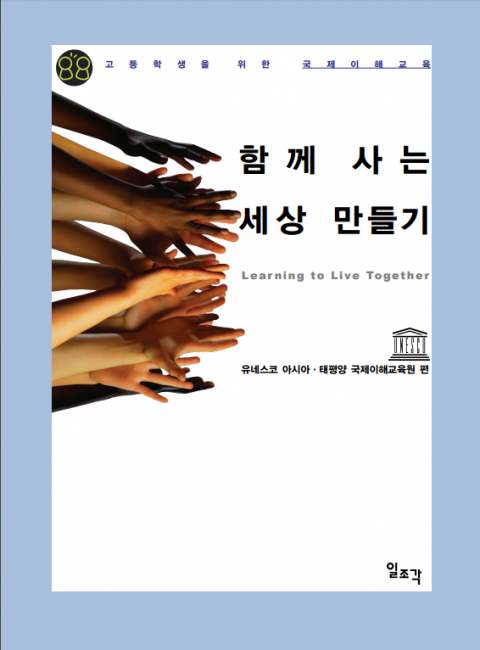 함께 사는 세상 만들기 Año de publicación: 2004 Autor corporativo: APCEIU This book, in essence, aims to introduce Education for International Understanding (EIU) to high school students, college students and teachers at all levels as well as the general public. The growing interconnectedness and interdependence compels all of us to understand the world beyond our immediate living space, to critically reflect on issues affecting us and others, and to work together to make our world a more peaceful and sustainable one. It requires values education that is transformative and participatory in nature to arouse genuine interests and passions to learn more and eventually to make positive changes. The book is comprised of five parts, organized by five thematic areas of EIU, namely, intercultural understanding, globalization, human rights, peace and Education for Sustainable Development (ESD). It introduces carefully chosen topics and discussions which may pique readers’ interest in some of the issues at stake, thus, encourage them to critically reflect on the complexities surrounding the issues and motivate them to engage further. Using an interdisciplinary lens, the book also borrows some ideas and approaches commonly practiced in critical anthropology.
  Electronic resources on education for sustainable development Año de publicación: 2007 Autor corporativo: APCEIU | UNESCO Bangkok The Asia-Pacific Programme of Educational Innovation for Development (APEID) of UNESCO Bangkok and the Asia-Pacific Centre of Education for International Understanding (APCEIU) collaborated to produce this document listing these electronic resources. The value of such resources is not limited to teachers alone; it is also useful to policy and decision makers, teacher educators, researchers and academics as well as students themselves.