
Recursos
Exploren una amplia gama de recursos valiosos en GCED para profundizar su comprensión y promover su búsqueda, incidencia, enseñanza y aprendizaje.
139 resultados encontrados
 Japón: se necesita una (pequeña) aldea Año de publicación: 2015 Autor: Catherine Nolan | Julie Saito | Mary de Sousa Autor corporativo: UNESCO ESD Success Stories are showcasing compelling stories with a personal/human dimension from all five UNESCO regions (Africa, Arab States, Asia and Pacific, Europe & North America and Latin America & the Caribbean). The stories illustrate the wide diversity of ESD approaches and initiatives taking place in different parts of the world. They show how involvement with ESD has changed the lives of specific individual persons and how they have become more active in their community. Each story centers on one individual or a group of individuals.The small village of Omori-cho in Japan explores alternative paths to prosperity based on community action and sustainability.
  Green impact: las cifras hablan por sí solas Año de publicación: 2015 Autor: Christopher Slaney Autor corporativo: UNESCO ESD Success Stories are showcasing compelling stories with a personal/human dimension from all five UNESCO regions (Africa, Arab States, Asia and Pacific, Europe & North America and Latin America & the Caribbean). The stories illustrate the wide diversity of ESD approaches and initiatives taking place in different parts of the world. They show how involvement with ESD has changed the lives of specific individual persons and how they have become more active in their community. Each story centers on one individual or a group of individuals.The National Union of Students (NUS) UK enables, accredits and awards university departments for sustainability efforts through its "Green Impact" scheme.
  Guatemala: se el cambio que quieres ver Año de publicación: 2016 Autor: Karina García-Ruano Autor corporativo: UNESCO ESD Success Stories are showcasing compelling stories with a personal/human dimension from all five UNESCO regions (Africa, Arab States, Asia and Pacific, Europe & North America and Latin America & the Caribbean). The stories illustrate the wide diversity of ESD approaches and initiatives taking place in different parts of the world. They show how involvement with ESD has changed the lives of specific individual persons and how they have become more active in their community. Each story centers on one individual or a group of individuals.Asociación SERES, from Guatemala and El Salvador, works with youth to give them the skills needed to bring about positive change through sustainable development.
  Orientaciones Técnicas Internacionales sobre Educación en Sexualidad: un enfoque basado en evidencia orientado a escuelas, docentes y educadores de la salud Año de publicación: 2009 Autor corporativo: UNESCO El presente documento Orientaciones Técnicas Internacionales, basado en un riguroso análisis de la evidencia existente sobre programas de educación en sexualidad, está orientado a profesionales y a personas responsables de la toma de decisiones de los sectores salud y educación. Este documento (Volumen 1) se centra en aquellos elementos que justifican la educación en sexualidad y ofrece sólidas recomendaciones técnicas sobre las características que todo programa efectivo debe tener. El documento acompañante (Volumen 2) cubre los temas y objetivos de aprendizaje que se deben abordar en los diferentes tramos etarios en un programa básico de educación en sexualidad destinado a niños, niñas y jóvenes entre las edades de 5 a 18 y más años e incluye una bibliografía de referencias. El documento Orientaciones Técnicas Internacionales es relevante no sólo para los países más afectados por el VIH y el SIDA, sino también para los que exhiben una epidemia de baja prevalencia y alta concentración.
  Si no entiendes, ¿cómo puedes aprender? Año de publicación: 2016 Autor corporativo: UNESCO Key Messages:1. Children should be taught in a language they understand, yet as much as 40% of the global population does not have access to education in a language they speak or understand.2. Speaking a language that is not spoken in the classroom frequently holds back a child’s learning, especially for those living in poverty.3. At least six years of mother tongue instruction is needed to reduce learning gaps for minority language speakers.4. In multi-ethnic societies, imposing a dominant language through a school system has frequently been a source of grievance linked to wider issues of social and cultural inequality.5. Education policies should recognize the importance of mother tongue learning. 6. Linguistic diversity creates challenges within the education system, notably in areas of teacher recruitment, curriculum development and the provision of teaching materials.
 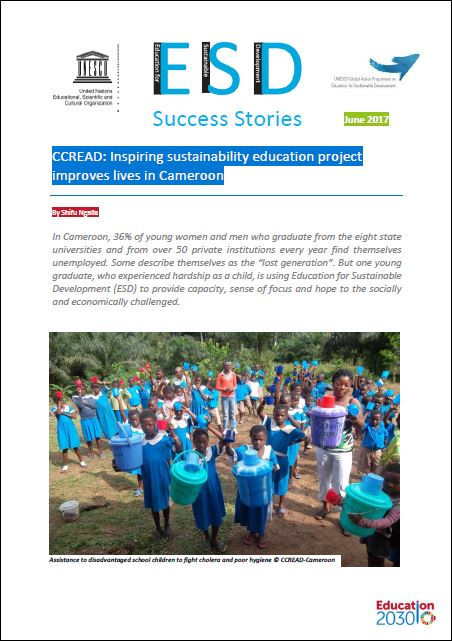 CCREAD: Un Estimulante Proyecto Sobre Educación para la Sostenibilidad Mejora la Vida en el Camerún Año de publicación: 2017 Autor: Shifu Ngalla Autor corporativo: UNESCO Este es un artículo acerca de proyecto sobre el educación para la sostenibilidad en Camerún.En el Camerún, 36% de las mujeres y de los hombres jóvenes que se gradúan anualmente en alguna de las ocho universidades estatales o en alguna de las 50 instituciones privadas se encuentran sin empleo. Algunos se describen a sí mismos como la “generación perdida”. Pero un joven diplomado que experimentó dificultades cuando era niño está utilizando la educación para el desarrollo sostenible (EDS) como un medio para proporcionar capacidades, centrar mejor las prioridades y dar esperanza a las personas social y económicamente desfavorecidas.
  Educación 2030: Declaración de Incheon y Marco de Acción para la realización del Objetivo de Desarrollo Sostenible 4: Garantizar une aducación inclusiva y equitativa de calidad y promover oportunidades de aprendizaje permanente para todos Año de publicación: 2016 Autor corporativo: UNESCO The Incheon Declaration articulates the collective vision and commitment of the international community on global education. The 2030 Framework for Action provides guidance for the implementation of Sustainable Development Goal 4.
  Invertir en la diversidad cultural y el diálogo intercultural: informe mundial de la UNESCO Año de publicación: 2009 Autor corporativo: Organización de las Naciones Unidas para la Educación, la Ciencia y la Cultura (UNESCO) La diversidad cultural ha comenzado a suscitar un interés fundamental al iniciarse el nuevo siglo. Sin embargo, los significados que se le asignan a esta expresión "comodín" son tan variados como cambiantes. Algunos consideran que la diversidad cultural es intrínsecamente positiva, en la medida en que se refiere a un intercambio de la riqueza inherente a cada cultura del mundo y, por ende, a los vínculos que nos unen en los procesos de diálogo e intercambio. Para otros, las diferencias culturales son la causa de que perdamos de vista lo que tenemos en común en cuanto seres humanos y, por lo tanto, constituyen la raíz de numerosos conflictos.Este segundo diagnóstico resulta hoy tanto más digno de crédito cuanto que la mundialización ha aumentado los puntos de interacción y fricción entre las culturas, originando tensiones, repliegues y reivindicaciones en relación con la identidad, en particular de índole religiosa, que se convierten en fuentes potenciales de conflicto. Por consiguiente, el desafío fundamental consistiría en proponer una perspectiva coherente de la diversidad cultural y, por su conducto, aclarar cómo, lejos de ser una amenaza, puede contribuir a las medidas que adopte la comunidad internacional. Éste es el objetivo esencial del presente informe.
  Educación para el desarollo sostenible: libro de consulta Año de publicación: 2012 Autor corporativo: UNESCO The target audiences for the Education for Sustainable Development Sourcebook are primary and secondary teachers and mid-level decision-makers, who have responsibility for primary and secondary education. Another primary audience is teacher educators who work with pre-service and in-service primary and secondary school teachers. The purpose of the publication is to describe ways in which education for sustainable development (ESD) can be integrated into primary and secondary schooling. This collection of briefs is designed to complement other ESD materials published by UNESCO. The topics for the briefs were selected in consultation with UNESCO Field Offices and Institutes. The briefs for primary and secondary teachers are specifically written for professional educators who work in formal education settings. The briefs for teachers as well as those for decision-makers address “gaps” in the UNESCO ESD literature. Buenas prácticas de educación para el desarrollo sostenible en materia de cambio climático Año de publicación: 2012 Autor corporativo: UNESCO Since the beginning of the UN Decade of Education for Sustainable Development (DESD, 2005-2014), the DESD Secretariat at UNESCO Headquarters in Paris has received numerous requests for case studies and descriptions of good practices in Education for Sustainable Development (ESD). These requests have increasingly included issues of providing an educational response to climate change. The increasing number of requests is only one indicator that climate change education is increasingly recognized in the broader education community as an essential part of ESD and life-long learning. ESD is a complex and evolving subject, and how it is applied and implemented is a challenge for all countries. The Decade aims to see ESD implemented in thousands of local situations on the ground, involving its integration into a multitude of different learning situations. These initiatives can be catalysts for action and contribute to the goals and objectives of the Decade. In such ways, organizations, local communities and individuals can be actors within the global movement for sustainable development. To support the growing interest in climate change issues and ESD, UNESCO is publishing this volume containing 17 examples of programmes addressing climate change in ESD settings and practices. These good practices and shared experiences, which were provided by a range of different stakeholders, are concrete examples of successful implementation of ESD in different fields and sectors, from the political to the school level, and including formal, nonformal and informal learning situations.