
Recursos
Exploren una amplia gama de recursos valiosos en GCED para profundizar su comprensión y promover su búsqueda, incidencia, enseñanza y aprendizaje.
139 resultados encontrados
 La Función de la UNESCO en la promoción de la educación como instrumento para prevenir el extremismo violento Año de publicación: 2016 Autor corporativo: UNESCO The Director-General reports on the progress made on the implementation of 197 EX/Decision 46 on “UNESCO’s role in promoting education as a tool to prevent violent extremism”. This report presents the activities that have been implemented as well as those that are underway to take forward the Decision.
  Décima Reunión del Grupo de Alto Nivel sobre Educación para Todos (EPT): Declaración de Jomtien Año de publicación: 2011 Autor corporativo: UNESCO This statement is the outcome of 10th meeting of the High-level Group on Education for All. The meeting was held from 22 to 24 March 2011 in Jomtien, Thailand to urge to progress towards the EFA goals.
 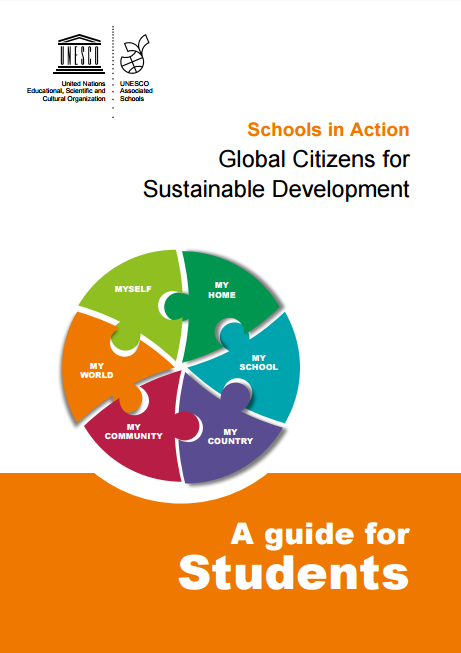 Escuelas en acción Ciudadanos del mundo para el desarrollo sostenible: guía para el alumnado Año de publicación: 2016 Autor corporativo: UNESCO The UNESCO Associated Schools Project Network (ASPnet) in Action: Global Citizens for Sustainable Development student guide aims to introduce secondary school students to Global Citizenship Education (GCED) and Education for Sustainable Development (ESD) and provide them with ideas and activities to contribute proactively to a more peaceful and sustainable world. The guide draws on the discussions and activities of almost 1,100 participants from 104 countries, including ASPnet National Coordinators, school principals, teachers, students and experts who contributed to the ASPnet Online Collaborative Platform: Global Citizens Connected for Sustainable Development in 2014 and 2015 [http://en.unesco.org/aspnet/globalcitizens]. You will find in this student guide: An overview of what it means to be a global citizen and of how you can contribute to sustainable development. Ideas for getting active yourself, as part of your home, school, community, country and globally. Selected activities on GCED and ESD from ASPnet schools around the world. Más allá de 2015: la educación que queremos Año de publicación: 2014 Autor corporativo: UNESCO | United Nations Children's Fund (UNICEF) The post-2015 education agenda should be aspirational, transformative and holistic, and an integral part of the broader post-2015 development agenda. It should be of universal relevance and mobilize all stakeholders in all countries. Education must be a stand-alone goal in the broader post-2015 development agenda and should be framed by a comprehensive overarching goal, with measurable global targets and related indicators. In addition, education must be integrated into other development goals. The future education agenda should be rights-based and reflect a perspective based on equity and inclusion, with particular attention to gender equality and to overcoming all forms of discrimination in and through education, ensuring that no-one is left behind. It must support free and compulsory basic education. It should expand the vision of access for all to reflect relevant learning outcomes through the provision of quality education at all levels, from early childhood to higher education, in safe and healthy environments. It should take a holistic and lifelong learning approach, and provide multiple pathways of learning using innovative methods and information and communication technologies. It should reinforce approaches such as global citizenship education and education for sustainable development, which foster attitudes and behaviours that promote peace, conflict resolution and mutual understanding, tolerance, critical thinking, and respect for cultural diversity and for the environment.
  La Función de la UNESCO en la promoción de la educación como instrumento para prevenir el extremismo violento Año de publicación: 2015 Autor corporativo: UNESCO This item has been included in the provisional agenda of the 197th session of the Executive Board at the request of the United States of America and co-sponsored by Bosnia and Herzegovina, Bulgaria, Costa Rica, Côte d’Ivoire, Djibouti, Finland, France, Germany, Jordan, Kenya, Latvia, Nigeria, Norway, Pakistan, Philippines, Republic of Korea, Rwanda, Senegal, Slovenia, Suriname, Switzerland and Turkey
  Directrices para educadores sobre la manera de combatir la intolerancia y la discriminación contra los musulmanes: afrontar la islamofobia mediante la educación Año de publicación: 2013 Autor corporativo: UNESCO | Council of Europe | OSCE. Office for Democratic Institutions and Human Rights (ODIHR) Intolerance and discrimination against Muslims are not new phenomena. However, they have evolved and gained momentum in recent years, particularly under conditions of the “war on terror”, the global economic crisis, anxieties about national identity and difficulties in coping with the increased diversity in many societies. Such developments have contributed to a growth in resentment and fear of Muslims and Islam that often been fuelled by sections of the media and by some political discourse. Muslims are often portrayed as extremists who threaten the security and well-being of others.These stereotypes have impact not only on young people but also on their parents, as well as on teachers and other education professionals. This presents a new challenge for educators. While teachers cannot be expected to resolve the political and social tensions among communities, they can play a central role in shaping the attitudes and behaviours of young people. The actions and approaches adopted by teachers and school administrators can be crucial in promoting respect for diversity and mutual understanding, both in schools and in society.Developed by OSCE/ODIHR, the Council of Europe and UNESCO, these Guidelines aim to support educators in countering intolerance and discrimination against Muslims. They are intended for a wide audience, including teachers, principals and head teachers, education policymakers and officials, teacher trainers, teacher unions and professional associations, and NGOs. The Guidelines are relevant for both primary and secondary education and can also be used in non-formal education settings.
 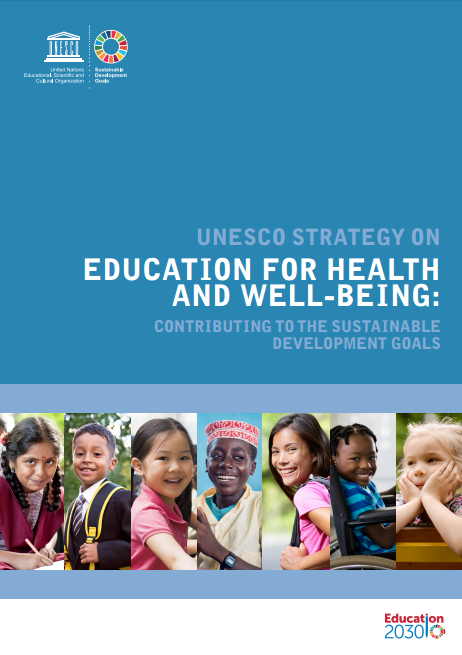 Proyecto de estrategia de la UNESCO sobre la educación para la salud y el bienestar: contribución a los Objetivos de Desarrollo Sostenible Año de publicación: 2016 Autor corporativo: UNESCO This strategy builds on UNESCO’s longstanding commitment to strengthen the links between education and health, reflecting international recognition that a more comprehensive approach to school health and coordinated action across sectors is needed. As stated in the 2015 Incheon Declaration, education develops the skills, values and attitudes that enable citizens to lead healthy and fulfilled lives, make informed decisions, and respond to local and global challenges. It updates previous UNESCO strategies and expands on UNESCO’s work on HIV and on promoting comprehensive sexuality education and safe and inclusive learning environments, placing more emphasis on the role of schools in promoting health. More specifically, it reflects recent developments in the global education, HIV and health agendas, and is aligned with the new UNAIDS 2016-2021 Strategy and the Sustainable Development Goals, in particular SDG 3 Health, SDG 4 Education and SDG 5 Gender Equality. Respuestas del sector de educación frente al bullying homofóbico Año de publicación: 2013 Autor corporativo: UNESCO This publication is part of a Good Policy and Practice series that addresses key themes of UNESCO’s work with the education sector including HIV and AIDS and safe, healthy educational environments for all learners. This volume, on the theme of homophobic bullying in educational institutions, builds on UNESCO’s work on gender, discrimination and violence in schools.
 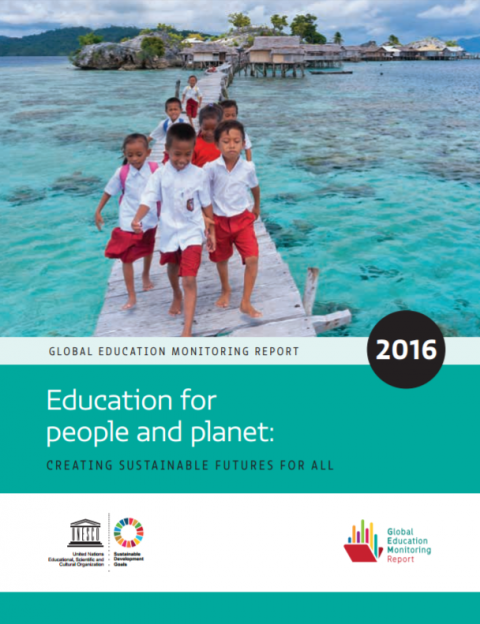 Informe de Seguimiento de la Educación en el Mundo, 2016: La Educación al servicio de los pueblos y el planeta: creación de futuros sostenibles para todos Año de publicación: 2016 Autor corporativo: UNESCO | Global Education Monitoring Report Team Education for People and Planet: Creating Sustainable Futures for All explores the complex relationship between education and the new 2030 Agenda for Sustainable Development, covering six fundamental pillars – Planet, Prosperity, People, Peace, Place and Partnerships. This report shows that education will not deliver its full potential unless participation rates increase dramatically and sustainable development guides education system reform. It also warns of the destructive impact that climate change, conflict, unsustainable consumption and the increasing gap between rich and poor have on education. A huge transformation is needed if we are to create sustainable futures for all.
 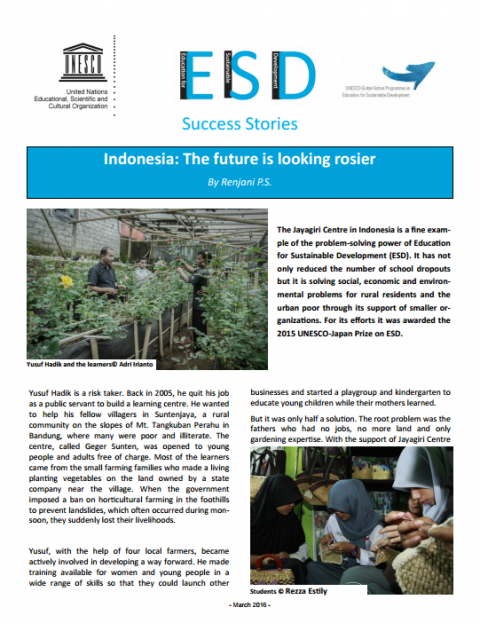 Indonesia: hacia un futuro más prometedor Año de publicación: 2016 Autor: P.S. Renjani Autor corporativo: UNESCO ESD Success Stories are showcasing compelling stories with a personal/human dimension from all five UNESCO regions (Africa, Arab States, Asia and Pacific, Europe & North America and Latin America & the Caribbean). The stories illustrate the wide diversity of ESD approaches and initiatives taking place in different parts of the world. They show how involvement with ESD has changed the lives of specific individual persons and how they have become more active in their community. Each story centers on one individual or a group of individuals.The Jayagiri Centre in Indonesia teaches environment-friendly business skills. It helps reduce the number of school dropouts and supports rural residents.