
Recursos
Exploren una amplia gama de recursos valiosos en GCED para profundizar su comprensión y promover su búsqueda, incidencia, enseñanza y aprendizaje.
792 resultados encontrados
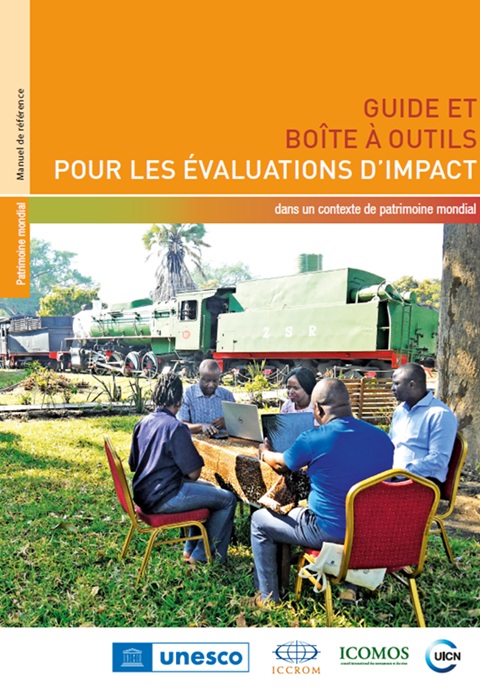 Guide et boîte à outils pour les évaluations d’impact dans un contexte de patrimoine mondial Año de publicación: 2023 Autor: Sarah Court | Eugene Jo | Richard Mackay | Mizuki Murai | Riki Therivel Autor corporativo: UNESCO | International Centre for the Study of the Preservation and Restoration of Cultural Property (ICCROM) | International Council on Monuments and Sites (ICOMOS) | International Union for Conservation of Nature (IUCN) Notre patrimoine mondial menacé : les évaluations d’impact offrent des solutionsLors du 50e anniversaire de la Convention du patrimoine mondial, en 2022, on dénombrait plus de 1 100 sites du patrimoine mondial de l’UNESCO. Ces sites sont si précieux pour l’humanité que leur conservation nous incombe à tous. Pourtant, nombre de ces lieux exceptionnels sont confrontés à la pression croissante qu’exercent les divers types de développement et des projets dans et autour des sites. L’évaluation des impacts de ces projets – avant toute décision de mise en œuvre – est essentielle pour éviter tout dommage causé au patrimoine mondial et identifier des choix durables.Le Guide et boîte à outils pour les évaluations d’impact dans un contexte de patrimoine mondial est la référence incontournable qui explique la démarche à suivre pour atteindre cet objectif. Grâce à des conseils et outils (dont des listes de contrôle et glossaire), il fournit un cadre permettant de réaliser des évaluations d’impact pour les sites du patrimoine culturel et naturel.Élaboré par l’UNESCO et les Organisations consultatives du Comité du patrimoine mondial – l’ICCROM, l’ICOMOS et l’UICN –, ce manuel constitue une base de collaboration intersectorielle et multidisciplinaire en vue de trouver des réponses permettant de protéger les sites du patrimoine mondial et de soutenir un développement qualitatif et approprié. Les États parties, les gestionnaires du patrimoine, les décideurs, les planificateurs et les aménageurs de la Convention du patrimoine mondial sont invités à l’utiliser pour contribuer à la réalisation de notre engagement collectif : la transmission de notre patrimoine inestimable aux générations futures.
  国連持続可能な開発のための教育の10年中間年レビューESDの文脈と構造 Año de publicación: 2009 Autor corporativo: UNESCO This document suggests key findings and ways forward in review of the contexts and strctures of education for sustainable development. Review of contexts and structures for education for sustainable development 2009: key findings & ways forward Año de publicación: 2009 Autor corporativo: UNESCO This document suggests key findings and ways forward in review of the contexts and strctures of education for sustainable development. Education for sustainable development: shaping the future Año de publicación: 2009 Autor corporativo: UNESCO This poster portrays the importance of education for sustainable development in terms of shaping the future. Education for Arctic sustainable development Año de publicación: 2009 Autor: Lars Kullerud Autor corporativo: UNESCO Education is an essential component of sustainable development. However, for the Arctic there is a history of education systems that tried to force central school models on local people, including different degrees of suppression of local language. This has been improved today to various degrees in the Arctic states. However, lack of skilled teachers with local roots is a circumpolar challenge. Arctic higher educational institutions also face many challenges when attempting to be innovative and competitive due to their small size and geographic isolation. The model of the University of the Arctic allows for a dynamic development of shared education systems through mutual cooperation. This network can be a very efficient tool to for delivering a relevant curriculum for a changing North. Education for sustainable development: an expert review of processes and learning Año de publicación: 2011 Autor: Daniella Tilbury Autor corporativo: UNESCO A key objective of this expert review is to gather information to inform the choice of tools and the specific questions which need to be asked as part of the 2011 DESD monitoring and evaluation report. The review seeks clarification on: i) Which commonly accepted learning processes are aligned with ESD and should be promoted through ESD activities? ii) What are ESD and related learning opportunities contributing to sustainable development?
  National journeys towards education for sustainable development, 2011: reviewing national experiences from Chile, Indonesia, Kenya, the Netherlands, Oman Año de publicación: 2011 Autor: I. Mulà | Daniella Tilbury Autor corporativo: UNESCO This publication has sourced information from a series of national reviews commissioned by UNESCO in 2010 and written by authoritative stakeholders in Chile, Indonesia, Kenya, the Netherlands and Oman. The selection of countries was based on: i) work showcased at the 2009 World Conference on Education for Sustainable Development held in Bonn, Germany; ii) submissions to the monitoring and evaluation process for the Decade of Education for Sustainable Development (DESD); as well as iii) through evaluation material submitted by UNESCO staff in regional bureaux of education.The countries showcased in this report are not necessarily the ‘best’ examples of the region, as many other countries are also progressing effectively towards implementing ESD. Rather, the countries selected illustrate the wide diversity of ESD approaches and initiatives taking place in different parts of the learnt world. The national studies were then edited and harmonized before common themes and lessons learned were identified to support other national efforts in moving towards the second half of the UN Decade of Education for Sustainable Development. UN decade of education for sustainable development: success stories Año de publicación: 2011 Autor corporativo: UNESCO The UN Decade of Education for Sustainable Development (DESD, 2005-2014) is a global initiative led by UNESCO. It aims at reorienting education worldwide: everyone should have the opportunity to acquire the values, competencies, skills and knowledge that are needed to contribute to sustainable development. This document includes some achievements of the UN DESD. Education for sustainable development lens: a policy and practice review tool Año de publicación: 2010 Autor corporativo: UNESCO The Education for Sustainable Development (ESD) Lens has been prepared to support UN Member States to respond to these challenges through implementation of the United Nations Decade of Education for Sustainable Development (DESD, 2005- 2014). The ESD Lens supports the goals of the DESD, and encourages policy-makers and practitioners in Member States to initiate the process of re-orienting education, particularly the formal education system, towards sustainable development. The overall goal of the UN Decade of Education for Sustainable Development (DESD) is for countries to integrate the understandings, skills and values inherent in sustainable development into all aspects of national education plans to encourage changes in lifestyles and behaviour that allow for a more sustainable and just society for all. This complements existing Education for All initiatives, and strengthens the objectives of the Millennium Development Goals. Education for Sustainable Development has the potential to improve the quality and relevance of education everywhere.
  Education for Sustainable Devleopment: Sourcebook Año de publicación: 2013 Autor corporativo: UNESCO The target audiences for the Education for Sustainable Development Sourcebook are primary and secondary teachers and mid-level decision-makers, who have responsibility for primary and secondary education. Another primary audience is teacher educators who work with pre-service and in-service primary and secondary school teachers. The purpose of the publication is to describe ways in which education for sustainable development (ESD) can be integrated into primary and secondary schooling. This collection of briefs is designed to complement other ESD materials published by UNESCO. The topics for the briefs were selected in consultation with UNESCO Field Offices and Institutes. The briefs for primary and secondary teachers are specifically written for professional educators who work in formal education settings. The briefs for teachers as well as those for decision-makers address “gaps” in the UNESCO ESD literature.