
Recursos
Exploren una amplia gama de recursos valiosos en GCED para profundizar su comprensión y promover su búsqueda, incidencia, enseñanza y aprendizaje.
1,583 resultados encontrados
 Education for Arctic sustainable development Año de publicación: 2009 Autor: Lars Kullerud Autor corporativo: UNESCO Education is an essential component of sustainable development. However, for the Arctic there is a history of education systems that tried to force central school models on local people, including different degrees of suppression of local language. This has been improved today to various degrees in the Arctic states. However, lack of skilled teachers with local roots is a circumpolar challenge. Arctic higher educational institutions also face many challenges when attempting to be innovative and competitive due to their small size and geographic isolation. The model of the University of the Arctic allows for a dynamic development of shared education systems through mutual cooperation. This network can be a very efficient tool to for delivering a relevant curriculum for a changing North. Education for sustainable development: shaping the future Año de publicación: 2009 Autor corporativo: UNESCO This poster portrays the importance of education for sustainable development in terms of shaping the future. L'éducation au développement durable: façonner l'avenir Año de publicación: 2009 Autor corporativo: UNESCO Cette affiche dépeint l'importance de l'éducation pour le développement durable en termes de façonner l'avenir.
 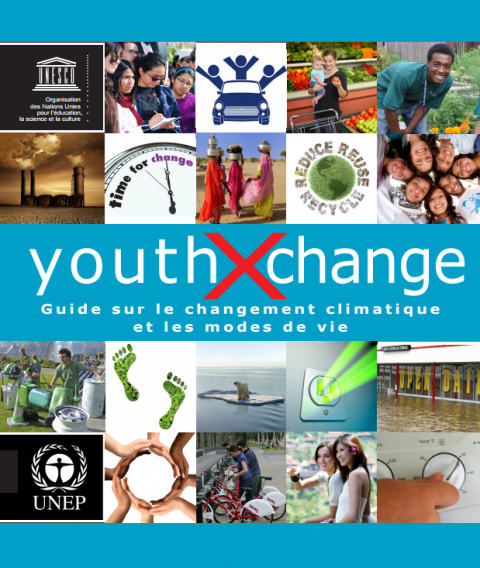 YouthXchange: guide sur le changement climatique et les modes de vie Año de publicación: 2015 Autor: Adam Cade | Rob Bowden Autor corporativo: UNESCO | United Nations Environment Programme (UNEP) Climate Change and Lifestyles is the first in a series of guidebooks supporting the UNESCO/ UNEP YouthXchange (YXC) Initiative, which was created in 2001 to promote sustainable lifestyles among youth (15-24 years) through education, dialogue, awareness raising and capacity building. The series is being produced for young people and people working with youth, such as educators, teachers, trainers and youth leaders in both developed and developing countries. Almost half of the world’s population is under the age of 25, and nearly 90 per cent of them live in developing countries. Youth is a critical stakeholder in the global economy and will be the main actor and motor for change in the near future. Thus, the energy, motivation and creativity of youth are essential assets to stimulating change. Aims of the YXC Guidebook on Climate Change and Lifestyles:• Explore the links between lifestyles and climate change; • Help young people consider the actions they should take towards more sustainable lifestyles;• Support courses and actions that promote greater understanding of climate change and lifestyles among youth. The guidebook:• Considers the causes and effects of climate change and its human impacts and responses, while connecting them to lifestyle choices and the technical and social infrastructures of a society;• Provides scientific, political, economic, social, ethical and cultural perspectives on climate change;• Explains complex issues in accessible language supported by facts, graphics, images, examples and web links;• Develops the critical skills young people need to make personal choices to address the challenges of climate change. 지속가능발전교육 렌즈: 정책 및 실행 평가도구 Año de publicación: 2013 Autor corporativo: UNESCO The Education for Sustainable Development (ESD) Lens has been prepared to support UN Member States to respond to these challenges through implementation of the United Nations Decade of Education for Sustainable Development (DESD, 2005- 2014). The ESD Lens supports the goals of the DESD, and encourages policy-makers and practitioners in Member States to initiate the process of re-orienting education, particularly the formal education system, towards sustainable development. The overall goal of the UN Decade of Education for Sustainable Development (DESD) is for countries to integrate the understandings, skills and values inherent in sustainable development into all aspects of national education plans to encourage changes in lifestyles and behaviour that allow for a more sustainable and just society for all. This complements existing Education for All initiatives, and strengthens the objectives of the Millennium Development Goals. Education for Sustainable Development has the potential to improve the quality and relevance of education everywhere. Стратегии ЮНЕСКО на вторую половину Десятилетия образования в интересах устойчивого развития Организации Объединенных Наций Año de publicación: 2010 Autor corporativo: UNESCO The UNESCO Strategy for the Second Half of the United Nations (UN) Decade of Education for Sustainable Development (DESD) draws on the findings and lessons learnt from the first phase of the DESD monitoring and evaluation (M&E) process (as reflected in the 2009 DESD M&E report Learning for a Sustainable World: Review of Contexts and Structures for Education for Sustainable Development. It also builds on the UNESCO World Conference on ESD and the Bonn Declaration as well as on the outcomes of other key international ESD meetings. The Bonn Declaration gives particular emphasis to the importance of education for the global development agenda and underlines the essential contribution of ESD to shaping the purpose, content and quality of all education. The UNESCO strategy will be implemented in line with the International Implementation Scheme (IIS), which, along with the Bonn Declaration, will provide the global strategic framework for UNESCO and its DESD partners during the second half of the Decade. The Strategy takes into account key DESD regional challenges and opportunities. It is also shaped by the shared vision of education emerging from the four 2008-2009 UNESCO international education conferences: one of education systems that encourage equity and inclusion, quality learning, flexibility and innovation. While UNESCO puts highest emphasis on achieving Education for All (EFA), the Organization’s actions in education extend beyond this, to pay explicit attention to inclusion, social cohesion and social justice, to lifelong learning and to the crucial role of higher education and research. The overall goal of the UNESCO Strategy for the Second Half of the DESD is to support Member States and other stakeholders in addressing global sustainable development challenges at regional, national and global level through ESD, thus addressing the challenges of learning for bringing about a more sustainable world. Estrategia de la UNESCO para la segunda mitad del decenio de las Naciones Unidas de la educación para el desarrollo sostenible Año de publicación: 2010 Autor corporativo: UNESCO The UNESCO Strategy for the Second Half of the United Nations (UN) Decade of Education for Sustainable Development (DESD) draws on the findings and lessons learnt from the first phase of the DESD monitoring and evaluation (M&E) process (as reflected in the 2009 DESD M&E report Learning for a Sustainable World: Review of Contexts and Structures for Education for Sustainable Development. It also builds on the UNESCO World Conference on ESD and the Bonn Declaration as well as on the outcomes of other key international ESD meetings. The Bonn Declaration gives particular emphasis to the importance of education for the global development agenda and underlines the essential contribution of ESD to shaping the purpose, content and quality of all education. The UNESCO strategy will be implemented in line with the International Implementation Scheme (IIS), which, along with the Bonn Declaration, will provide the global strategic framework for UNESCO and its DESD partners during the second half of the Decade. The Strategy takes into account key DESD regional challenges and opportunities. It is also shaped by the shared vision of education emerging from the four 2008-2009 UNESCO international education conferences: one of education systems that encourage equity and inclusion, quality learning, flexibility and innovation. While UNESCO puts highest emphasis on achieving Education for All (EFA), the Organization’s actions in education extend beyond this, to pay explicit attention to inclusion, social cohesion and social justice, to lifelong learning and to the crucial role of higher education and research. The overall goal of the UNESCO Strategy for the Second Half of the DESD is to support Member States and other stakeholders in addressing global sustainable development challenges at regional, national and global level through ESD, thus addressing the challenges of learning for bringing about a more sustainable world. Stratégie de l'UNESCO pour la seconde moitié de la décennie de l'éducation au service du développement durable Año de publicación: 2010 Autor corporativo: UNESCO The UNESCO Strategy for the Second Half of the United Nations (UN) Decade of Education for Sustainable Development (DESD) draws on the findings and lessons learnt from the first phase of the DESD monitoring and evaluation (M&E) process (as reflected in the 2009 DESD M&E report Learning for a Sustainable World: Review of Contexts and Structures for Education for Sustainable Development. It also builds on the UNESCO World Conference on ESD and the Bonn Declaration as well as on the outcomes of other key international ESD meetings. The Bonn Declaration gives particular emphasis to the importance of education for the global development agenda and underlines the essential contribution of ESD to shaping the purpose, content and quality of all education. The UNESCO strategy will be implemented in line with the International Implementation Scheme (IIS), which, along with the Bonn Declaration, will provide the global strategic framework for UNESCO and its DESD partners during the second half of the Decade. The Strategy takes into account key DESD regional challenges and opportunities. It is also shaped by the shared vision of education emerging from the four 2008-2009 UNESCO international education conferences: one of education systems that encourage equity and inclusion, quality learning, flexibility and innovation. While UNESCO puts highest emphasis on achieving Education for All (EFA), the Organization’s actions in education extend beyond this, to pay explicit attention to inclusion, social cohesion and social justice, to lifelong learning and to the crucial role of higher education and research. The overall goal of the UNESCO Strategy for the Second Half of the DESD is to support Member States and other stakeholders in addressing global sustainable development challenges at regional, national and global level through ESD, thus addressing the challenges of learning for bringing about a more sustainable world. L'Education pour le développement durable: ouvrage de référence Año de publicación: 2012 Autor corporativo: UNESCO The target audiences for the Education for Sustainable Development Sourcebook are primary and secondary teachers and mid-level decision-makers, who have responsibility for primary and secondary education. Another primary audience is teacher educators who work with pre-service and in-service primary and secondary school teachers. The purpose of the publication is to describe ways in which education for sustainable development (ESD) can be integrated into primary and secondary schooling. This collection of briefs is designed to complement other ESD materials published by UNESCO. The topics for the briefs were selected in consultation with UNESCO Field Offices and Institutes. The briefs for primary and secondary teachers are specifically written for professional educators who work in formal education settings. The briefs for teachers as well as those for decision-makers address “gaps” in the UNESCO ESD literature. 유엔 지속가능발전교육 10년: 성공 사례 Año de publicación: 2011 Autor corporativo: UNESCO 유엔 지속가능발전교육 10년(UN Decade of Education for Sustainable Development , DESD, 2005-2014)은 유네스코가 주도하는 글로벌 이니셔티브이다. 이것은 전세계의 교육 방향을 재조정하는 것을 목표로 한다. 즉, 지속 가능한 발전에 기여하도록 모든 사람들은 필요한 가치, 역량, 기술과 지식을 습득할 수 있는 기회를 가져야 한다. 이 문서는 유엔 DESD의 일부 업적을 포함한다.