
Recursos
Exploren una amplia gama de recursos valiosos en GCED para profundizar su comprensión y promover su búsqueda, incidencia, enseñanza y aprendizaje.
792 resultados encontrados
 Report on the survey on the implementation of the road map for arts education Año de publicación: 2010 Autor corporativo: UNESCO The Road Map for Arts Education is a reference document that aims to explore the role of arts education in meeting the need for creativity and cultural awareness in the 21st Century, while placing emphasis on the strategies required to introduce or promote arts education in the learning environment. Within this conceptual framework, all UNESCO Member States interested in initiating or developing arts education practices can mould their own national policy guidelines, adapted to their socio-cultural specificities. With the Road Map, UNESCO advocates the essential role of arts education within societies, to create a common ground of understanding for all stakeholders. The development of the Road Map for Arts Education was a lengthy and comprehensive consultation process. The document was first elaborated by a group of experts and UNESCO, then presented at the First World Conference on Arts Education (Lisbon, 2006) and later revised and updated, following recommendations from NGOs and Member States. The Road Map was finally distributed to the UNESCO Member States in November 2007 in English and French and then translated into Spanish and Russian following popular demand. More than a year after this distribution, UNESCO launched a wide-ranging survey in order to assess the implementation of the Road Map in its 193 Member States. Through its National Commissions, the Organization relayed this document to Ministries of both Education and Culture. The aim of this exercise was threefold: to learn whether the Road Map was being applied and to what extent it was influencing policy decisions at national level; to act as a reminder of the importance of the UNESCO reference document and encourage its use; finally, to assess the situation of arts education in the responding countries. Thus, this survey not only acted as a catalyst for the implementation of the Road Map, but also provided precious knowledge on arts education around the world. The Member States’ responses also contributed greatly to the Second World Conference on Arts Education (Seoul, May 2010), inspiring one of its main themes and the topics for a number of workshops. They also encouraged a more integral participation of these States in the conference through preparatory consultations.
  Thinkpiece on education and conflict Año de publicación: 2009 Autor: Lynn Davies Autor corporativo: UNESCO This paper looks first at the learning sites generally (violent schools, schools as a weapon of war, curriculum and textbooks). It then focuses on specific groups in conflict – gender, language, refugees, child soldiers. Thirdly it discusses education policy and donor intervention; and finally talks of the role of research. All these overlap hugely. This is not a prescription for how the Global Monitoring Report should be structured, but identification of themes and lessons learned that seem the most significant.
  Considerations on the follow-up of the United Nations International Year for the Rapprochement of Cultures with regard to implementation of the Kyiv Statement towards Mutual Understanding and Dialogue Año de publicación: 2011 Autor corporativo: UNESCO As one of the co-initiators of the International Year for the Rapprochement of Cultures, Ukraine proposed to initiate a general discussion regarding the protection of monuments and sites with religious or spiritual meaning (hereinafter referred to as religious2 and sacred3 properties) at the international level. This discussion was timely and in line with one of the four themes, selected to build an action plan for the Year in the fields of UNESCO’s competence, namely to promote reciprocal knowledge of cultural, ethnic, linguistic and religious diversity. 2. This initiative, having constituted one of the essential elements of the International Year of Rapprochement of Cultures, is aimed at enhancing protection and management of religious properties. It stems from the appeal of the Ukrainian authorities, launched at the 35th session of the UNESCO General Conference (2009), inviting all Member States to participate in the International Seminar “The Role of religious communities in the management of World Heritage properties” (2-5 November 2010). This announcement was welcomed by UNESCO within the framework of the Year. Numerous Member States expressing their support for the proposal designated representatives to participate in this Seminar. The elaboration of the Kyiv Statement (as one of the main outcomes of the Seminar) and its adoption in close cooperation with representatives of religious communities contributes to the creation of a culture of dialogue.
 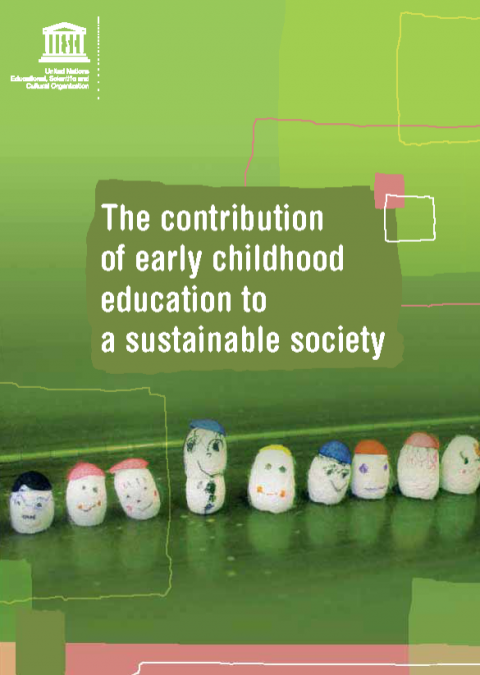 The contribution of early childhood education to a sustainable society Año de publicación: 2008 Autor corporativo: UNESCO This report originates from the international workshop, ‘The Role of Early Childhood Education for a Sustainable Society’, jointly organized in Göteborg, Sweden, by Göteborg University, Chalmers University of Technology and the City of Göteborg, from 2 to 4 May 2007. It was attended by thirty-five participants from sixteen different countries (see ‘List of Participants’). The workshop was a follow-up to the international conference on education for sustainable development, ‘Learning to Change Our World’, held in May 2004, in Göteborg. It was one of four preparatory workshops leading to another international conference on education for sustainable development, to be organized in 2008 or 2009, in the same city. The aim of the four workshops is to discuss promoters and barriers related to learning for sustainability, and to propose recommendations for the upcoming international conference. The present workshop was conceived for the following reasons. First, our societies urgently require new kinds of education that can help prevent further degradation of our planet, and that foster caring and responsible citizens genuinely concerned with and capable of contributing to a just and peaceful world. Second, these new kinds of education must be available to all – not only a handful of people – and take place in various settings, including families and communities. Third, they must begin in early childhood, as the values, attitudes, behaviours and skills acquired in this period may have a long-lasting impact in later life. Thus, early childhood education clearly has an important place in the efforts to bring about sustainable development.
  UN Decade of Education for Sustainable Development, 2005-2014: the DESD at a glance Año de publicación: 2005 Autor corporativo: UNESCO This document briefs on the Decade of Education for Sustainable Development (DESD), detailing its objectives, the implementation plans, good practices, and challenges that DESD faces.
 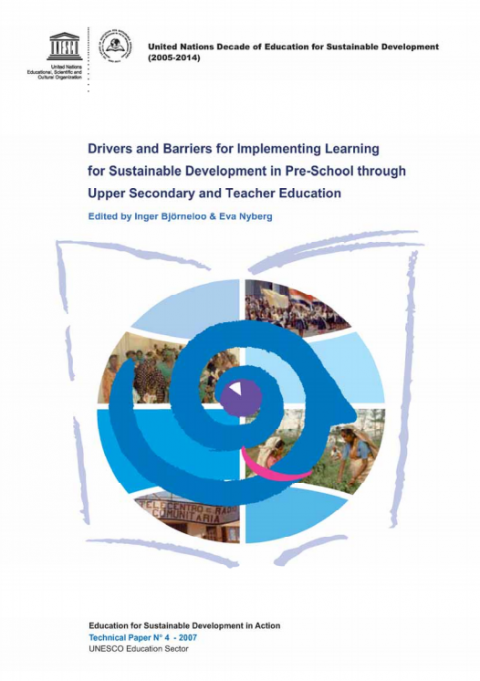 Drivers and barriers for implementing learning for sustainable development in pre-school through upper secondary and teacher education Año de publicación: 2007 Autor: Inger Björneloo | Eva Nyberg Autor corporativo: UNESCO This publication is the product of the workshop on Drivers and Barriers for Implementing Learning for Sustainable Development in Pre-School through Upper Secondary and Teacher Education held in Göteborg, Sweden in March 2006. The workshop was the second in the series of workshops emanating from the Learning to Change Our World International Consultation on Learning for Sustainable Development, held in Göteborg in May 2004 on behalf of the Swedish Government. The purpose of this paper is to make visible some of the pluralism of different perspectives on education for sustainable development. This pluralism, which, during the workshop seemed to hinder progress, could through this be turned into a forceful driver instead of remaining a frustrating barrier. Contemporary issues in human rights education Año de publicación: 2011 Autor corporativo: UNESCO The format of this publication presents the main strands concerning the role of human rights education as well as the key elements for its implementation. Each strand addresses current issues and challenges faced when incorporating a culture for human rights, also illustrating the collective importance of human rights education as a fundamental base for a peaceful and just society. Under each strand, a list of examples inspired by country initiatives is proposed. Education sector technical notes: human rights education Año de publicación: 2013 Autor corporativo: UNESCO Human rights are enshrined in international law, and states have an obligation to respect, protect and fulfil them. Despite this, human rights violations remain widespread. ◗ Educating children and adults on human rights is essential. Individuals and groups must understand their rights in order to see them upheld and to ensure that their own behavior does not compromise the rights of others. ◗ States have an obligation to promote human rights and human rights education is now recognized as a right in itself. ◗ UNESCO, along with the Office of the United Nations High Commissioner for Human Rights, co-leads the World Programme for Human Rights Education (2005-ongoing). Le Risposte del settore educativo al bullismo omofobico Año de publicación: 2014 Autor corporativo: UNESCO This publication is part of a Good Policy and Practice series that addresses key themes of UNESCO’s work with the education sector including HIV and AIDS and safe, healthy educational environments for all learners. This volume, on the theme of homophobic bullying in educational institutions, builds on UNESCO’s work on gender, discrimination and violence in schools. Respostas do Setor de Educação ao bullying homofóbico Año de publicación: 2013 Autor corporativo: UNESCO This publication is part of a Good Policy and Practice series that addresses key themes of UNESCO’s work with the education sector including HIV and AIDS and safe, healthy educational environments for all learners. This volume, on the theme of homophobic bullying in educational institutions, builds on UNESCO’s work on gender, discrimination and violence in schools.