
Recursos
Exploren una amplia gama de recursos valiosos en GCED para profundizar su comprensión y promover su búsqueda, incidencia, enseñanza y aprendizaje.
1,583 resultados encontrados
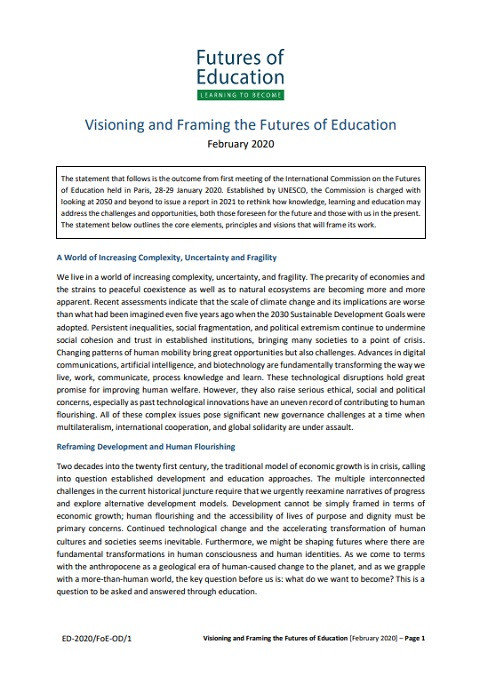 Visioning and Framing the Futures of Education: February 2020 Año de publicación: 2020 Autor corporativo: UNESCO This statement is the outcome from first meeting of the International Commission on the Futures of Education held in Paris, 28-29 January 2020. Established by UNESCO, the Commission is charged with looking at 2050 and beyond to issue a report in 2021 to rethink how knowledge, learning and education may address the challenges and opportunities, both those foreseen for the future and those with us in the present. Visióny marco de los futuros de la educación: Febrero de 2020 Año de publicación: 2020 Autor corporativo: UNESCO La declaración es el resultado de la primera reunión de la Comisión Internacional sobre los Futuros de la Educación, celebrada en París los días 28 y 29 de enero de 2020. La Comisión, establecida por la UNESCO, se encarga de mirarhacia 2050 y más allá para publicar en 2021 un informe con el fin de repensar el modo en que el conocimiento, el aprendizaje y la educación pueden ayudar a abordar los desafíos y las oportunidades, tanto los previstos para el futuro como los que nos acompañan en el presente. Note de cadrage sur les Futurs de l'éducation: Février 2020 Año de publicación: 2020 Autor corporativo: UNESCO Cette note est le fruit de la première réunion de la Commission internationale sur les futurs de l’éducation qui s’est tenue à Paris les 28 et 29 janvier 2020. Etablie par l’UNESCO, la Commission est chargée de repenser lessavoirs, l’apprentissage et l’éducationface aux défis et auxopportunités, tant ceux envisagés à l’horizon2050 et au-delà, que ceux duprésent.
  Re|shaping cultural policies: a decade promoting the diversity of cultural expressions for development Año de publicación: 2015 Autor corporativo: UNESCO This Report presents the work of fourteen independent experts, as well as the Secretary of the Convention and the Principal Editor, who have analysed the implementation of the Convention on the Protection and Promotion of the Diversity of Cultural Expressions. Its purpose is to move forward the process of monitoring the Convention’s implementation that was put in place by a mechanism of Quadrennial Periodic Reports (QPRs) approved by the Convention’s Conference of Parties in 2011. The contributors have consulted the 71 reports submitted by Parties, but have also used data derived from other, non-official sources and have drawn upon their own expert experience. Re|pensar las politicas culturales: 10 anos de promocion de la diversidad de las expresiones culturales para el desarrollo Año de publicación: 2015 Autor corporativo: UNESCO This Report presents the work of fourteen independent experts, as well as the Secretary of the Convention and the Principal Editor, who have analysed the implementation of the Convention on the Protection and Promotion of the Diversity of Cultural Expressions. Its purpose is to move forward the process of monitoring the Convention’s implementation that was put in place by a mechanism of Quadrennial Periodic Reports (QPRs) approved by the Convention’s Conference of Parties in 2011. The contributors have consulted the 71 reports submitted by Parties, but have also used data derived from other, non-official sources and have drawn upon their own expert experience. Re|penser les politiques culturelles: 10 ans de promotion de la diversité des expressions culturelles pour le développement Año de publicación: 2015 Autor corporativo: UNESCO This Report presents the work of fourteen independent experts, as well as the Secretary of the Convention and the Principal Editor, who have analysed the implementation of the Convention on the Protection and Promotion of the Diversity of Cultural Expressions. Its purpose is to move forward the process of monitoring the Convention’s implementation that was put in place by a mechanism of Quadrennial Periodic Reports (QPRs) approved by the Convention’s Conference of Parties in 2011. The contributors have consulted the 71 reports submitted by Parties, but have also used data derived from other, non-official sources and have drawn upon their own expert experience.
  Preventing Violent Extremism through Education: A guide for policy-makers Año de publicación: 2017 Autor corporativo: UNESCO This publication offers technical guidance for education professionals (policy-makers, teachers and various education stakeholders) on how to address the concrete challenges posed by violent extremism. The Guide particularly aims to help policy-makers within ministries of education to prioritize, plan and implement effective preventive educationrelated actions, contributing to national prevention efforts. La Prévention de l'extrémisme violent par l'éducation Año de publicación: 2017 Autor corporativo: UNESCO Cette publication propose un guide technique pour les professionnels de l’éducation (décideurs, enseignants et autres acteurs du domaine) sur les façons d’adresser les défis posés par l’extrémisme violent. Le Guide vise particulièrement à assister les décideurs au sein des ministères de l’Éducation pour prioriser, planifier et instaurer des actions préventives en milieu scolaire complémentaires aux mesures préventives nationales. Preventing Violent Extremism through Education: A guide for policy-makers Año de publicación: 2017 Autor corporativo: UNESCO 该出版物在如何处理暴力极端主义带来的具体挑战的问题上为教育领域人员(政策制定者、教师以及各类教育利益相关者)提供了技术性的指导。该指导手册特别旨在帮助教育相关教育部门的政策制定者从教育方面入手优先考虑、规划并采取有效的预防性的相关行动,为国家预防工作做出贡献。
  Holocaust Education in a Global Context: Report Año de publicación: 2013 Autor corporativo: UNESCO Teaching and learning about the Holocaust, which until this point had largely been a matter of regional interest, for Europeans, as well as North Americans and Israelis, became officially an issue of universal concern. Other countries are now invited to teach about the Holocaust even if they do not have a direct link to the event. This raises many issues concerning the pedagogical implications of this global perspective on Holocaust education. Why and how is the Holocaust taught in countries that have no connections with the genocide and the history of the Jewish people? How does this history connect and resonate with the preoccupations of these countries? Generally speaking, what could be the purposes and the benefits of teaching about the Holocaust globally?In order to address these issues, UNESCO organized an experts-meeting on 27 April 2012, in partnership with the Topography of Terror Foundation (Berlin, Germany). The purpose was specifically to clarify the following questions: What are the current trends of Holocaust education worldwide? How can the Holocaust be studied in a comparative fashion in the classroom? In which ways does Holocaust education contribute to the prevention of genocide? Furthermore, how is it taught in a human rights education perspective? Can the Holocaust provide a suitable framework to address other traumatic events of the past?