
Recursos
Exploren una amplia gama de recursos valiosos en GCED para profundizar su comprensión y promover su búsqueda, incidencia, enseñanza y aprendizaje.
1,583 resultados encontrados
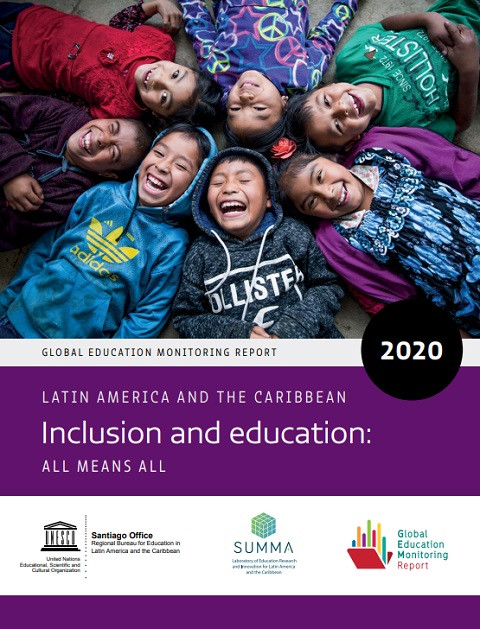 Latin America and the Caribbean 2020: Inclusion and Education; All Means All (Global Education Monitoring Report) Año de publicación: 2020 Autor corporativo: Global Education Monitoring Report Team | UNESCO | Laboratory of Education Research and Innovation for Latin America and the Caribbean (SUMMA) Latin America and the Caribbean has the largest and most challenging socio-economic inequalities in the world, which have shaped its education systems over the decades. This report looks at everyone both in and excluded from education in the region, pinpointing barriers facing learners, especially when multiple disadvantages intersect. The report also explores challenges in education posed by COVID-19 and the need for urgent action to prevent an exacerbation of inequalities. Produced by the Global Education Monitoring (GEM) Report team, in partnership with the UNESCO Regional Bureau for Education in Latin America and the Caribbean (OREALC) and the Laboratory of Education Research and Innovation for Latin America and the Caribbean (SUMMA), the report assesses key solutions for greater inclusion through several case studies from the region. It provides in-depth analysis on challenges to inclusion in education arising from migration and displacement in Colombia and Costa Rica; remoteness in Brazil and Suriname; disability in Cuba and Nicaragua; gender in Peru and Jamaica; sexual orientation, gender identity and expression in Chile and Mexico; poverty in the Dominican Republic and Honduras; ethnicity in Bolivia and Ecuador; and incarceration in El Salvador and Uruguay. Building on the 2020 Global Education Monitoring Report, this regional edition concludes that strong laws and policies in Latin America and the Caribbean demonstrate a commitment to inclusion, but that the daily realities faced by learners suggest implementation is lagging. Recommendations are aimed at promoting more inclusive education systems to benefit all children and youth, no matter their background, identity or ability. The recommendations provide a systematic framework for identifying and dismantling barriers for vulnerable populations, according to the principle that ‘every learner matters and matters equally’. América Latina y el Caribe 2020: Inclusión y educación; Todos y todas sin excepción (Informe de seguimiento de la educación en el mundo) Año de publicación: 2020 Autor corporativo: Global Education Monitoring Report Team | UNESCO | Laboratory of Education Research and Innovation for Latin America and the Caribbean (SUMMA) América Latina y el Caribe es la región con las mayores y más tenaces desigualdades socioeconómicas del mundo. Durante decenios estas desigualdades se han reflejado en sus sistemas educativos. El presente informe examina a quiénes incluyen y a quiénes excluyen estos sistemas y llama la atención sobre las barreras que enfrentan los educandos, especialmente cuando están expuestos a múltiples desventajas. El informe también explora los nuevos retos educativos que plantea la pandemia de la Covid-19 y la necesidad de actuar sin dilación para evitar que se agraven las desigualdades. El informe, elaborado por el equipo del Informe de Seguimiento de la Educación en el Mundo (Informe GEM), en colaboración con la Oficina Regional de Educación para América Latina y el Caribe (OREALC/ UNESCO Santiago) y el Laboratorio de Investigación e Innovación en Educación para América Latina y el Caribe -SUMMA, evalúa algunas de las principales iniciativas emprendidas para mejorar la inclusión, basándose en varios estudios de casos de la región. Analiza en profundidad algunos ejemplos de los grandes desafíos que amenazan la inclusión en la educación: migración y desplazamiento en Colombia y Costa Rica; aislamiento rural en el Brasil y Suriname; discapacidad en Cuba y Nicaragua; discriminación de género en el Perú y Jamaica; orientación sexual e identidad y expresión de género en Chile y México; pobreza en la República Dominicana y Honduras; etnicidad en Bolivia y el Ecuador; y jóvenes en situación de privación de libertad en El Salvador y el Uruguay. Esta edición regional del Informe de Seguimiento de la Educación en el Mundo 2020 concluye que, si bien las leyes y políticas de América Latina y el Caribe demuestran la firme determinación de promover la inclusión, la realidad cotidiana de los alumnos y las alumnas sugiere que la aplicación práctica lleva retraso. Se formulan recomendaciones con el objeto de promover sistemas de educación más inclusivos en beneficio de todos los niños, niñas y jóvenes, sin distinción de origen, identidad o capacidad. Las recomendaciones brindan un marco sistemático que permite identificar y eliminar barreras para las poblaciones marginadas, conforme al principio de que “cada alumno es importante y todos los alumnos importan por igual”.
  Youth and Violent Extremism on Social Media: Mapping the Research Año de publicación: 2017 Autor: Séraphin Alava | Divina Frau-Meigs | Ghayda Hassan Autor corporativo: UNESCO | Information for All Programme (IFAP) Does social media lead vulnerable individuals to resort to violence? Many people believe it does. And they respond with online censorship, surveillance and counter-speech. But what do we really know about the Internet as a cause, and what do we know about the impact of these reactions? All over the world, governments and Internet companies are making decisions on the basis of assumptions about the causes and remedies to violent attacks.The challenge is to have analysis and responses firmly grounded. The need is for a policy that is constructed on the basis of facts and evidence, and not founded on hunches – or driven by panic and fearmongering.It is in this context that UNESCO has commissioned the study titled Youth and Violent Extremism on Social Media – Mapping the Research. This work provides a global mapping of research (mainly during 2012-16) about the assumed roles played by social media in violent radicalization processes, especially when they affect youth and women. The research responds to the belief that the Internet at large is an active vector for violent radicalization that facilitates the proliferation of violent extremist ideologies.Indeed, much research shows that protagonists are indeed heavily spread throughout the Internet. There is a growing body of knowledge about how terrorists use cyberspace. Less clear, however, is the impact of this use, and even more opaque is the extent to which counter measures are helping to promote peaceful alternatives. While Internet may play a facilitating role, it is not established that there is a causative link between it and radicalization towards extremism, violent radicalization, or the commission of actual acts of extremist violence. Молодежь и насильственный экстремизм в социальных медиа: Сопоставление исследований Año de publicación: 2017 Autor: Séraphin Alava | Divina Frau-Meigs | Ghayda Hassan Autor corporativo: UNESCO | Information for All Programme (IFAP) Оказывают ли влияние социальные сети на уязвимые группы молодежи, в последствие которого они прибегают к насилию? Многие считают, что да. И они отвечают онлайн-цензурой, наблюдением и контрречью. Но что действительно мы знаем об Интернете в качестве причины развития насилия, и что мы знаем о влиянии реакций людей? Во всем мире правительства и интернет-компании принимают решения на основе предположений о причинах и средствах защиты от насильственных нападений.Задача состоит в том, чтобы анализ и ответы были прочно обоснованы. Существует необходимость в политике, которая построена на основе фактов и доказательств, а не основана на суждениях или на панике и страхе.Именно в этом контексте ЮНЕСКО поручила провести исследование под названием «Молодежь и насильственный экстремизм в социальных медиа - сопоставление исследований". Эта работа обеспечивает глобальное сопоставление (в основном в течение 2012-16 гг.) о предполагаемых ролях, которые играют социальные медиа в процессе радикализации, особенно когда они затрагивают молодежь и женщин. Исследование реагирует на убеждение, что Интернет в целом является активным вектором насильственной радикализации, что способствует распространению насильственных экстремистских идеологий.Действительно, много исследований показывает, что протагонисты достаточно широко распространены по всему Интернету. Eсть растущий объем знаний о том, как террористы используют киберпространство. Менее ясное, однако,влияние этого использования и еще более непрозрачное - это степень, в которой встречные меры помогают продвигать мирные альтернативы.
  UNESCO Roadmap for Implementing the Global Action Programme on Education for Sustainable Development Año de publicación: 2014 Autor corporativo: UNESCO To create a world that is more just, peaceful and sustainable, all individuals and societies must be equipped with and empowered by knowledge, skills and values as well as be instilled with a heightened awareness to drive such change. There is now a growing international recognition of Education for Sustainable Development (ESD) as an integral element of quality education and a key enabler for sustainabledevelopment. Both the Muscat Agreement adopted at the Global Education For All Meeting in 2014 (GEM) and the proposal for Sustainable Development Goals (SDGs) developed by the Open Working Group of the UN General Assembly on SDGs (OWG) include ESD in the proposed targets for the post-2015 agenda.In 2013, the 37th session of the General Conference of UNESCO endorsed the Global Action Programme (GAP) on ESD as the follow-up to the UN Decade of ESD (2005-2014). Building on the achievements of the Decade, the GAP aims to generate and scale up concrete actions in ESD. The present Roadmap communicates the GAP endorsed by UNESCO Member States (37 C/Resolution 12) to decision-makers, stakeholders and actors, and provides suggestions for the implementation of the GAP, as well as details on UNESCO’s role. Feuille de route de l'UNESCO pour la mise en œuvre du programme d'action mondiale sur l'éducation pour le développement durable Año de publicación: 2014 Autor corporativo: UNESCO Les défis mondiaux interconnectés d'aujourd'hui exigent des réponses qui sont enracinées dans l'esprit de notre humanité collective. Je crois que les risques et les opportunités auxquels nous sommes confrontés appellent à un changement de paradigme qui ne peut être intégré dans nos sociétés par le biais de l'éducation et de l'apprentissage. Le rôle de l'éducation en tant que catalyseur pour la construction d'un avenir meilleur et plus durable pour tous a acquis une reconnaissance croissante, ce qui conduit à la déclaration de la Décennie des Nations Unies pour l'éducation pour le développement durable en 2005. Cet engagement a gagné davantage de force lorsque les États membres se sont engagés à promouvoir Education pour le développement durable au-delà de la fin de la Décennie au Royaume-Nationsconférenceon développement durable 2012 - Rio + 20. Pour tirer profit des réalisations et de créer un nouvel élan lorsque la Décennie des Nations Unies se ferme en 2014, l'UNESCO, en tant qu'organisme chef de file de la Décennie, a mis au point un programme d'action mondiale sur l'éducation pour le développement durable. Sur la base de larges consultations et des contributions d'un large éventail de parties prenantes, le programme a été approuvé par le Generalconférencein UNESCO 2013. Elle intervient à un moment où la communauté internationale est chargé de proposer un nouvel ensemble d'objectifs de développement durable qui sont orientés vers l'action, global dans la nature et universellement applicable.En tant que suivi de la Décennie, le Programme d'action mondial est également conçu comme un béton, contribution tangible à l'après 2015 développement et d'éducation agendas L'. Le Programme d'action mondial est livré avec une feuille de route de mise en œuvre détaillé. Il est destiné à toutes les parties prenantes - gouvernements, les organisations de la société civile, le secteur privé, les médias, la communauté universitaire et de recherche, les organisations intergouvernementales et d'autres institutions pertinentes qui facilitent et appuyer l'apprentissage et la formation, tout le chemin aux enseignants et aux apprenants individuels. La feuille de route explique le Programme de but, les objectifs et les domaines d'action prioritaires afin de permettre l'orientation stratégique et l'engagement des parties prenantes, ainsi que des stratégies de mise en œuvre et de Suivi. Je souhaite que le Programme d'action mondial, qui sera lancé à l'éducation Worldconférenceon pour le développement durable à Aichi-Nagoya, au Japon (Novembre 2014), sera successed dans la mobilisation de la communauté des acteurs de l'éducation pour le développement durable et de fournir des conseils pratiques pour sa mise en œuvre effective . Nous avons tous un intérêt profond dans son succès. Avant-propos Introduction - A Better Tomorrow Begins Today - De la Décennie de l'EDD au programme d'action mondial - Esquisse d'une vision commune - Comprendre EDD Feuille de route - But et objectifs - Domaines d'action prioritaires - Stratégies - Mécanismes - Ressources - Suivi et évaluation Annexe - Action Globale Programme sur l'éducation pour le développement durable comme le suivi de la Décennie des Nations Unies pour le développement durable après 2014. ЮНЕСКО Дорожная карта осуществления Глобальной программы действий по образованию в интересах устойчивого развития Año de publicación: 2014 Autor corporativo: UNESCO Для построения более справедливого, мирного и устойчивого мирового сообщества каждый отдельный человек и каждое общество должны быть обеспечены и вооружены знаниями, навыками и ценностными ориентирами, а также обладать четким пониманием того, как добиться подобных изменений. Сегодня мы являемся свидетелями растущего международного признания принципов образования в интересах устойчивого развития (ОУР) как неотъемлемого элемента качественного образования и ключевого фактора устойчивого развития. В Маскатском соглашении, принятом на Глобальном совещании по программе «Образование для всех» в 2014 г., а также в предложении по целям в области устойчивого развития (ЦУР), подготовленном Рабочей группой открытого состава Генеральной Ассамблеи ООН по ЦУР, образование в интересах устойчивого развития фигурирует в числе целей, предложенных к включению в повестку дня на период после 2015 г.В 2013 г. 37-я сессия Генеральной конференции ЮНЕСКО одобрила Глобальную программу действий (ГПД) по ОУР в качестве деятельности по итогам Десятилетия образования в интересах устойчивого развития Организации Объединенных Наций (2005-2014 гг.).Развивая достигнутые в рамках Десятилетия успехи, ГПД направлена на осуществление конкретной деятельности в области ОУР и расширение ее масштабов. Цель настоящей Дорожнойкарты – информировать директивные органы, заинтересованные стороны и участников о принятии государствами – членами ЮНЕСКО Глобальной программы действий и представить предложения по осуществлению ГПД, а также информацию о роли ЮНЕСКО в ее реализации.
  The Digital Transformation of Education: Connecting Schools, Empowering Learners Año de publicación: 2020 Autor: Ana Sepúlveda | Doreen Bogdan-Martin | Alex Wong | Chris Fabian | Borhene Chakroun | Anna Polomska | Samantha O’Riordan | Miguel Alcaine | Istvan Bozsoki | Vladimir Daigele | Jose Maria Diaz Batanero | Hani Eskandar | Aminata Amadou Garba | John Garrity | Farid Nakhli | Sylvia Poll Ahrens | Martin Schaaper | Christine Sund | Nancy Sundberg | Sandeep Taxali | Cleveland Thomas | Frank McCosker | James Lo | Fengchun Miao | Jaime Archundia | Janice Dean | Sophia Farrar | Sunita Grote | Aditi Poddar | Naroa Zurutuza | Nanjira Sambuli | Kavita Gupta Autor corporativo: International Telecommunication Union (ITU) | UNESCO | United Nations Children's Fund (UNICEF) This report looks into school connectivity and introduces a methodology and framework for mapping and connecting primary and secondary schools to the Internet. It aims to help governments, their partners and interested stakeholders to develop more holistic school connectivity plans. The analysis of this report provides a better understanding of the school connectivity landscape and requirements, to evaluate the benefits of different technologies for different environments, and to analyze business and financial models, as well as suitable content articulating connectivity with quality, safe, and inclusive learning.
  From insult to inclusion: Asia-Pacific report on school bullying, violence and discrimination on the basis of sexual orientation and gender identity Año de publicación: 2015 Autor corporativo: UNESCO This review recognises the complexity in terminology globally, and within the region, on sex, sexuality and gender. For simplicity, ‘SOGIE-based bullying, violence and discrimination’ is used to refer to the various anifestations of violence and exclusion based on gender discrimination, gender role expectations and stereotypes, intersex prejudice, and societal expectations for heterosexual relationships. This is sometimes referred to as homophobic or transphobic bullying, violence and discrimination. This report considers violence experienced by children and young people because of actual or perceived sexual orientation and gender identity or expression, or because their bodies differ from typical definitions of male or female. The term ‘LGBTI people/youth’ is used in this report when inclusive of intersex persons, and LGBT when the situation or needs of intersex people/ youth have not been considered. Local terms and those from original studies are also included, and the glossary provides information for readers on concepts and terms in this report. De l'insulte à l'inclusion: Rapport sur l'Asie-Pacifique sur les brimades à l'école, la violence et la discrimination sur la base de l'orientation sexuelle et l'identité de genre Año de publicación: 2015 Autor corporativo: UNESCO Cet avis reconnaît la complexité de la terminologie au niveau mondial, et dans la région, sur le sexe, la sexualité et le genre. Par souci de simplicité, ‘sur la base Sogie l'intimidation, la violence et la discrimination’ est utilisé pour désigner les différents anifestations de violence et d'exclusion fondées sur la discrimination entre les sexes, les attentes de rôle de genre et les stéréotypes, les préjugés intersexe et attentes de la société pour les relations hétérosexuelles. Ceci est parfois désigné comme homosexuels ou les transsexuels intimidation, la violence et la discrimination. Ce rapport considère la violence vécue par les enfants et les jeunes en raison de l'orientation et l'identité ou l'expression sexuelle réelle ou perçue, ou parce que leurs corps diffèrent des définitions typiques de sexe masculin ou féminin. Le terme «personnes LGBTI / jeunesse» est utilisé dans ce rapport lorsque compris les personnes intersexuées et LGBT lorsque la situation ou les besoins des personnes intersexuées / jeunes n'ont pas été pris en considération. Les termes locaux et ceux des études originales sont également inclus, et le glossaire fournit des informations pour les lecteurs sur les concepts et termes utilisés dans ce rapport.