
Recursos
Exploren una amplia gama de recursos valiosos en GCED para profundizar su comprensión y promover su búsqueda, incidencia, enseñanza y aprendizaje.
1,583 resultados encontrados
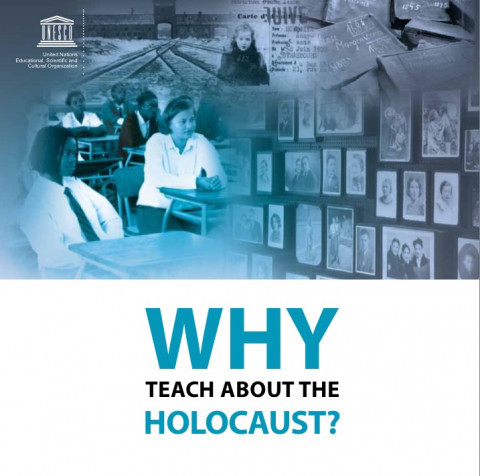 Why Teach about the Holocaust? Año de publicación: 2014 Autor corporativo: UNESCO The Holocaust was a turning point in human history. Understanding the genocide of the Jewish people and other crimes perpetrated by the Nazi regime remains of great signi cance in the modern world.Regardless of where we live or who we are, learning about this universal history can help engage students in a critical re action about the roots of genocide and the necessity to nurture peace and human rights to prevent such atrocities in the future.This short introduction provides an essential overview on education about the Holocaust that can support policymakers, educators and students alike in their understanding of genocide and why it is vital that we continue to teach about the Holocaust today. ¿Por qué enseñar sobre el holocausto? Año de publicación: 2014 Autor corporativo: UNESCO The Holocaust was a turning point in human history. Understanding the genocide of the Jewish people and other crimes perpetrated by the Nazi regime remains of great signi cance in the modern world.Regardless of where we live or who we are, learning about this universal history can help engage students in a critical re action about the roots of genocide and the necessity to nurture peace and human rights to prevent such atrocities in the future.This short introduction provides an essential overview on education about the Holocaust that can support policymakers, educators and students alike in their understanding of genocide and why it is vital that we continue to teach about the Holocaust today. Pourquoi enseigner l'holocauste Año de publicación: 2014 Autor corporativo: UNESCO The Holocaust was a turning point in human history. Understanding the genocide of the Jewish people and other crimes perpetrated by the Nazi regime remains of great signi cance in the modern world.Regardless of where we live or who we are, learning about this universal history can help engage students in a critical re action about the roots of genocide and the necessity to nurture peace and human rights to prevent such atrocities in the future.This short introduction provides an essential overview on education about the Holocaust that can support policymakers, educators and students alike in their understanding of genocide and why it is vital that we continue to teach about the Holocaust today.
  UNESCO's Role and Responsibilities in Implementing Global Citizenship Education and Promoting Peace and Human Rights Eudcation and Education for Sustainable Development Año de publicación: 2015 Autor corporativo: UNESCO This document is an addendum to document 196 EX/32. This item was included in the provisional agenda of the 196th session of the Executive Board at the request of Austria and Italy Función y responsabilidades de la UNESCO en la realización de la educación para la ciudadanía mundial y la promoción de la educación para la paz y los derechos humanos y la educación para el desarrollo sostenible Año de publicación: 2015 Autor corporativo: UNESCO This document is an addendum to document 196 EX/32. This item was included in the provisional agenda of the 196th session of the Executive Board at the request of Austria and Italy Rôle et responsabilités de l'UNESCO dans la mise en oeuvre de l'éducation à la citoyenneté mondiale et la promotion de l'éducation relative à la paix et aux droits de l'homme et de l'éducation en vue du développement durable Año de publicación: 2015 Autor corporativo: UNESCO This document is an addendum to document 196 EX/32. This item was included in the provisional agenda of the 196th session of the Executive Board at the request of Austria and Italy Роль и ответственность ЮНЕСКО в реализации программ обучения основам глобальной гражданственности, в поощрении воспитания в духе мира и прав человека и в образовании в интересах устойчивого развития Año de publicación: 2015 Autor corporativo: UNESCO This document is an addendum to document 196 EX/32. This item was included in the provisional agenda of the 196th session of the Executive Board at the request of Austria and Italy
  Non-formal and Informal Programs and Activities that Promote the Acquisition of Knowledge and Skills in Areas of Global Citizenship Education (GCED) and Education for Sustainable Development (ESD) Año de publicación: 2016 Autor: Ashley Stepanek Lockhart Autor corporativo: UNESCO This study will examine the nature of, and how, non-formal and informal programs and activities contribute to the acquisition of knowledge and skills for children, adolescents, youth and adults in precise areas of Target 4.7. This will be done by highlighting different definitions, conceptual approaches and history, along with policies of GCED and ESD and non-formal education and informal learning, comparing attempts to operationalize GCED and ESD to indicators for measurement and monitoring and challenges therein, and by identifying relevant sample programs and activities from around the world to analyze and consider using as data sources. How non-formal and informal provision related to GCED and ESD links to formal education will be considered, along with its connection to the larger notion of lifelong learning.
  Towards the development of an international module for assessing learning in Global Citizenship Education (GCE) and Education for Sustainable Development (ESD): a critical review of current measurement strategies Año de publicación: 2016 Autor: Bryony Hoskins Autor corporativo: UNESCO The aim of the study is to support the development of an indicator for target 4.7 of the UN sustainable development goals (STG). The study provides a conceptual framework for measuring the competences from global citizenship education (GCE) and education for sustainable development (ESD) from a review of the literature and then an audit of the different aspects of these competences. The study establishes the extent that these competences can be measured using existing data. The results of this analysis show that most dimensions of GCE can to some extent be measured by the existing IEA ICCS 2009 and 2016 datasets and an outline of how this data can be used to develop an initial indicator or set of indicators for target 4.7 is given. However, in contrast, the study finds that existing data is much more limited on measuring ESD and the existing data does not provide enough coverage for indicator development at the moment. The study recommends that in order to provide a more comprehensive measure of both these competences it would be necessary to develop a new module on GCE and ESD. After considering the options, it is concluded that the most realistic option is for this module to be attached to the existing IEA ICCS survey. The study concludes that an indicator of all citizens across the whole world is probably unrealistic considering the challenges faced, but what could be achievable is an indicator covering some countries from each region from around the world. To make this a reality considerable political effort and search for funding would be required to engage new regions to the ICCS survey, for example, from Africa and the Middle East
  Developing a Monitoring Instrument to Measure Extracurricular and Non-formal Activities which Promote Global Citizenship Education (GCED) and Education for Sustainable Development (ESD) Año de publicación: 2016 Autor: Bassel Akar Autor corporativo: UNESCO The goal on Education is 1 of 17 Sustainable Development Goals that comprises a target to ensure all learners around the world have an opportunity to develop the competencies to promote sustainable approaches to living, including appreciating of cultural diversity, non-violence, and gender equality. Extracurricular activities and non-formal education (ENA) provides a non-traditional space for learning global citizenship and sustainable development. Around the world, communities have organized education programs and activities for youth outside school to learn the values and practices of being global citizens. Research shows, however, that most efforts to review and improve ENA for global citizenship and sustainable development have focused on summative evaluations with little attention to formative approaches of monitoring. Drawing on basic principles of action research, sustainable professional development, and education quality enhancement, a monitoring framework emerges to support organizations around the world in measuring progress towards education for global citizenship and sustainable development. This framework also suggests (1) inclusive monitoring spaces like internal reviews and online social networking platforms, (2) roles of stakeholders like donor agencies in institutionalizing monitoring practices, (3) instruments and measurable scales to facilitate dialogues that review program objectives and action plans, and (4) challenges in inclusive and sustainable monitoring tools and approaches.