
Recursos
Exploren una amplia gama de recursos valiosos en GCED para profundizar su comprensión y promover su búsqueda, incidencia, enseñanza y aprendizaje.
795 resultados encontrados
 UNESCO’s Recommendation on the Ethics of Artificial Intelligence: Key Facts Año de publicación: 2023 Autor corporativo: UNESCO This brochure is a summary of "Recommendation on the Ethics of Artificial Intelligence". The Recommendation addresses ethical issues related to the domain of Artificial Intelligence to the extent that they are within UNESCO’s mandate. With its unique mandate, UNESCO’s Social and Human Sciences Sector has led the international effort to ensure that science and technology develop with strong ethical guardrails for decades. AI technology brings major benefits in many areas, but without the ethical guardrails, it risks reproducing real world biases and discrimination, fueling divisions and threatening fundamental human rights and freedoms. The Recommendation establishes a set of values in line with the promotion and protection of human rights, human dignity, and environmental sustainability. It advances essential principles such as transparency, accountability, and the rule of law online. It also includes concrete policy chapters that call for better governance of data, gender equality, and important aspects of AI applications on education, culture, labour markets, the environment, communication and information, health and social well-being, and the economy. Unlike other international instruments, the Recommendation includes monitoring and evaluation chapters and means for implementation in the form of a Readiness Assessment and the Ethical Impact Assessment to ensure real change on the ground.
  “I Don’t Have a Gender, Consciousness, or Emotions. I’m Just a Machine Learning Model” Año de publicación: 2023 Autor corporativo: UNESCO | International Research Centre on Artificial Intelligence (IRCAI) An introduction to a forthcoming Gender bias in Artificial Intelligence report coming out on March 8, 2024. As we stand on the precipice of a technological revolution driven by Artificial Intelligence (AI), it is imperative to ensure that this future is shaped equitably, representing all genders. With this essay we are excited to announce our forthcoming in-depth report on Gender and Artificial Intelligence in a partnership between IRCAI and UNESCO, set for release on March 8, 2024. As we prepare for this milestone event, we extend an invitation to experts, scholars, and all interested stakeholders to join us in our research.
  Missing Links in AI Governance Año de publicación: 2023 Autor corporativo: UNESCO | Mila – Quebec Artificial Intelligence Institute Over the next decade, Artificial Intelligence (“AI”) will continue to significantly impact societies. While these scientific and technological advances take place at an extraordinary pace, it is necessary that we simultaneously stimulate a global and inclusive conversation around their development and governance. It is in this context that Mila and UNESCO join forces to steer a collective work to identify and understand missing links in AI governance. This publication is a compilation of 18 selected submissions from a global open call for proposals launched in 2021. The works featured cross disciplinary and geographical boundaries, and include the perspectives of academics, civil society representatives, and innovators to help shift the conversation on AI from what we do know and foresee to what we do not, the missing links. The topics covered are wide ranging, including AI and Indigenous rights, Deepfakes, Third-Party Audits of AI Systems, AI alignment with SDGs, and the centralization of decision-making power AI allows. Policymakers and civil society members will benefit from the insightful perspectives brought forward to face the immense task they are presented with – which is to ensure the development of AI in a human-centred, responsible and ethical way, in accordance with human rights.
 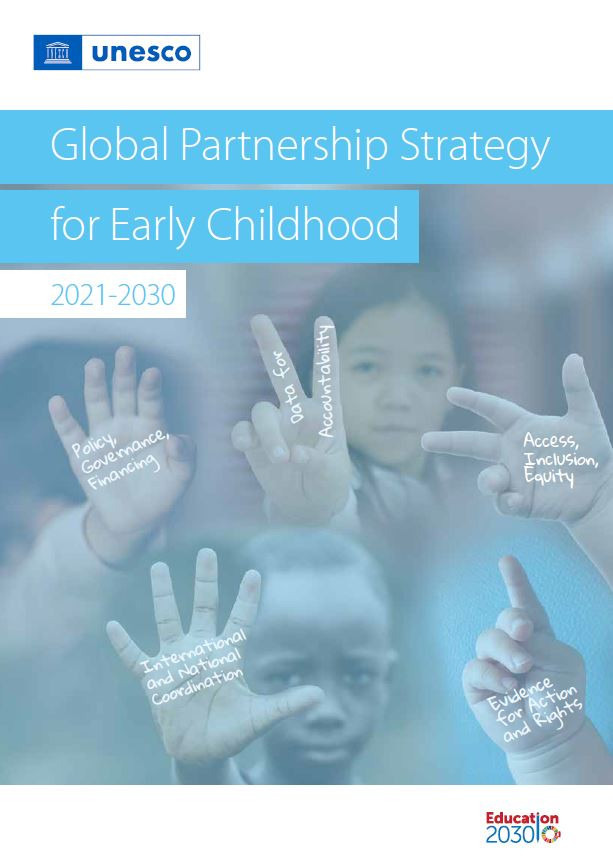 Global Partnership Strategy for Early Childhood, 2021-2030 Año de publicación: 2022 Autor corporativo: UNESCO The Global Partnership Strategy for early childhood is the result of inter-agency efforts to counter the negative trend in education and to overcome the reduction and closure of services for health, nutrition, sanitation, and child protection in all regions of the world during the COVID-19 pandemic. Well-designed and implemented policies and services for early childhood care, education and development enable all countries to protect and guarantee child rights, achieve high rates of return on their investments in child and family development and widen avenues for transforming societies and lives.
  Addressing Conspiracy Theories: What Teachers Need to Know Año de publicación: 2022 Autor corporativo: UNESCO This document is a first introduction for educators, working in and outside of formal schooling, on how to identify, prevent and address conspiracy theories in education settings. It seeks to provide educators with key definitions and essential knowledge to grasp the complexity of the phenomenon and alert learners about the key characteristics and harmful effects of conspiracy theories for a first, immediate response. To support educators in this endeavour, this document outlines strategies to prevent the belief in conspiracy theories as well as to engage with learners who already believe in them.
  Addressing Hate Speech: Educational Responses Año de publicación: 2022 Autor: Nicole Fournier-Sylvester Autor corporativo: UNESCO | UN. Office on Genocide Prevention and the Responsibility to Protect This paper is part of a collection of discussion papers, commissioned and produced by UNESCO and the United Nations Office of the Special Adviser on the Prevention of Genocide (OSAPG).The papers are a direct contribution to the United Nations Strategy and Plan of Action and are published in the context of the Multistakeholder Forum and Ministerial Conference on Addressing Hate Speech through Education in September and October 2021.The outbreak of the COVID-19 pandemic has highlighted the pertinence of the United Nations Strategy and Plan of Action, generating a wave of hate speech across the world –further exacerbating intolerance and discrimination towards particular groups and destabilizing societies and political systems. The discussion papers seek to unpack key issues related to this global challenge and propose possible responses and recommendations.
  Translation: From One World to Another (The UNESCO Courier No. 2; April-June 2022) Año de publicación: 2022 Autor corporativo: UNESCO To translate is “to say almost the same thing”, in the words of the Italian writer Umberto Eco. A whole world is contained in this “almost”. To translate is to confront the other, the different, the unknown. It is often the essential prerequisite for those who want to access a universal, multiple, diverse culture. It is therefore no coincidence that the League of Nations took up the issue in the 1930s, envisaging the creation of an Index Translationum.Taken over by UNESCO in 1948, this Index allowed the first census of translated works in the world. Two years later, the Representative Works programme was launched to translate masterpieces of world literature. UNESCO’s support for the publication last year of a lexicon of words from indigenous languages of Mexico that are untranslatable into Spanish is a continuation of these efforts.Although their disappearance was predicted as early as the 1950s, translators – who are most often women – have never been as numerous as they are today. The machines developed in the aftermath of the war have not been able to outdo this behind-the-scenes profession. Nor have digital translation tools, which have become the standard feature of our globalized conversations, even if they have contributed to transforming the job.This is because language is more than just a means of communication. It is that, and much more. It is what written or oral works make of it, contributing to forge what is sometimes called the ‘genius of the language’, which the most powerful applications cannot restore.
  How Youth Drive Change (The UNESCO Courier no. 3; July-September 2011) Año de publicación: 2011 Autor corporativo: UNESCO Considering school history as a place of confrontation of discourse and knowledge from competing socialization spaces (school, family, media), we are interested in citizenship education work and challenges posed by these plural socializations. In an important context media coverage of debates on the recognition of minority memories in France and their entry into the school programs of the college in 2008, how do students appropriate the ""socially vivid issues"" of immigration, colonization, and decolonization? Fromcontent analysis of a corpus made up of around a hundred interviews semi-structured conducted between 2007 and 2010 with 3rd year college students (end of lower secondary and compulsory education), we analyze and highlight contrasting interpretations of these heritages by majority students and minority students, respectively supplied by categories of public debate and family narratives. We show, following work relating to the sociology of school curricula, which learning citizenship in the light of these historical legacies results from the confrontation of the pupils with the discourses and knowledge different spaces in which they take part. But it is above all the product oftheir position in the face of these historical legacies, according to their experiences social and the role they give to these stories in building a common identity and belonging.
  Trash Hack Action Learning for Sustainable Development: A Teacher's Guide Año de publicación: 2021 Autor corporativo: UNESCO Education for Sustainable Development (ESD) gives people the tools to tackle the problems of the present and future, to fight the climate crisis, change the world and achieve the SDGs. ESD rethinks what we learn, where we learn and how we learn. It is about lifelong learning, which lets people develop the knowledge, skills, values and attitudes that enable them to make informed decisions and actions on global problems.The action-based activities in this guide intend to contribute to fostering the three dimensions of learning (cognitive, socio-emotional andbehavioural) and thereby promoting cross-cutting competencies for the SDGs, such as systems thinking, anticipatory competency, collaboration, critical thinking and integrated problem-solving.
  A New Social Contract for Education (The UNESCO Courier Special Edition; November 2021) Año de publicación: 2021 Autor corporativo: UNESCO Reimagining Our Futures Together upholds the tradition of the major UNESCO reports that have already structured education policies throughout the world in the past. The Faure report, Learning to be, in 1972, and the Delors report, Learning: The Treasure Within, in 1996, have become benchmarks in the debate on learning. This third document presents a lucid assessment of the challenges confronting education today.Faced with the rapid changes in our environment, a change of direction is needed. We need to devote more importance to ecology; to provide students with the critical tools to detect misinformation, prejudices, and preconceived ideas; to strengthen teamwork, and to improve the professionalization of teachers. Beyond these imperatives, we must also rethink the multiple interdependencies, the links between generations and between cultures, and our relationship with living beings, to establish a new social contract for education.