
Recursos
Exploren una amplia gama de recursos valiosos en GCED para profundizar su comprensión y promover su búsqueda, incidencia, enseñanza y aprendizaje.
792 resultados encontrados
 Human rights: questions and answers Año de publicación: 2009 Autor: Leah Levin Autor corporativo: UNESCO This 5th edition presents an overview of the scope and content of international human rights law, procedures to monitor its implementation, organizations and institutions working for human rights, major international events, as well as new developments and challenges. It also offers a brief commentary on the articles of the Universal Declaration of Human Rights explaining their meaning and providing examples on their practical implications. A permanent feature of this publication, and one of the reasons of its success, are the cartoons of Plantu, a well-known French political cartoonist and a devoted human rights activist.
 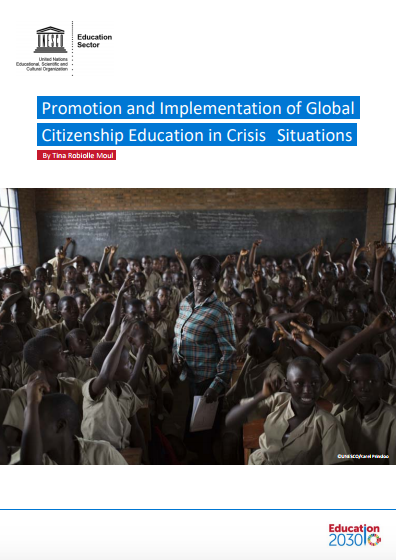 Promotion and implementation of global citizenship education in crisis situations Año de publicación: 2017 Autor: Robiolle Moul, Tina Autor corporativo: UNESCO Crisis situations affect the realization of human rights of many people and communities across all regions of the world. Within UNESCO’s relevant areas of work, GCED is a powerful approach to education that can empower people to recover from crises and transform their communities into peaceful and sustainable societies. UNESCO commissioned a desk study that aimed at reviewing existing research on the promotion and implementation of GCED and related programs in countries affected by crisis situations, with particular attention to initiatives benefiting the refugee population. This study unveils the key challenges these programs encounter in such contexts, as well as promising practices that can guide the design and implementation of future GCED in crisis situations.This report is a synthesis of this desk study and supports the evidence that, after analyzing the context and the available means, GCED and related programs can and should be systematically adapted and implemented in crisis situations, including in response to refugee crises.
  Lifelong learning from a social justice perspective Año de publicación: 2017 Autor: Carlos Vargas Autor corporativo: UNESCO Over the past two decades, a set of globally converging discourses on lifelong learning (LLL) has emerged around the world. Driven mostly by inter-governmental organizations, these discourses have been largely embraced by national and local education systems seeking to reflect local traditions and priorities. This paper argues that these discourses tend to look remarkably alike, converging into a homogeneous rationale in which the economic dimension of education predominates over other dimensions of learning, and in which adaptation takes pre-eminence over social transformation as a goal of LLL. It also shows how these converging discourses are embedded in the logic of the knowledge economy, driven by concern for human capital formation as dictated by the changing demands of the global labour market, and can neglect the learning needs and interests of local communities. The paper concludes that the globally converging discourse of LLL tends to serve the interests of the market ahead of those of the community, and argues that an alternative characterization of LLL, anchored in social justice, is necessary in the light of the 2030 Agenda for Sustainable Development, and especially Sustainable Development Goal 4, which aims to ensure inclusive and equitable quality education and to promote lifelong learning opportunities for all.
 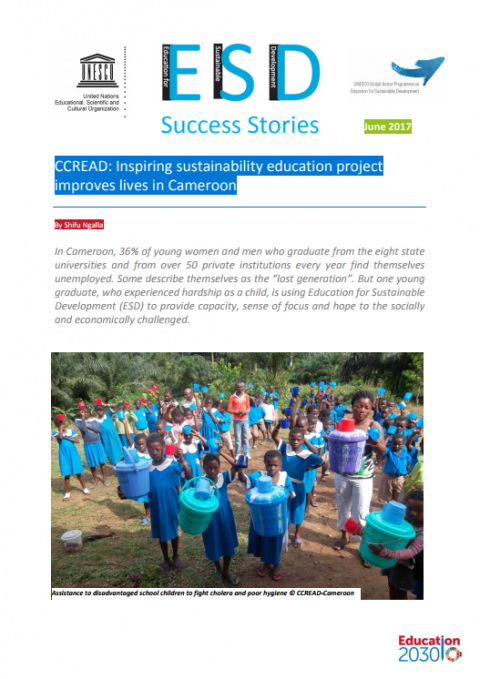 CCREAD: Inspiring sustainability education project improves lives in Cameroon (CAMEROON) Año de publicación: 2017 Autor: Shifu Ngalla Autor corporativo: UNESCO In Cameroon, 36% of young women and men who graduate from the eight state universities and from over 50 private institutions every year find themselves unemployed. Some describe themselves as the “lost generation”. But one young graduate, who experienced hardship as a child, is using Education for Sustainable Development (ESD) to provide capacity, sense of focus and hope to the socially and economically challenged.
  Repensar l'educacio: vers un bé comú mundial? Año de publicación: 2015 Autor corporativo: UNESCO The changes in the world today are characterized by new levels of complexity and contradiction. These changes generate tensions for which education is expected to prepare individuals and communities by giving them the capability to adapt and to respond. This publication contributes to rethinking education and learning in this context. It builds on one of UNESCO’s main tasks as a global observatory of social transformation with the objective of stimulating public policy debate. It is a call for dialogue among all stakeholders. It is inspired by a humanistic vision of education and development, based on respect for life and human dignity, equal rights, social justice, cultural diversity, international solidarity, and shared responsibility for a sustainable future. These are the fundamentals of our common humanity. This book enhances the vision provided by the two landmark UNESCO publications: Learning to Be: The world of education today and tomorrow (1972), the ‘Faure Report’, and Learning: The treasure within (1996), the ‘Delors Report’.
 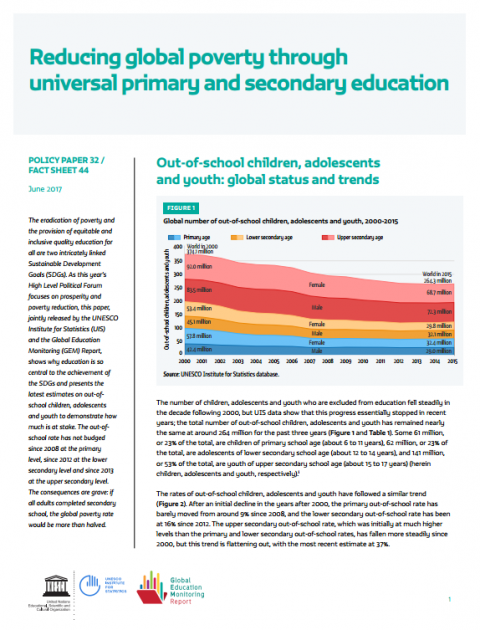 Reducing global poverty through universal primary and secondary education Año de publicación: 2017 Autor corporativo: UNESCO The eradication of poverty and the provision of equitable and inclusive quality education for all are two intricately linked Sustainable Development Goals (SDGs). As this year’s High Level Political Forum focuses on prosperity and poverty reduction, this paper, jointly released by the UNESCO Institute for Statistics (UIS) and the Global Education Monitoring (GEM) Report, shows why education is so central to the achievement of the SDGs and presents the latest estimates on out-ofschool children, adolescents and youth to demonstrate how much is at stake. The out-ofschool rate has not budged since 2008 at the primary level, since 2012 at the lower secondary level and since 2013 at the upper secondary level. The consequences are grave: if all adults completed secondary school, the global poverty rate would be more than halved.
 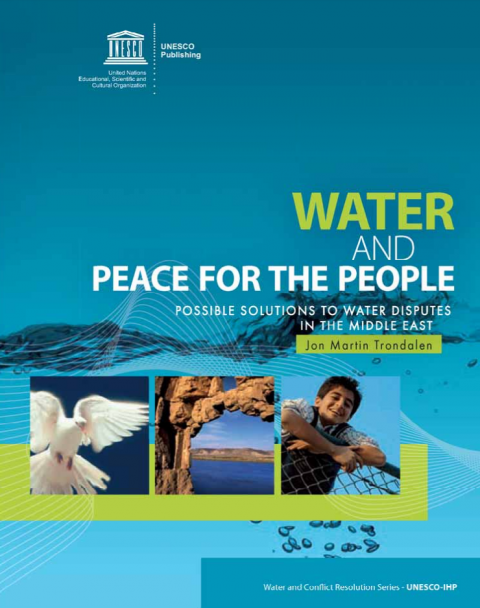 Water and peace for the people: possible solutions to water disputes in the Middle East Año de publicación: 2008 Autor corporativo: UNESCO This book proposes practical and objective solutions to the entrenched water conflicts in the Middle East. The author reveals and clarifies the complexity of the water conflicts, drawing on years of experience facilitating and chairing water negotiations in the region. The bottom line is: Unless the countries involved co-operate, the consequences will be devastating. The lack of plentiful and clean water for the people will not only result in severe human suffering, but could also have grave geopolitical consequences.
  Study on challenges in the development of local equality indicators: a human-rights-centred model; Commitment 2 of the Ten-Point Plan of Action Año de publicación: 2010 Autor: Klaus Starl | Jennifer Pinno Autor corporativo: UNESCO | European Training and Research Centre for Human Rights and Democracy (Austria) The study aims at: Providing a theoretical fundament of ECCAR Indicators to measure racism or (in)equality1 and to evaluate municipal anti-discrimination policies (framework concept), and Discussing related legal and practical issues such as legality and reliability of available ‘ethnic’ data (legal and practical preconditions) in the context of ECCAR’s endeavours to set up an ECCAR-wide applicable system of monitoring racism, discrimination, equality and respective municipal policies. The study is structured in three parts. In the first part, preliminary questions concerning legality and practical feasibility of ‘ethnic’ data collection as a prerequisite for the development of and work with adequate indicators will be discussed. The second part deals with the conceptualization of human rights law as the constructing principle of ECCAR Indicators. It includes the discussion of the proposed model of the ECCAR-ADIX. The third part of the study describes practical examples of indicator use in selected ECCAR member cities. The section shows various approaches and gives evidence on different attempts by municipalities to set up fact-based anti-racism policies but also highlights the variety of methods, data, measurement topics, goals, etc. 2014 GEM Final Statement: The Muscat Agreement Año de publicación: 2014 Autor corporativo: UNESCO This statement is agreed by Ministers, heads of delegations, leading officials of multilateral and bilateral organizations, and senior representatives of civil society and private sector organizations at the Global Education for All (EFA) Meeting in Muscat, Oman on May 12-14, 2014. Recalling the GEM 2012 Final Statement, the conference took note of the 2013/14 EFA Global Monitoring Report, the regional EFA reports, the Resolution of the 37th session of UNESCO's General Conference on Education Beyond 2015, the Decision of the Executive Board of UNESCO at its 194th session and the Joint Proposal of the EFA Steering Committee on Education Post-2015. Shaping the future we want: UN decade of education for sustainable development; final report Año de publicación: 2014 Autor: Carolee Buckler | Heather Creech Autor corporativo: UNESCO The United Nations Decade of Education for Sustainable Development (2005 –2014) (DESD) aimed at integrating the principles and practices of sustainable development into all aspects of education and learning, to encourage changes in knowledge, values and attitudes with the vision of enabling a more sustainable and just society for all. The mandate of the DESD has energized a vast number of stakeholders – across Member States, UN agencies, the education sector, the private sector and civil society – to work in partnership to reorient education systems towards sustainable development. This final DESD Global Monitoring and Evaluation Report (GME) provides an assessment of progress towards embedding Education for Sustainable Development (ESD) into education systems and into sustainable development efforts. Building on the findings of the past two DESD GME reports, and based upon Member States’ and other stakeholders’ assessments of the current state of ESD, this report maps the achievements and challenges of a decade of progress and action on ESD at the global, regional, national and local levels – and within all areas and levels of education.