
Recursos
Exploren una amplia gama de recursos valiosos en GCED para profundizar su comprensión y promover su búsqueda, incidencia, enseñanza y aprendizaje.
1,583 resultados encontrados
 Quelques réflexions sur le progrès, le développement durable et la citoyenneté globale Año de publicación: 2013 Autor: Georges Haddad Autor corporativo: UNESCO The arguments developed in this concise presentation demonstrate that sustainable development, progress and global citizenship, efficiently embedded in the context of the Knowledge Society, undeniably participate in the development of the New Humanism promoted by the Director-General of UNESCO, and which we all agree to consider essential for the wealth and prosperity of Humanity in an agreeable, peaceful and friendly common environment.
  Reflections on Progress, Sustainable Development and Global Citizenship Año de publicación: 2013 Autor: Georges Haddad Autor corporativo: UNESCO The arguments developed in this concise presentation demonstrate that sustainable development, progress and global citizenship, efficiently embedded in the context of the Knowledge Society, undeniably participate in the development of the New Humanism promoted by the Director-General of UNESCO, and which we all agree to consider essential for the wealth and prosperity of Humanity in an agreeable, peaceful and friendly common environment. Reflexiones Sobre el Progreso, el Desarrollo Sostenible y la Ciudadanía Mundial Año de publicación: 2013 Autor: Georges Haddad Autor corporativo: UNESCO Los argumentos desarrollados en esta breve ponencia ponen de manifiesto que el desarrollo sostenible, el progreso y la ciudadanía mundial sólidamente arraigados en la Sociedad del Conocimiento contribuyen indudablemente a construir este Nuevo Humanismo promovido por la Directora General de la UNESCO, y que todos coincidimos en considerar esencial para la riqueza y la prosperidad de la Humanidad, en un entorno común grato, pacífico y cordial.
  Review of the Evidence on Sexuality Education: Report to Inform the Update of the UNESCO International Technical Guidance on Sexuality Education Año de publicación: 2018 Autor: Paul Montgomery | Wendy Knerr Autor corporativo: UNESCO UNESCO published the International Technical Guidance on Sexuality Education (ITGSE): An evidence-informed approach for schools, teachers and health educators, in 2009. It put forward the rationale for sexuality education, technical advice on characteristics of effective programmes, and topics and learning objectives to be covered in a ‘basic minimum package’ of sexuality education for children and young people aged 5–18+. Since the publication, UNESCO, several UNAIDS cosponsors and other international partners have advocated for ‘comprehensive sexuality education’ (CSE) for all adolescents and youth, and as an essential component of quality education.With the passage of time and the expanded understanding of the role of CSE, UNESCO sought to review the ITGSE with the aim of updating its content to reflect the evidence and lessons learned from implementing sexuality education programmes since 2009. UNESCO sought the technical services of a consultant team to conduct an evidence review to inform the update.This review would involve research on new evidence and good practice in sexuality education including evidence on the effectiveness of CSE and lessons documented through the implementation of sexuality education programmes to highlight benchmarks of quality CSE content and modalities of delivery. The research was also intended to make recommendations as to the: adequacy of existing content; presence of any gaps in this content; and evidence-based recommendations on how such content gaps can be addressed in the updated ITGSE.
 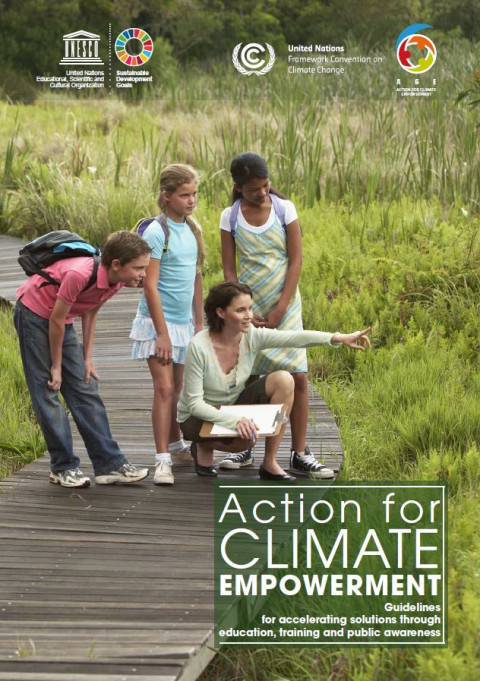 Action for Climate Empowerment: Guidelines for Accelerating Solutions through Education, Training and Public Awareness Año de publicación: 2016 Autor: Leslie Paas Autor corporativo: UNESCO | United Nations Framework Convention on Climate Change Secretariat (UNFCCC) Action for Climate Empowerment (ACE) is the popular term adopted by the United Nations Framework Convention on Climate Change (UNFCCC) for its Article 6, pertaining to education, training, public awareness, access to information and participation, and international cooperation.Country-driven implementation of these interrelated elements is increasingly recognized as crucial for meeting the objectives of the Convention, and for achieving sustainable development in general.This publication is designed to help national decision-makers better understand the components of ACE and how they can be bolstered by the principles and methods of Education for Sustainable Development (ESD). It also aims to provide guidance on engaging with a wide variety of stakeholders, establishing cross-sector partnerships, and mobilizing technical and financial support for ACE implementation. Educación en pro de la 'ciudadanía mundial': marco para el debate Año de publicación: 2013 Autor: Sobhi Tawil Autor corporativo: UNESCO The notion of ‘global citizenship’ has recently gained prominence in international development discourse with the recently-adopted United Nations Secretary-General’s Global Education First Initiative (2012). Among the three priority areas outlined in this global initiative, the third aims to ‘foster global citizenship’. Education must fully assume its central role in helping people to forge more just, peaceful, tolerant and inclusive societies. It must give people the understanding, skills and values they need to cooperate in resolving the interconnected challenges of the 21st century. The notion of ‘global citizenship’, however, remains very broad, if not contested, and consequently difficult to operationalize in education. There are two possible reasons for this. Firstly, it is unclear whether the very notion of ‘global citizenship’ is a metaphor, a contradiction of terms, or an oxymoron (Davies, 2006). What does ‘global citizenship’ possibly imply both from a legal perspective, as well as from that of collective identity, sense of belonging, and civic engagement? Secondly, when applied to education, the notion of ‘global citizenship’ implies a certain degree of confusion. Is ‘global citizenship education’ (or ‘education for global citizenship’) merely an expression of a fundamental purpose of education systems? Does it also refer to a broad area of teaching and learning? If so, what are the contours of this domain? How does it relate to other often overlapping areas of learning associated with civic and political socialization?
  Education for 'global citizenship': a framework for discussion Año de publicación: 2013 Autor: Sobhi Tawil Autor corporativo: UNESCO The notion of ‘global citizenship’ has recently gained prominence in international development discourse with the recently-adopted United Nations Secretary-General’s Global Education First Initiative (2012). Among the three priority areas outlined in this global initiative, the third aims to ‘foster global citizenship’. Education must fully assume its central role in helping people to forge more just, peaceful, tolerant and inclusive societies. It must give people the understanding, skills and values they need to cooperate in resolving the interconnected challenges of the 21st century. The notion of ‘global citizenship’, however, remains very broad, if not contested, and consequently difficult to operationalize in education. There are two possible reasons for this. Firstly, it is unclear whether the very notion of ‘global citizenship’ is a metaphor, a contradiction of terms, or an oxymoron (Davies, 2006). What does ‘global citizenship’ possibly imply both from a legal perspective, as well as from that of collective identity, sense of belonging, and civic engagement? Secondly, when applied to education, the notion of ‘global citizenship’ implies a certain degree of confusion. Is ‘global citizenship education’ (or ‘education for global citizenship’) merely an expression of a fundamental purpose of education systems? Does it also refer to a broad area of teaching and learning? If so, what are the contours of this domain? How does it relate to other often overlapping areas of learning associated with civic and political socialization? Education for 'global citizenship': a framework for discussion Año de publicación: 2013 Autor: Sobhi Tawil Autor corporativo: UNESCO La notion de ‘citoyenneté mondiale’ a récemment pris de l'importance dans le discours du développement international avec la Première Initiative Éducation Modiale adoptée récemment du Secrétaire Général de l’ONU(2012). Parmi les trois domaines prioritaires énoncés dans cette initiative mondiale, la troisième vise à ‘favorsier citoyenneté mondiale'. L'éducation doit assumer pleinement son rôle central en aidant les gens à forger plus justes, des sociétés pacifiques, tolérantes et inclusives. Il faut donner aux gens la compréhension, les compétences et les valeurs dont ils ont besoin de coopérer pour résoudre les défis interdépendants du 21ème siècle. La notion de ‘citoyenneté mondiale’, cependant, reste très large, sinon contestée, et par conséquent difficile à appliquer dans l'éducation. Il y a deux raisons possibles pour cela. Tout d'abord, il est difficile de savoir si la notion même de ‘citoyenneté mondiale’ est une métaphore, une contradiction dans les termes, ou un oxymore (Davies, 2006). Qu'est-ce que la ‘citoyenneté mondiale’ implique peut-être à la fois d'un point de vue juridique, ainsi que de celle de l'identité collective, le sentiment d'appartenance et l'engagement civique? Deuxièmement, lorsqu'il est appliqué à l'éducation, la notion de ‘citoyenneté mondiale’ implique un certain degré de confusion. Est-ce que 'éducation à la citoyenneté mondiale’(ou ‘éducation pour la citoyenneté mondiale’) est seulement une expression d'un objectif fondamental des systèmes éducatifs? Est-ce qu'il se réfère également à un large domaine de l'enseignement et l'apprentissage? Si oui, quels sont les contours de ce domaine? Comment est-elle liée à d'autres domaines qui se recoupent souvent de l'apprentissage associés à la socialisation civique et politique? Reflexiones sobre el progreso, el desarrollo sostenible y la ciudadanía mundial Año de publicación: 2013 Autor: Georges Haddad Autor corporativo: UNESCO The arguments developed in this concise presentation demonstrate that sustainable development, progress and global citizenship, efficiently embedded in the context of the Knowledge Society, undeniably participate in the development of the New Humanism promoted by the Director-General of UNESCO, and which we all agree to consider essential for the wealth and prosperity of Humanity in an agreeable, peaceful and friendly common environment.
  The Influence of education on conflict and peace building Año de publicación: 2010 Autor: Alan Smith Autor corporativo: UNESCO The purpose of this paper is to identify aspects of education that may have a positive influence on the dynamics of conflict or make a contribution to peacebuilding. The UN Secretary-General’s (2009) report on peacebuilding identifies a number of recurring priorities in conflict-affected situations, ‘establishing security, building confidence in a political process, delivering initial peace dividends and expanding core national capacity’. These priorities include ‘the provision of basic services, such as water and sanitation, health and primary education’. However, in conflict-affected situations education is also about more than service delivery because it is a means of socialization and identity development through the transmission of knowledge, skills, values and attitudes across generations. Education may therefore be a driver of conflict (fuelling grievances, stereotypes, xenophobia and other antagonisms), but can also be a way of contributing to ‘conflict transformation’ and ‘peacebuilding’.