
Recursos
Exploren una amplia gama de recursos valiosos en GCED para profundizar su comprensión y promover su búsqueda, incidencia, enseñanza y aprendizaje.
1,583 resultados encontrados
 La enseñanza del Holocausto en América Latina - Los desafios para los educadores y legisladores Año de publicación: 2015 Autor corporativo: UNESCO L'Holocauste est devenu un point de référence dans le monde entier afin de sensibiliser sur les violations des droits de l'homme et de la violence de l'État. Quelle est l'importance de l'enseignement de l'Holocauste dans les régions du monde qui ont aucun rapport direct avec l'histoire du peuple juif et les crimes du nazisme, en particulier en Amérique latine? Y at-il une augmentation des pratiques éducatives pertinentes au niveau international en raison de l'expansion de l'éducation sur l'Holocauste? Comment les enseignants peuvent aborder un sujet si complexe et chargé d'émotion dans l'évolution des sociétés multiculturelles? Cette publication de l'UNESCO rassemble les contributions d'historiens et éducateurs du monde entier et les cadres débats actuels dans le domaine importants, en insistant sur les questions que les éducateurs en Amérique latine sont confrontés et révéler les raisons pour lesquelles il est essentiel de continuer à enseigner l'histoire de l'Holocauste dans le monde aujourd'hui , peu importe où nous vivons. (Par l'éditeur - traduction)
 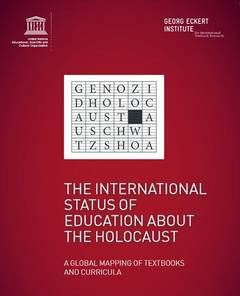 The International status of education about the Holocaust : A global mapping of textbooks and curricula Año de publicación: 2015 Autor corporativo: UNESCO This publication by UNESCO and the Georg Eckert Institute documents ways in which the Holocaust is presented in secondary school level history and social studies curricula worldwide, and conceptualized and narrated in textbooks from twenty-six countries, with all continents represented. Historical understandings of the Holocaust are defined in terms of the spatial and temporal scales with which the event is portrayed, the protagonists involved, interpretative patterns (according to definitions, comprehensiveness, causes, relativization or banalization), narrative techniques and viewpoints, didactic methods, and national idiosyncrasies. The study is based on 272 currently valid curricula from 135 countries, and on 89 textbooks published in 26 countries since 2000. The aim of the study is primarily to document information in such a way that it reflects local understandings of the Holocaust, principally by recording concepts and narratives of the Holocaust found in educational media currently in use in schools. The findings show both convergence and divergence in the representations analysed. The Holocaust is subject to shared patterns of representation, which include selectivity, personalization, appropriation, screening and omission. It is also subject to narrative idiosyncrasies. One of the main trends worldwide is domestication, a process whereby countries place emphasis on the local significance of the event or appropriate them in the interests of local populations. Drawing on such national and international patterns of representation, the publication concludes by formulating recommendations for future curricula and textbook narratives about the Holocaust. These recommendations relate to such issues as the use of terms, the comprehensiveness of historical facts, the definition of causes, the combination of universal and local approaches, and the development of historical literacy. (By the publisher) Le statut international de l'éducation sur l'Holocauste: Une cartographie mondiale des manuels et des programmes Año de publicación: 2015 Autor corporativo: UNESCO Cette publication par l'UNESCO et l'Institut Georg Eckert documente façons dont l'Holocauste est présenté dans l'histoire du niveau de l'école et de programmes d'études sociales secondaire dans le monde, et conceptualiser et narré dans les manuels de vingt-six pays, avec tous les continents représentés. compréhensions historiques de l'Holocauste sont définis en fonction des échelles spatiales et temporelles avec laquelle l'événement est dépeint, les acteurs impliqués, les modèles d'interprétation (selon les définitions, l'intégralité, causes, relativisation ou banalisation), les techniques narratives et des points de vue, des méthodes didactiques, et les particularités nationales. L'étude est basée sur 272 programmes en cours de validité à partir de 135 pays, et 89 manuels publiés dans 26 pays depuis 2000. L'objectif de l'étude est d'abord de documenter l'information de façon à ce qu'il reflète la vision locale de l'Holocauste, principalement par l'enregistrement les concepts et les récits de la Shoah trouvés dans les médias éducatifs actuellement en usage dans les écoles. Les résultats montrent à la fois la convergence et de divergence dans les représentations analysées. L'Holocauste est soumis à des modèles communs de représentation, qui comprennent la sélectivité, la personnalisation, l'appropriation, le dépistage et l'omission. Il est également soumis à des particularités narratives. L'une des principales tendances dans le monde est la domestication, un processus par lequel les pays mettent l'aCECnt sur l'importance locale de l'événement ou les approprient dans l'intérêt des populations locales. Dessin sur ces modèles nationaux et internationaux de représentation, de la publication conclut en formulant des recommandations pour les futurs programmes et manuels scolaires récits sur l'Holocauste. Ces recommandations portent sur des questions telles que l'utilisation des termes, l'exhaustivité des faits historiques, la définition des causes, la combinaison des approches universelles et locales, ainsi que le développement de l'alphabétisation historique. (Par l'éditeur)
 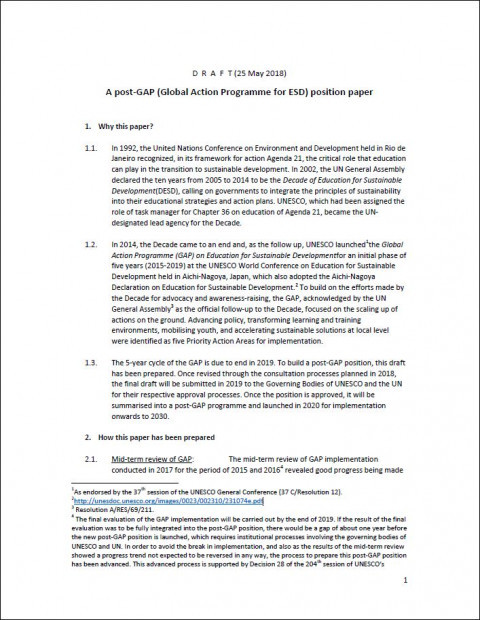 A Post-GAP (Global Action Programme for ESD) Position Paper Año de publicación: 2018 Autor corporativo: UNESCO The 5-year cycle of the GAP is due to end in 2019. To build a post-GAP position, this draft position paper has been prepared. Once revised through the consultation processes planned in 2018, the final draft will be submitted in 2019 to the Governing Bodies of UNESCO and the UN for their respective approval processes. Once the position is approved, it will be summarised into a post-GAP programme and launched in 2020 for implementation onwards to 2030. Концептуальный документ по пост-ГПД периоду (Глобальная программа действий по ОУР) Año de publicación: 2018 Autor corporativo: UNESCO Пятилетний цикл Глобальной программы действий по ОУР (ГПД) должен завершиться в 2019 г. Настоящий проект подготовлен в целях разработки концепции деятельности после окончания ГПД. Вслед за внесением поправок в ходе запланированных на 2018 г. консультаций, окончательный вариант проекта будет представлен в 2019 г. на утверждение руководящим органам ЮНЕСКО и ООН. Положения утвержденного документа будут обобщены в программе деятельности, которая будет осуществляться в 2020-2030 гг. после окончания ГПД. Cadre pour une stratégie de communication en appui à la décennie des Nations Unies pour l'éducation en vue du développement durable Año de publicación: 2007 Autor corporativo: UNESCO The following framework for a DESD Communication Strategy seeks to provide guidelines for different stakeholders to come together and work on a joint harmonious communication strategy, dedicated to furthering the exchange of information on ESD issues in order to: • share ESD information and resources between and among partners; • promote better cooperation among partners doing ESD work and create synergies; • reduce duplication of efforts in programme planning, design, and ESD advocacy; • strengthen individual partner's ability to help create a viable future by working together with others, with each partner contributing its own "piece of the puzzle". Minimum elements of a DESD communication strategy include an appropriate emphasis on: • dissemination of basic ESD information to all partners; • dissemination of available information sources pertinent to partners’ needs in ESD; • sharing prototype training materials, experiences of demonstration activities and related resources for testing, adapting and translating them to other cultural contexts; • dissemination of information about the experiences of project participants, emphasizing openness and clarity about problems encountered, in order to allow others to benefit from the lessons learned in practice.
 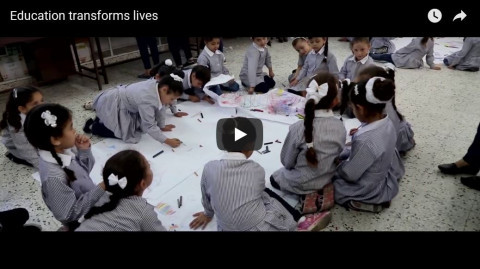 [Video] Education Transforms Lives Año de publicación: 2017 Autor corporativo: UNESCO Education transforms lives every day and in every corner of society. This video explores the power of education and UNESCO’s role in leading and coordinating the Education 2030 Agenda, which is part of a global movement to eradicate poverty through 17 Sustainable Development Goals by 2030.Education is the right of every woman, man and child. Together, we are shaping the global citizens of tomorrow, empowered on the path of education to build a more sustainable future.UNESCO's campaign "Education transforms lives" supports the effort to build peace in the minds of men and women. [Видео] Образование меняет жизни Año de publicación: 2017 Autor corporativo: UNESCO Образование преображает жизнь людей каждый день во всех слоях общества. Ролик повествует о важности образования и роли ЮНЕСКО в ведении и координации Повестки дня «Образование-2030», которая является частью глобального движения для искоренения бедности посредством достижения 17 Целей устойчивого развития до 2030 года.Каждая женщина, каждый мужчина и каждый ребенок имеют право на образование. Вместе мы создаем мировых сограждан завтрашнего дня и даем им силу образования для построения более устойчивого будущего.Кампания ЮНЕСКО "Образование преображает жизнь людей" направлена на то, чтобы нести мир в сознание мужчин и женщин.
  Framework for a DESD communication strategy in support of the UN decade of education for sustainable development Año de publicación: 2007 Autor corporativo: UNESCO The following framework for a DESD Communication Strategy seeks to provide guidelines for different stakeholders to come together and work on a joint harmonious communication strategy, dedicated to furthering the exchange of information on ESD issues in order to: • share ESD information and resources between and among partners; • promote better cooperation among partners doing ESD work and create synergies; • reduce duplication of efforts in programme planning, design, and ESD advocacy; • strengthen individual partner's ability to help create a viable future by working together with others, with each partner contributing its own "piece of the puzzle". Minimum elements of a DESD communication strategy include an appropriate emphasis on: • dissemination of basic ESD information to all partners; • dissemination of available information sources pertinent to partners’ needs in ESD; • sharing prototype training materials, experiences of demonstration activities and related resources for testing, adapting and translating them to other cultural contexts; • dissemination of information about the experiences of project participants, emphasizing openness and clarity about problems encountered, in order to allow others to benefit from the lessons learned in practice. 지속가능발전교육 및 새천년 개발목표 Año de publicación: 2009 Autor corporativo: UNESCO 새천년개발목표(MDGs)는 2000년 유엔 회원국 모두가 동의한 개발을 위한 보편적인 틀을 제공한다. 이는 개발 도상국과 개발 파트너가 지속 가능한 미래를 추구하기 위해 함께 노력할 수 있는 하나의 수단을 제공한다. 지속가능발전교육(ESD)은 모든 새천년개발목표(MDGs) 달성에 기여할 수 있다. ESD는 정부와 개발 파트너가 MDGs 달성을 위한 역량을 확보할 수 있도록 도울 수 있다. ESD는 MDGs 달성에 도움이 되는 학습 목표를 제공한다.