
Recursos
Exploren una amplia gama de recursos valiosos en GCED para profundizar su comprensión y promover su búsqueda, incidencia, enseñanza y aprendizaje.
24 resultados encontrados
 Best Practices in TVET Policies Coping with COVID-19 Crisis: UNEVOC Network East and Southeast Asia Cluster Countries Año de publicación: 2020 Autor: Jihee Choi | Hanbyul Lee | Kunjoo Lim | Hyunsik Choi | Jongtaek Han Autor corporativo: UNESCO International Centre for Technical and Vocational Education and Training (UNEVOC) | Korea Research Institute for Vocational Education and Training (KRIVET) This book presents the best practices with regard to TVET policies to cope with COVID-19 crisis. It includes 8 cases of manuscripts from 6 countries in total. The topics covered range from the national TVET policies responding to COVID-19 crisis to open and digital learning, migrant female workers, and TVET strategies to deal with youth unemployment. UNESCO-UNEVOC 동아시아 동남아시아 클러스터: TVET 정책 우수사례집 Año de publicación: 2020 Autor: 최지희 | 이한별 | 임건주 | 최현식 | 한종택 Autor corporativo: UNESCO International Centre for Technical and Vocational Education and Training (UNEVOC) | 한국직업능력개발원 본 자료는 COVID-19시대에 대응하는 국가전략에 관한 동남아지역 우수사례를 소개하고 있다. 총 6개국의 8개 사례를 포함하고 있으며, COVID-19에 대한 TVET의 대응에서 원격 및 디지털 학습, 청년실업, 이주 여성 근로자 문제 등 다양한 주제에 대해 각국의 정책까지 다양한 사례를 다루고 있다. 본 저작물은 ‘한국직업능력연구원’에서 ‘2020’년 작성하여 공공누리 4유형으로 개방한 ‘ UNESCO-UNEVOC 동아시아 동남아시아 클러스터: TVET 정책 우수사례집 (작성자: 최지희; 이한별; 임건주; 최현식; 한종택) ’을 이용하였으며, 해당 저작물은 ‘한국직업능력연구원(www.krivet.re.kr)’에서 무료로 다운받으실 수 있습니다.
  Skills Development and Climate Change Action Plans: Enhancing TVET's Contribution Año de publicación: 2021 Autor corporativo: UNESCO International Centre for Technical and Vocational Education and Training (UNEVOC) Climate change is an ongoing process that, at the current pace of such activities, cannot be avoided. Tools have been proposed to deal with climate change focus on adaptation and mitigation. Strengthening national and international awareness of and commitment to reducing the impact of climate change has become the only viable option to ensure the sustainability of life on Earth.The Paris Agreement entered into force in 2016 with the aim of bringing all nations together in a common goal of combating climate change and adapting to its impacts. According to the Agreement, every party should submit a climate plan laying out its adaptation and mitigation targets. Technical and vocational education and training (TVET) has the potential to play significant roles in these plans. The smooth transition to green societies and economies relies on amongst others the knowledge, skills and competencies to promote sustainable development. Effective education and training for sustainable development pivots on governance and vision, and the ability to empower people in an inclusive manner to act in favour of sustainable development. It also relies on the ability to train, upskill, reskill and empower those that can take advantage of the job growth and job creation potential in a changing economy.This discussion paper compiles and reviews relevant information regarding the country submissions (Nationally Determined Contributions and National Communications) which lay out adaptation plans and the policies created in fifty-seven selected countries. The aim is to summarize key information that can help assess the ongoing and potential contribution of TVET to the realization of these plans. The analysis made through this discussion paper has helped to generate a set of approaches for climate change adaption, through the education and training lens. These approaches can be used to advance the discussion in strengthening the technical and vocational skills development component in country climate adaptation plans.
  Understanding the Impact of Artificial Intelligence on Skills Development Año de publicación: 2021 Autor: Kelly Shiohira Autor corporativo: UNESCO International Centre for Technical and Vocational Education and Training (UNEVOC) The era of artificial intelligence is young in years but advanced in impact. Intermediate skill jobs as we know them are fast disappearing as their tasks are systematically automated, and individuals are increasingly likely to encounter AI technology in their everyday lives. In fact, fifty percent of organizations worldwide report using some form of AI in their operations.It is clear that AI has broad implications for the whole of humanity, and therefore on the education and training institutions that equip lifelong learners with the skills to navigate both work and society. A wide range of institutions and other stakeholders have risen to the challenge through research and innovative programmes, paving the way for a better understanding of AI’s potential – and its pitfalls.This paper synthesizes research on current trends, programmes, policies and uses of AI related to technical and vocational education and training across six continents, covering developing and developed contexts, as a resource for stakeholders invested in the future of intermediate-level workers and TVET. Lecturers, students, administrators, policymakers, programme implementers and lifelong learners are invited to examine current practices, opportunities and challenges raised by AI, and recommendations to build a future-ready education and training system.
 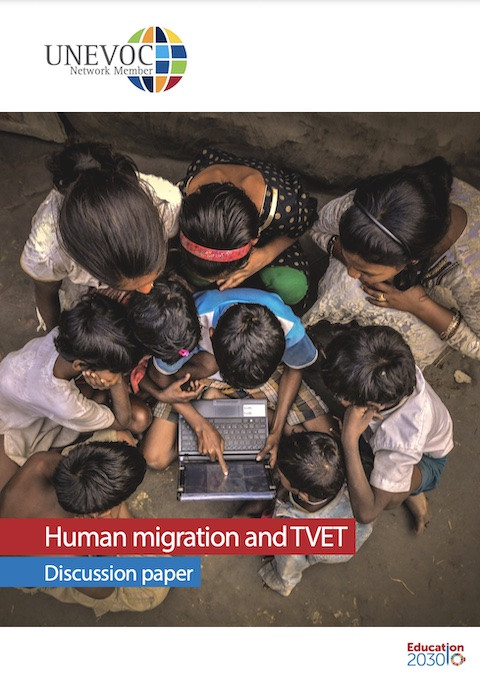 Human Migration and TVET Año de publicación: 2019 Autor: Volker Wedekind | Haya Fakoush | Joyceline Alla-Mensah Autor corporativo: UNESCO International Centre for Technical and Vocational Education and Training (UNEVOC) In the context of increased international migration, the importance of education and training and a global governance of migration is widely acknowledged in academic and international development debates. This discussion paper looks at the relationship between migration and technical and vocational education and training (TVET), distinguishing between forced, labour and environmental migration.
 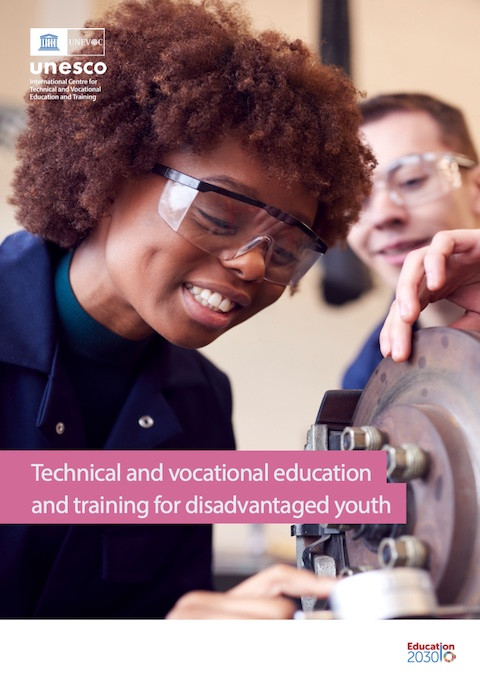 Technical and Vocational Education and Training for Disadvantaged Youth Año de publicación: 2021 Autor corporativo: UNESCO International Centre for Technical and Vocational Education and Training (UNEVOC) Due to its close links to the labour market, technical and vocational education and training (TVET) can play an important role to improve job opportunities and livelihoods for young people, and in particular for disadvantaged youth. However, this potential is not always fully realized, and relatively little research and evidence has been collected about the barriers disadvantaged youth face when accessing to and progressing through TVET.This paper maps some of the main barriers disadvantaged youth face in TVET and examines available evidence on strategies and approaches that are being used or can be used to meet the needs of disadvantaged youth. The paper discusses these barriers using a framework that looks at ‘4As’: availability, accessibility, acceptability, and adaptability. The report is the outcome of a study conducted in collaboration with the University of Nottingham and other members of the UNEVOC Network.
  Understanding the Return on Investment from TVET: A Practical Guide Año de publicación: 2020 Autor: Jane Schueler | Phil Loveder Autor corporativo: UNESCO International Centre for Technical and Vocational Education and Training (UNEVOC) | National Centre for Vocational Education Research(NCVER) This guide presents an analytic framework that summarizes some of the main elements and issues that need to be considered in measuring ROI. This includes establishing the scope, context and purpose for measuring ROI, adopting guiding principles, identifying costs, benefits and factors that impact on ROI, and approaches to data collection and analysis. The Guide then introduces a framework that looks at the ROI equation from a range of perspectives – including economic and social dimensions – and for different stakeholders, including individuals, businesses and societies. The Guide presents relevant ROI indicators and measures drawn from the existing international research. Finally, it provides guidelines to planning and collecting ROI data, along with a set of practical pro forma resources and case studies to assist the reader.
 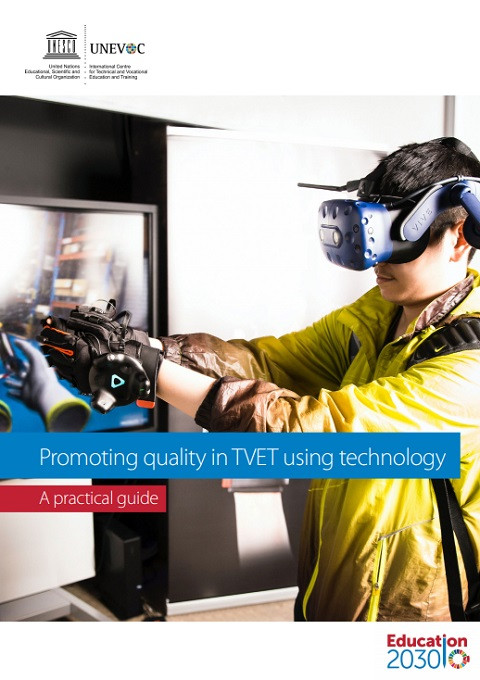 Promoting Quality in TVET Using Technology: A Practical Guide Año de publicación: 2020 Autor corporativo: UNESCO International Centre for Technical and Vocational Education and Training (UNEVOC) Technology has altered many aspects of life, including education and training. As a result of technological developments, technical and vocational education and training (TVET) has become more accessible to students, and the quality of education and training has improved too. Teachers and trainers can use digital tools to manage their tasks effectively and engage learners in digital rich environments. Learners can also use technology to learn new skills and to collaborate and interact with teachers and trainers. The COVID-19 pandemic has however underlined the current difficulties in effectively integrating technologies in the delivery of education and training. Institutions need to make constant assessments of their capacity and readiness to provide technology-rich environment for learning. At the same time, teachers’ and trainers’ readiness is also of particular importance to adopt appropriate pedagogic approaches with technology. This practical guide addresses institutions and teachers and trainers. It helps TVET institutions to understand the organizational plans to build up their capacity to stimulate digital learning. It also guides teachers that want to develop their competencies, improve their pedagogical strategies with use of technology, and learn from existing practice. By showing how technology is used in an integrated instruction model and providing helpful resources, this guide helps teachers and trainers to effectively plan their own tasks and delivery of instruction with the right technology tools.
  UNESCO-UNEVOC Study on the Trends Shaping the Future of TVET Teaching (Trends Mapping Studies) Año de publicación: 2020 Autor: Gita Subrahmanyam Autor corporativo: UNESCO International Centre for Technical and Vocational Education and Training (UNEVOC) This report presents the results of the trends mapping study on the future of technical and vocational education and training (TVET) teaching, conducted by UNESCO-UNEVOC. The study aimed to engage the international TVET community to: (i) improve the understanding of the implications of global disruptions; (ii) gather knowledge, insights, experiences; and (iii) highlight promising practices in preparing TVET teaching staff to deliver the skills needed in the 21st century and beyond. Coordinated by UNESCO-UNEVOC, trends mapping studies aim to further the international community's understandings on contemporary key issues concerning TVET. The studies review existing literature and policies, and engage TVET stakeholders from around the world through surveys and virtual conferences.
  Advancing Innovation: UNESCO-UNEVOC in Action; Biennial Report 2018-2019 Año de publicación: 2020 Autor corporativo: UNESCO International Centre for Technical and Vocational Education and Training (UNEVOC) In a rapidly evolving world filled with societal, environmental and economic disruptions, technical and vocational education and training (TVET) systems need to develop innovative strategies to tackle emerging challenges while simultaneously seizing the opportunities that have arisen from the advent of 21st century technology.This Biennial Report gives a comprehensive overview of UNESCO-UNEVOC's activities in technical and vocational education and training over the biennium 2018-2019.