
Recursos
Exploren una amplia gama de recursos valiosos en GCED para profundizar su comprensión y promover su búsqueda, incidencia, enseñanza y aprendizaje.
7 resultados encontrados
 أدوات التقييم الخاصة بتطبيق أداة تعليم المهارات الحياتية والمواطنة: قياس المهارات الحياتية بناءً على إطار العمل الإقليمي لتعليم المهارات الحياتية والمواطنة في منطقة الشرق الأوسط وشمال أفريقيا; امللخص التنفيذي Año de publicación: 2021 Autor corporativo: UNICEF Middle East and North Africa "إن تعليم المهارات الحياتية مُهم للغاية لتمكين الأطفال والشباب من تحقيق النجاح في التعليم والعمل والأهداف الشخصية. ومع ذلك، قد أدرجت القليل من الأنظمة التعليمية المهارات الحياتية في نظامها التعليمي. ومن أسباب ذلك هو التحديات المتعلقة بنقص المعرفة الخاصة بكيفية قياس المهارات الحياتية وتقييمها. وبناءً على إطار العمل الإقليمي لتعليم المهارات الحياتية والمواطنة في الشرق الأوسط وشمال أفريقيا، فإن منظمة اليونيسف والبنك الدولي قد طورا أداة تعليم المهارات الحياتية والمواطنة لقياس المستوى الوطني لنتائج طلبة الصف السابع في ثماني مهارات حياتية بوصفه تقييم وطني واسع النطاق. يرجى أيضًا الاطلاع على منشور قياس المهارات الحياتية." LSCE Measurement Instrument: Measuring Life Skills in the Context of Life Skills and Citizenship Education in the Middle East and North Africal; Advocacy Brief Año de publicación: 2021 Autor corporativo: UNICEF Middle East and North Africa Teaching and learning life skills is incredibly important for empowering children and young people to achieve success in education, employment, and personal goals. Nevertheless, few education systems have integrated life skills into their education systems. One of the reasons for this is challenges concerning the lack of knowledge as to how life skills can be measured, assessed, and evaluated. Building on the regional Life Skills and Citizenship Education (LSCE) framework in the Middle East and North Africa (MENA), UNICEF and The World Bank have developed this LSCE Measurement Instrument, to measure the national level of grade 7 students’ scores in eight life skills as national large-scale assessment.
 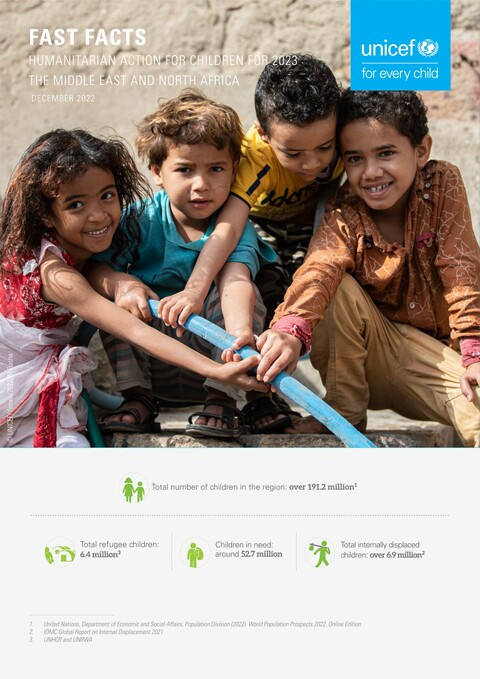 Humanitarian Action for Children in the Middle East and North Africa for 2023: Fast Facts Año de publicación: 2022 Autor corporativo: UNICEF Middle East and North Africa Total number of children in the region: over 191.2 million Total refugee children: 6.4 million Children in need: around 52.7 million Total internally displaced children: over 6.9 million UNICEF MENA is appealing for US$ 2.6 billion to respond to the ongoing humanitarian crises and children’s humanitarian needs around the region. العمـل الإنسـاني مـن أجـل الأطفـال في الشـرق الأوسـط وشـمال أفريقيا للعام ٢٠٢٣; حقائـق سـريعة Año de publicación: 2022 Autor corporativo: UNICEF Middle East and North Africa إجمالي عدد الأطفال في المنطقة: أكثر من 191.2 مليون طفلالأطفال المحتاجون: 52.7 مليون طفلمجموع النازحين من الأطفال: أكثر من 6.4 ملايين طفلمجموع اللاجئين من الأطفال: 6.4 مليون طفلتطلق اليونيسف نداءً للحصول على 2,6 مليار دولار أمريكي للاستجابة للأزمات الإنسانية المستمرة واحتياجات الأطفال الإنسانية في المنطقة.
  Reimagining Life Skills and Citizenship Education in the Middle East and North Africa: A Four-Dimensional and Systems Approach to 21st Century Skills; Conceptual and Programmatic Framework Año de publicación: 2017 Autor corporativo: UNICEF Middle East and North Africa The situation of learning in MENA calls for a holistic, lifelong and rights-based vision of education that maximizes the potential of all children and youth in the region and better equips them to create meaning out of knowledge and to face the transitions from childhood to adulthood, from education to work, and from unreflective development to responsible and active citizenship. This is what drives the MENA Life Skills and Citizenship Education (LSCE) Initiative, kicked off in 2015 with the aim of supporting the countries of the region – conceptually, programmatically and technically – to improve learning and to better invest such learning in individual, social and economic development.The LSCE Conceptual and Programmatic Framework (CPF) puts forth a roadmap to guide policies, strategies and programmes on life skills and citizenship education supporting the region-wide efforts to provide children and youth with opportunities to learn, transition from childhood to adulthood, move from school to work settings, and become responsible and active citizens of their communities.A set of twelve core life skills for MENA has been identified using the four-dimensional learning model: ‘Learning to Know’ (Cognitive Dimension), ‘Learning to Do’ (Instrumental Dimension), ‘Learning to Be’ (Individual Dimension), and ‘Learning to Live Together’ (Social Dimension). The twelve core life skills are life-long, and they build on evidence that underlines the importance of skills acquisition from an early age. Furthermore, the twelve core life skills are acquired and sustained through all forms of learning in a systems approach that recognizes multiple pathways of learning, formal, non-formal and informal. Réimaginer l’éducation aux compétences de vie et à la citoyenneté au Moyen-Orient et en Afrique du Nord : Une approche à quatre dimensions et systémique des compétences pour le XXIe siècle ; Cadre programmatique et conceptuel Año de publicación: 2017 Autor corporativo: UNICEF Middle East and North Africa L’Initiative pour l’éducation aux compétences de vie et à la citoyenneté de la région MENA (LSCE) représente un effort de collaboration étatique et régional en faveur de la réalisation de l’objectif de développement durable (ODD) 4 – Assurer l’accès de tous à une éducation de qualité, sur un pied d’égalité, et promouvoir les possibilités d’apprentissage tout au long de la vie. Elle cherche à reformuler la compréhension traditionnelle de l’éducation aux compétences de vie et à la citoyenneté dans la région, tout en rappelant les questions fondamentales au sujet du but et du rôle de l’éducation dans le développement sociétal qui sont pertinentes dans le contexte actuel.L’Initiative LSCE se concentre sur trois défis interdépendants :Une société du savoir inaccessible, résultat de la mauvaise qualité de l’éducation, du bas niveau des résultats scolaires et d’une équité et inclusion limitées.Une croissance économique en déclin, résultat d’un manque d’aptitudes à l’employabilité, du haut taux de chômage chez les jeunes, de l’inégalité des sexes face à l’accès au marché du travail, du manque de création d’emplois, et d’un environnement économique faible.Une faible cohésion sociale, résultat de l’escalade de la violence et de la radicalisation tout autant que d’un faible engagement civique.
  Analytical Mapping of Life Skills and Citizenship Education in the Middle East and North Africa Año de publicación: 2017 Autor corporativo: UNICEF Middle East and North Africa The Analytical Mapping of the Life Skills and Citizenship Education in MENA, published in October 2017, provides a multi-stakeholder view of the status of life skills and citizenship education in MENA and the corresponding vision for the region. It does not evaluate existing interventions, nor is it meant to generate an exhaustive list of all existing life skills programmes in MENA. It rather aims to provide an analytical overview of Life Skills and Citizenship Education (LSCE) related intervention in the region. Through analyzation, it also attempts to highlight general challenges encountered in the programming of LSCE, as well as focus on opportunities for LSCE in MENA national education systems.