
Recursos
Exploren una amplia gama de recursos valiosos en GCED para profundizar su comprensión y promover su búsqueda, incidencia, enseñanza y aprendizaje.
70 resultados encontrados
 Hacer las promesas realidad: La igualdad de género en la agenda 2030 para el desarrollo sostenible Año de publicación: 2018 Autor corporativo: United Nations Entity for Gender Equality and the Empowerment of Women (UN Women) “Hacer las promesas realidad: La igualdad de género en la Agenda 2030 para el Desarrollo Sostenible” presenta una evaluación exhaustiva y fidedigna de los avances, dificultades y posibilidades de la aplicación de los Objetivos de Desarrollo Sostenible (ODS) desde una perspectiva de género. El informe hace seguimiento de las tendencias mundiales y regionales con miras a la consecución de los ODS para las mujeres y las niñas sobre la base de los datos disponibles, y ofrece orientación práctica para la ejecución de políticas sensibles al género y los consiguientes procesos de rendición de cuentas. Como fuente de análisis de alta calidad de datos y políticas, el informe es una referencia e instrumento de rendición de cuentas esencial para responsables de la formulación de políticas, organizaciones de mujeres, el sistema de las Naciones Unidas y otras partes interesadas.
  Spotlight on Gender, COVID-19 and the SDGs: Will the Pandemic Derail Hard-Won Progress on Gender Equality? Año de publicación: 2020 Autor: Priya Alvarez | Emma-Louise Anderson | Nazneen Damji | Gaëlle Ferrant | Rosina Gammarano | Steve Kapsos | Ann Beth Moller | Amy Patterson Autor corporativo: United Nations Entity for Gender Equality and the Empowerment of Women (UN Women) COVID-19 has been declared a public health emergency of international concern and a global pandemic by the World Health Organization. This global threat to health security underscores the urgent need to accelerate progress on achieving Sustainable Development Goal (SDG) 3 and the need to massively scale up international cooperation to deliver on SDG 3. It also reveals what is less obvious, but no less urgent: how health emergencies such as COVID-19, and the response to them, can exacerbate gender inequality and derail hard-won progress not only on SDG 3 but on all the SDGs.This paper presents the latest evidence on the gendered impact of the pandemic, highlights potential and emerging trends, and reflects on the long-term impact of the crisis on the achievement of the 2030 Agenda for Sustainable Development.The paper begins by presenting key facts and figures relating to the gendered impacts of COVID-19 followed by reflecting on the health impacts of COVID-19 on SDG 3 targets. Then, the paper explores the socioeconomic and political implications of COVID-19 on women and gender across five of the Goals: SDG 1 (poverty), 4 (quality education), 5 (gender equality), 8 (decent work and economic growth), and 10 (reduced inequalities).
  Violence Against Women and Girls: Kyrgyz Republic (Gender in Society Perception Study; Oct. 2018) Año de publicación: 2018 Autor: Elena Kim Autor corporativo: United Nations Entity for Gender Equality and the Empowerment of Women (UN Women) This report is part of the Gender in the Perception of Society (GSPS) study, funded by the UN Peacebuilding Fund, jointly run by UN Women, UNFPA and IOM in the Kyrgyz Republic. The report on the results of the study is dedicated to the topic of violence against women through the prism of two types of widespread practice of forced marriage in the Kyrgyz Republic. The report, which consists of two main sections, focuses on the practice of abducting brides and child marriages. The report attempts to explain the attitude and reaction of society to both phenomena, which deprive women of their rights and opportunities and require changes in opinions, attitudes and institutional priorities. Насилие в отношении женщин и девочек: Кыргызская Республика (Исследование – Гендер в восприятии общества; Октябрь 2018) Año de publicación: 2018 Autor: Elena Kim Autor corporativo: United Nations Entity for Gender Equality and the Empowerment of Women (UN Women) Данный оттчет является частью исследования "Гендер в восприятии общества" (GSPS), финансируемого Фондом ООН по миростроительству, совместно выполняемого ООН-Женщины, ЮНФПА и МОМ в Кыргызской Республики. Отчет по результатам исследования посвящен теме насилия в отношении женщин через призму двух видов широкораспространенной практики насильственных браков в Кыргызской Республике. Состоящий из двух основных разделов отчет сфокусирован на практике похищения невест и детских браков. В отчете предпринимается попытка объяснить отношение и реакцию общества на оба явления, которые лишают женщин их прав и возможностей и требуют изменений в суждениях, отношении и институциональных приоритетах.
  Progress on the Sustainable Development Goals: The Gender Snapshot 2020 Año de publicación: 2020 Autor corporativo: United Nations Entity for Gender Equality and the Empowerment of Women (UN Women) This document brings together the latest available evidence on gender equality across all 17 Goals, underscoring the progress made, but also taking stock of areas where progress has been disrupted, as a result of COVID-19.
  Training Manual on Gender and Climate Change Resilience Año de publicación: 2021 Autor: Dharmistha Chauhan Autor corporativo: Asian-Pacific Resource & Research Centre for Women (ARROW) | United Nations Entity for Gender Equality and the Empowerment of Women (UN Women) This Training Manual on Gender and Climate Change Resilience is designed for use by Civil Society Organizations (CSOs) in Asia working with communities on gender, climate change resilience and disaster risk reduction. The manual aims to strengthen the capacities of CSOs to mainstream gender in their practices and to actively advocate for gender mainstreaming in policies, programmes, projects and legislation. The long-term objective is to promote climate resilience action on the ground with a gender equality perspective in the forefront.
  Gender and Climate Change: Training Handbook Año de publicación: 2018 Autor: Višnja Baćanović | Jasmina Murić Autor corporativo: United Nations Entity for Gender Equality and the Empowerment of Women (UN Women) | Government of Serbia | United Nations Development Programme (UNDP) This handbook aims to improve the understanding of gender aspects in climate change. It is intended for experts and interested public, and is organized as a training program for male and female representatives of institutions and state administration, so that it may can be used as a source for practical training, as well as a guide for the introduction of gender perspective in programs and projects.The manual is organized according to thematic units of training and includes basic concepts, gender roles and stereotypes; key gender aspects of climate change; legal and strategic frameworks; and the introduction of gender perspectives in policies and programs in the field of climate change.
 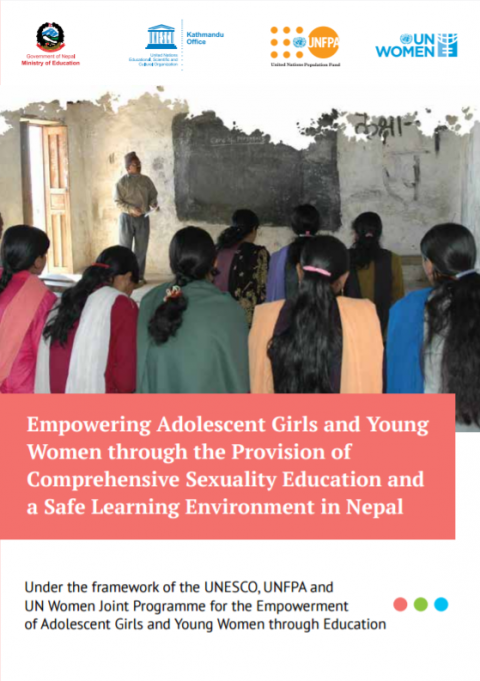 Empowering Adolescent Girls and Young Women through the Provision of Comprehensive Sexuality Education and a Safe Learning Environment in Nepal Año de publicación: 2016 Autor corporativo: UNESCO Kathmandu | United Nations Entity for Gender Equality and the Empowerment of Women (UN Women) | United Nations Population Fund (UNFPA) There are many challenges for adolescent girls and young women in Nepal in terms of access, participation, and completion of good quality education. Child marriage and early pregnancy, gender-based violence, lack of knowledge or provision of proper hygiene facilities such as WASH (water, sanitation and hygiene) are factors preventing adolescent girls and young women from accessing education. This publication is a project plan for empowering adolescent girls and young women in Nepal.
  Education 2030: Incheon declaration and framework for action towards inclusive and equitable quality education and lifelong learning for all Año de publicación: 2015 Autor corporativo: UNESCO | United Nations Development Programme (UNDP) | United Nations Population Fund (UNFPA) | UN. Office of the United Nations High Commissioner for Refugees (UNHCR) | United Nations Children's Fund (UNICEF) | United Nations Entity for Gender Equality and the Empowerment of Women (UN Women) | World Bank This framework — painstakingly drafted over many months with input from governments, international agencies, civil society and experts — provides guidance for implementing the education commitments made in the 2030 Agenda for Sustainable Development at a national, regional and global level. In particular: it aims at mobilizing all countries and partners around Sustainable Education Goal 4 and its targets;it proposes ways of implementing, coordinating, financing and monitoring the new commitments; andit proposes indicative strategies which countries may wish to draw upon in developing their plans, taking into account different national realities, capacities and levels of development and respecting national policies and priorities. 교육 2030 인천선언과 실행계획: 포용적이고 공평한 양질의 교육과 모두를 위한 평생학습을 향해 Año de publicación: 2015 Autor corporativo: 유네스코 | United Nations Development Programme (UNDP) | United Nations Population Fund (UNFPA) | UN. Office of the United Nations High Commissioner for Refugees (UNHCR) | United Nations Children's Fund (UNICEF) | United Nations Entity for Gender Equality and the Empowerment of Women (UN Women) | World Bank 정부, 국제기구, 시민사회와 전문가의 조언을 받아 몇 달 동안 많은 노력을 기울여 초안이 작성된 이 실행계획은 지속가능한 발전을 위한 2030 아젠다의 국가적, 지역적, 세계적 단계에서의 실현을 위한 교육의 역할에 대한 실천 가이드를 제공한다. 이는 모든 국가와 지속가능목표 4와 그 대상을 둘러싼 파트너들을 움직이도록 하는 데에 그 목적을 둔다.이 실행계획은 새로운 역할에 대한 실천, 협력, 자금조달과 관찰 방안을 제안한다.이 실행계획은 각 국가들이 서로 다른 국가적 상황과 역량, 발전 단계 및 각국의 정책과 우선순위를 존중한 계획을 세울 수 있도록 전략을 보여준다.