
Recursos
Exploren una amplia gama de recursos valiosos en GCED para profundizar su comprensión y promover su búsqueda, incidencia, enseñanza y aprendizaje.
70 resultados encontrados
 Education 2030: Déclaration d'Incheon et Cadre d'action: vers une éducation inclusive et équitable de qualité et un apprentissage tout au long de la vie pour tous Año de publicación: 2016 Autor corporativo: Organisation des Nations Unies pour l'éducation, la science et la culture (UNESCO) | United Nations Development Programme (UNDP) | United Nations Children's Fund (UNICEF) | United Nations Entity for Gender Equality and the Empowerment of Women (UN Women) | World Bank | United Nations Population Fund (UNFPA) | UN. Office of the United Nations High Commissioner for Refugees (UNHCR) This framework — painstakingly drafted over many months with input from governments, international agencies, civil society and experts — provides guidance for implementing the education commitments made in the 2030 Agenda for Sustainable Development at a national, regional and global level. In particular: it aims at mobilizing all countries and partners around Sustainable Education Goal 4 and its targets; it proposes ways of implementing, coordinating, financing and monitoring the new commitments; and it proposes indicative strategies which countries may wish to draw upon in developing their plans, taking into account different national realities, capacities and levels of development and respecting national policies and priorities. Educação 2030 Declaração de Incheon Rumo a uma educação de qualidade inclusiva e equitativa e à educação ao longo da vida para todos Año de publicación: 2016 Autor corporativo: UNESCO | United Nations Development Programme (UNDP) | UN. Office of the United Nations High Commissioner for Refugees (UNHCR) | United Nations Children's Fund (UNICEF) | United Nations Entity for Gender Equality and the Empowerment of Women (UN Women) | United Nations Population Fund (UNFPA) This framework — painstakingly drafted over many months with input from governments, international agencies, civil society and experts — provides guidance for implementing the education commitments made in the 2030 Agenda for Sustainable Development at a national, regional and global level. In particular: it aims at mobilizing all countries and partners around Sustainable Education Goal 4 and its targets; it proposes ways of implementing, coordinating, financing and monitoring the new commitments; and it proposes indicative strategies which countries may wish to draw upon in developing their plans, taking into account different national realities, capacities and levels of development and respecting national policies and priorities.
 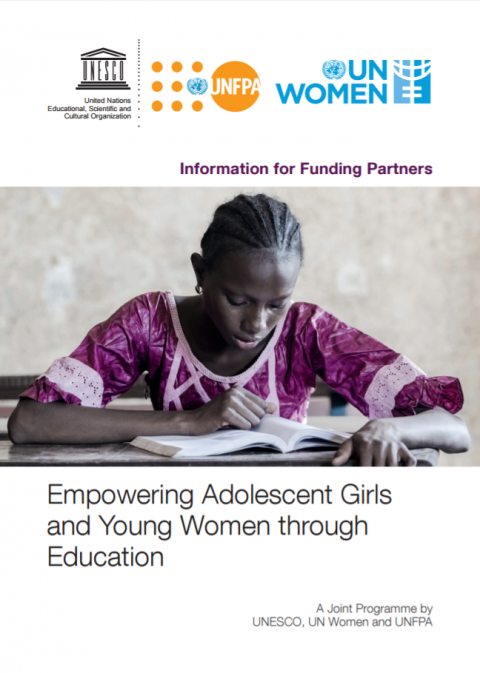 Empowering Adolescent Girls and Young Women through Education: Information for Funding Partners Año de publicación: 2016 Autor corporativo: UNESCO | United Nations Population Fund (UNFPA) | United Nations Entity for Gender Equality and the Empowerment of Women (UN Women) Empowering Adolescent Girls and Young Women through Education: Information for Funding Partners
  Global guidance on addressing school related gender based violence Año de publicación: 2016 Autor corporativo: UNESCO | United Nations Entity for Gender Equality and the Empowerment of Women (UN Women) More than 246 million children are subjected to gender-based violence in or around schools every year. This is a violation of their human rights, and a form of gender-discrimination that has far-reaching physical, psychological and educational consequences. Ending schoolrelated gender-based violence (SRGBV) is a priority for countries wishing to achieve ambitious global goals on inclusive and quality education for all and gender equality.WHAT IS THE AIM OF THIS GUIDANCE? This guidance aims to provide a comprehensive, one-stop resource on school-related gender-based violence (SRGBV), including clear, knowledge-based operational guidance, diverse case studies drawn from examples of promising practice and recommended tools for the education sector and its partners working to eliminate gender-based violence. It distils programme knowledge based on existing global literature, promising practices, expert recommendations and practitioner consensus.WHO IS THIS GUIDANCE FOR? The primary audience for this global guidance is the national education sector, including government policy-makers, education ministries, school administrators, educators and other school staff. The guidance may also have wider interest for other national and international stakeholders that are interested in addressing SRGBV, including NGOs, bilateral and multilateral agencies, teachers’ trade unions and policy-makers in other domestic sectors. The guidance is intended primarily for use in low- and middle-income settings, but is based on norms and principles that are universally applicable.WHAT IS COVERED IN THIS GUIDANCE? Promising practice case studies and recommended tools are embedded throughout the relevant sub-sections of the guidance. These provide readers with illustrative examples of implementation in real-life contexts and can serve as resources that have been successfully used – and can be adapted – for application in different contexts.This guidance complements other existing tools and materials for specific bilateral, multilateral and NGO audiences on violence against women and girls, and violence in schools. An expanded online version, which will be regularly updated, is available at www.endvawnow.org Lutte contre la violence de genre en milieu scolaire: orientations mondiales: Año de publicación: 2016 Autor corporativo: UNESCO | United Nations Entity for Gender Equality and the Empowerment of Women (UN Women) More than 246 million children are subjected to gender-based violence in or around schools every year. This is a violation of their human rights, and a form of gender-discrimination that has far-reaching physical, psychological and educational consequences. Ending schoolrelated gender-based violence (SRGBV) is a priority for countries wishing to achieve ambitious global goals on inclusive and quality education for all and gender equality.WHAT IS THE AIM OF THIS GUIDANCE? This guidance aims to provide a comprehensive, one-stop resource on school-related gender-based violence (SRGBV), including clear, knowledge-based operational guidance, diverse case studies drawn from examples of promising practice and recommended tools for the education sector and its partners working to eliminate gender-based violence. It distils programme knowledge based on existing global literature, promising practices, expert recommendations and practitioner consensus.WHO IS THIS GUIDANCE FOR? The primary audience for this global guidance is the national education sector, including government policy-makers, education ministries, school administrators, educators and other school staff. The guidance may also have wider interest for other national and international stakeholders that are interested in addressing SRGBV, including NGOs, bilateral and multilateral agencies, teachers’ trade unions and policy-makers in other domestic sectors. The guidance is intended primarily for use in low- and middle-income settings, but is based on norms and principles that are universally applicable.WHAT IS COVERED IN THIS GUIDANCE? Promising practice case studies and recommended tools are embedded throughout the relevant sub-sections of the guidance. These provide readers with illustrative examples of implementation in real-life contexts and can serve as resources that have been successfully used – and can be adapted – for application in different contexts.This guidance complements other existing tools and materials for specific bilateral, multilateral and NGO audiences on violence against women and girls, and violence in schools. An expanded online version, which will be regularly updated, is available at www.endvawnow.org
  School-related gender-based violence: global guidance (Infographic) Año de publicación: 2016 Autor corporativo: UNESCO | United Nations Entity for Gender Equality and the Empowerment of Women (UN Women) School-related gender-based violence: global guidance (Infographic) Lutte contre la violence de genre en milieu scolaire: orientations mondiales (Infographique) Año de publicación: 2016 Autor corporativo: UNESCO | United Nations Entity for Gender Equality and the Empowerment of Women (UN Women) Lutte contre la violence de genre en milieu scolaire: orientations mondiales (Infographique)
  The Journey Towards Comprehensive Sexuality Education: Global Status Report Año de publicación: 2021 Autor corporativo: UNESCO | Joint United Nations Programme on HIV/AIDS (UNAIDS) | United Nations Population Fund (UNFPA) | United Nations Children's Fund (UNICEF) | United Nations Entity for Gender Equality and the Empowerment of Women (UN Women) | World Health Organization (WHO) Comprehensive sexuality education (CSE) is central to children and young people’s well-being, equipping them with the knowledge and skills they need to make healthy and responsible choices in their lives. This report draws on multiple data sources to provide analysis of countries’ progress towards delivering good quality school-based CSE to all learners. 85 per cent of 155 countries surveyed have policies or laws relating to sexuality education, with considerably more countries reporting policies to mandate delivery at secondary education level than at primary level. However, the existence of policy and legal frameworks do not always equate to comprehensive content or strong implementation. Most countries report that they have some curricula in place but more detailed analysis suggests that it often lacks the breadth of topics needed to make sexuality education effective and relevant. Moreover, while efforts to scale-up teacher training are evident in a range of settings, research with teachers shows that many feel they lack confidence to deliver sexuality education. Surveys show that students frequently feel that they received information too late and would have preferred sexuality education to have started earlier in their schooling. There is evidence of opposition to CSE across a range of settings, often reflecting misinformation about the content, purpose or impact of such education. However, in many countries involvement of communities, including parents, school officials, religious leaders, media and young people themselves, has created a favourable environment for CSE. Recommendations to countries in this report include:Clear mandates and budgets to ensure implementation of policies and programmes that support the availability of good quality comprehensive sexuality education for all learners.Invest in quality curriculum reform and teacher training.Strengthen monitoring of the implementation of CSE.
  "Sustainable Development Goals and Gender in Kyrgyzstan" New Statistical Publication Año de publicación: 2023 Autor corporativo: National Statistical Committee of the Kyrgyz Republic | United Nations Entity for Gender Equality and the Empowerment of Women (UN Women) This publication is intended to inform the public and government officials about the current status and progress towards achieving sustainable development in Kyrgyzstan, promote informed policy and management decisions, and help identify further priority steps to achieve the SDGs and women’s empowerment. Статистический сборник "Цели в области устойчивого развития и гендер в Кыргызской Республике" Año de publicación: 2023 Autor corporativo: National Statistical Committee of the Kyrgyz Republic | United Nations Entity for Gender Equality and the Empowerment of Women (UN Women) Целью настоящего издания является информирование общественности и работников государственного управления о текущем состоянии и прогрессе в достижении устойчивого развития в Кыргызской Республике, а также для принятия обоснованных политических и управленческих решений и содействия в определении дальнейших приоритетных шагов для достижения успеха в реализации ЦУР и расширения прав и возможностей женщин.