
Recursos
Exploren una amplia gama de recursos valiosos en GCED para profundizar su comprensión y promover su búsqueda, incidencia, enseñanza y aprendizaje.
16 resultados encontrados
 Poverty Culture Impact on Some Educational Values and Attitudes of Secondary Stage Students in Al-Madinah Al-Munawarah Province Año de publicación: 2013 Autor: Aysha Al-Ahmadi Autor corporativo: University of Jordan The study aimed at identifying the impact of the culture of poverty on some educational values and attitudes of high school students in Madinah. The researcher adopted the descriptive approach through the application of a questionnaire concerned with monitoring the moral and sensory trends of the study sample. The questionnaire was developed towards measuring some educational values and attitudes, and collecting data related to the student’s gender and family income Ownership and type of housing, and parenting education. أثر ثقافة الفقر على بعض القيم والمواقف التعليمية لدى طلبة المرحلة الثانوية في منطقة المدينة المنورة Año de publicación: 2013 Autor: Aysha Al-Ahmadi Autor corporativo: University of Jordan هدفت الدراسة الحالية تعرّف أثر ثقافة الفقر على بعض القيم والمواقف التعليمية لدى طلبة المرحلة الثانوية بالمدينة المنورة، اعتمدت فيها الباحثة المنهج الوصفي من خلال تطبيق إستبانه اهتمت برصد التوجهات المعنوية والحسية لعينة الدراسة، نحو بعض القيم والمواقف التعليمية، وجمع بيانات ارتبطت بجنس الطالب، ودخل الأسرة، وملكية السكن ونوعه، وتعليم الوالدين.
  درجة إلمام معلمات رياض الأطفال لمبادئ حقوق الطفل المتضمنة في المنهاج الوطني التفاعلي بالأردن من منظور تربوي وقانوني Año de publicación: 2016 Autor: الزبون، سليم عودة Autor corporativo: University of Jordan هدفت هذه الدراسة إلى الكشف عن درجة إلمام معلمات رياض الأطفال بمبادئ حقوق الطفل المتضمنة في المنهاج الوطني التفاعلي بالأردن من منظور تربوي وقانوني، وتكونت عينة الدراسة من (53 ) معلمة من مجتمع الدراسة الأصلي، حيث تم اختيار العينة على أساس العينة الطبقية العشوائية. قام الباحثون بتطوير استبانة لهذا الغرض اشتملت على (38 ) حقًا من حقوق الطفل وزعت على أربعة مجالات: الاجتماعي، والمعرفي، والسياسي، والاقتصادي، وتم التحقق من صدقها وثباتها. وقد أظهرت النتائج ضعف إلمام معلمات رياض الأطفال بمبادئ حقوق الطفل المتضمنة في المنهاج الوطني التفاعلي. وقد خلص الباحثون إلى عدد من التوصيات، منها: تضمين المنهاج الوطني التفاعلي وأدلة المعلمين الصور والنشاطات التي توضح التطبيق الفعلي لحقوق الطفل في مواقف الحياة اليومية، وعقد دورات تدريبية لمعلمات رياض الأطفال للتعرف على مبادئ حقوق الطفل. The Degree of Familiarity with Kindergarten Teachers to Child Rights Principles Contained in the National Curriculum in Jordan, from Interactive Education and Legal Perspective Año de publicación: 2016 Autor: الزبون، سليم عودة Autor corporativo: University of Jordan The goal of this research is to detect the extent to which kindergarten teachers are familiar with the principles of the rights of children that are included in the National Curriculum, in Jordan, from the interactive education and legal perspective. The study sample consisted of (53) parameters of the original study population, where the sample was selected on the basis of stratified random sample . The researchers developed a questionnaire for this purpose which included (38) of the child rights and distributed them in four areas: social, cognitive, political and economic, and was verified. The results showed weakness in the familiarity by kindergarten teachers of the principles of the rights of children that are included in the National Curriculum. The researchers concluded with a number of recommendations including: to include in the National Curriculum and teachers' guides to interactive images and activities that illustrate the actual application of the rights of children in everyday situations, and holding training courses for kindergarten teachers on the principles of the rights of the child.
  إستراتيجية تربوية مقترحة لمؤسسات التنشئة السياسية في الأردن لتعزيز مفاهيم الوحدة الوطنية Año de publicación: 2016 Autor corporativo: University of Jordan هدفت الدراسة إلى وضع استراتيجية تربوية مقترحة لمؤسسات التنشئة السياسية في الأردن لتعزيز مفاهيم الوحدة الوطنية من وجهة نظر طلبة الجامعات الأردنية. تكونت عينة الدراسة من (350) طالب وطالبة، تم اختيارهم بالطريقة الطبقية العشوائية من طلبة الجامعات الأردنية الرسمية لمرحلة البكالوريوس للعام الدراسي 2013 /2014 ...تم اختيار ثلاث جامعات لتشملهم الدراسة موزعة على ثلاثة أقاليم، هي: إقليم الجنوب (جامعة مؤتة) والوسط (الجامعة الأردنية) والشمال (جامعة اليرموك)، واستخدم فيها المنهج المسحي التطويري. وقد توصلت الدراسة إلى النتائج الآتية: - التقدير الكلي لواقع دور مؤسسات التنشئة السياسية في تعزيز مفاهيم الوحدة الوطنية من وجهة نظر طلبة الجامعات الأردنية جاء بدرجة متوسطة. - التقدير الكلي لواقع التحديات التي تواجه مؤسسات التنشئة السياسية في تعزيز مفاهيم الوحدة الوطنية من وجهة نظر طلبة الجامعات الأردنية جاءت بدرجة متوسطة. وقد أوصت الدراسة بعدة توصيات أهمها الأخذ بالاستراتيجية المقترحة لتنمية دور مؤسسات التنشئة السياسية في تعزيز مفاهيم الوحدة الوطنية . A Proposed Strategy for Educational Institutions of Political Socialization in Jordan to Promote National Unity Concepts Año de publicación: 2016 Autor corporativo: University of Jordan This study aimed to develop an educational proposed strategy for the institutions of political socialization in Jordan to promote national unity concepts from the perspective of Jordanian university students. The study sample consisted of 350 male and female students, were chosen in a stratified random students way from Jordanian public universities for undergraduate for the academic year 2013/2014...the three universities were selected for the study were spread over three regions: southern Region (Muta University), the central Region (The University of Jordan) and the North Region (Yarmouk University)... The study found the following results: -The overall appreciation of the reality of the role of political education institutions in the promotion of national unity concepts from the perspective of Jordanian university students came moderate. -The overall appreciation of the reality of the challenges facing political education institutions in the promotion of national unity concepts from the point of Jordanian university students was moderate...Of the most important recommendations: the introduction of the proposed strategy for developing the role of the political education institutions in the promotion of national unity concepts.
  أثر برنامج تدريبي في تنمية مبادئ المواطنة العالمية لدى معلمي التاريخ في الأردن Año de publicación: 2015 Autor: Zaid Suleiman Autor corporativo: University of Jordan هدفت الدارسة إلى بناء برنامج تدريبيّ لمعلمي التاريخ في ضوء مبادئ المواطنة العالميّة واختبار أثره في مستوى معرفتهم لتلك المبادئ في الأردن. تكونت عينة الد ا رسة من ( 26 ) معلمًا ومعلمة، تم اختيارهم بالطريقة العشوائية من معلمي التاريخ في المرحلة الأساسيّة العليا في مديرية التربية والتعليم لمحافظة مأدبا. ولتحقيق أهداف الدارسة تم بناء برنامج تدريبيّ في ضوء مبادئ المواطنة العالميّة، هي: السلام العالميّ، والديمقراطيّة، وحقوق الإنسان، الإنسان والبيئة، التفكير العلميّ، التكنولوجيا، الثقافات المتعددة. وتم اعداد اختبار معرفيّ لمبادئ المواطنة العالميّة. وبعد اجراء التحليلات الاحصائية المناسبة أظهرت نتائج الدرارسة أن مستوى المعرفة القبْلية عند معلمي التاريخ في المرحلة الأساسيّة العليا لمبادئ المواطنة العالميّة كان أقل من المستوى المقبول تربويًّا ( % 80)، ووجود فروق ذات دلالة إحصائيّة عند مستوى الدلالة ( α= 0.01 ) بين مستوى المعرفة البَعدية عند معلمي التاريخ في المرحلة الأساسيّة العليا لمبادئ المواطنة العالميّة والمستوى المقبول تربويًّا (80 %)، ولصالح البرنامج التدريبيّ في كلّ مجال من مبادئ المواطنة العالمية وللمجالات مجتمعة. وأوصت الدراسة بتضمين أبعاد مفاهيم المواطنة العالميّة ومبادئها في البرامج التدريبيّة للمعلمين لزيادة وعيهم بالقضايا العالميّة. The Effect of a Training Program on Developing the Global Citizenship Principles of the History Teachers in Jordan Año de publicación: 2015 Autor: Zaid Suleiman Autor corporativo: University of Jordan This study aimed at building a training program for the history teachers in the light of the global citizenship principles and at testing its effect on their knowledge level of those principles, in Jordan. Study sample consisted of (26) male and female teachers randomly selected from the history teachers for the higher of Basic Education, in the education Directorate of the Ma'daba Governorate.To achieve the study goals, a training program was developed in the light of the global citizenship principles, which are: global peace, democracy, human rights, humans and the environment, scientific thinking, technology, and multicultures. and a cognitive test of the global citizenship's principles was prepared. After performing the relevant statistical analysis, the results revealed that the pre-knowledge level of the history among those teachers of the global citizenship principles was lower than the educationally accepted level (80%), and the presence of differences with statistical significance (α=0.01) between the post-knowledge level among the history teachers at the higher stage of basic education about the global citizenship principles and the educationalyl accepted level (80%), in favor of the training program in each domain of the global citizenship's principles and the domains collectively. The study recommended the inclusion of the global citizenship principles and concepts in the teachers training programs in order to increase their awareness in the global issues.
 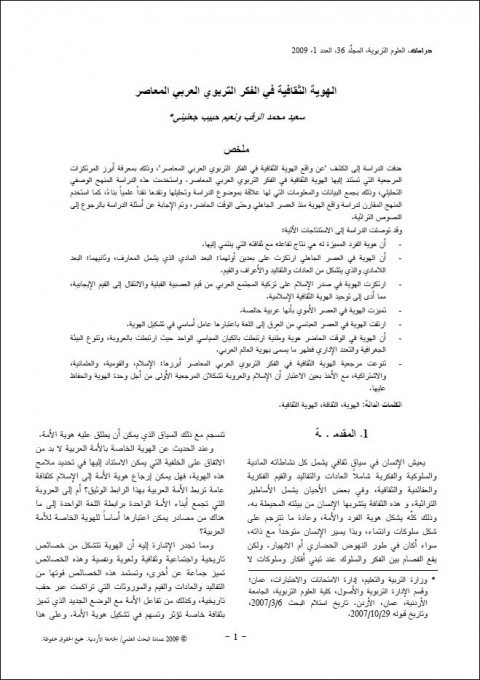 الهوية الثقافية في الفكر التربوي العربي المعاصر Año de publicación: 2009 Autor: الرقب، سعيد محمد Autor corporativo: University of Jordan هدفت الدراسة إلى الكشف عن واقع الهوية الثقافية في الفكر التربوي العربي المعاصر، وذلك بمعرفة أبرز المرتكزات المرجعية التي تستند إليها الهوية الثقافية في الفكر التربوي العربي المعاصر. وقد توصلت الدراسة إلى الاستنتاجات التالية: 1) أنّ هوية الفرد المميزة له هي نتاج تفاعله مع ثقافته التي ينتمي إليها. 2) أنّ الهويّة في العصر الجاهلي ارتكزت على بعدين أوّلهما: البعد المادي الذي يشمل المعارف، وثانيهما: البعد اللامادي والذي يتشكل من العادات والتقاليد والأعراف والقيم. 3) إرتكزت الهوية في صدر الإسلام على تزكية المجتمع العربي من قيم العصبية القبلية والانتقال إلى القيم الإيجابية، مما أدى إلى توحيد الهوية الثقافية الإسلامية. 4) تميّزت الهوية في العصر الأموي بأنّها عربية خالصة. 5) ارتفعت الهوية في العصر العباسي من العِرق إلى اللغة باعتبارها عاملاً أساسياً في تشكيل الهوية. 6) أنّ الهوية في الوقت الحاضر هوية وطنية ارتبطت بالكيان السياسي الواحد حيث ارتبطت بالعروبة، وتنوع البيئة الجغرافية والتعدد الإداري فظهر ما يسمّى بهويّة العالم العربي. 7) تنوّعت مرجعيّة الهوية الثقافيّة في الفكر التربوي المعاصر أبرزها: الإسلام، والقوميّة، والعلمانيّة، والاشتراكية، مع الأخذ بعين الاعتبار أنّ الإسلام والعروبة يُشكلان المرجعيّة الأولى من أجل وحدة الهويّة والحفاظ عليها. Cultural Identity in Contemporary Arab Educational Thought Año de publicación: 2009 Autor: الرقب، سعيد محمد Autor corporativo: University of Jordan The study aimed at revealing the reality of the “Cultural Identity” in the contemporary Arab thought, by tracing the most important references that the” Cultural Identity” stemmed from This study followed a descriptive analytic method: information and data related to the study were gathered, analysed and evaluated. The comparative method is used as well to study the reality of “the Identity”, from Pre-Islam era till present.The study concluded the followings: 1. A person’s Identity that distinguishes him is a result of his interaction with his culture that he belongs to. 2. In pre-Islam era, the identity was based on two dimensions: the first was physical and this included knowledge; the second was non-physical and was formulated from habits, traditions, customs, and values. 3. In the Early Islamic period, identity was based on the elimination of tribal fanatical values and on the transformation into positive values. That lead to the unification of the Islamic cultural identity. 4. In the Umayyad period, the identity was featured by its pure Arab identity. 5. In the Abbasid period, the identity elevated from the ethnic level to the language level which is considered as integral factor for identity formulation. 6. At present, “the Identity” is a national one aligned with the one political status, and connected with Arabism, the varied geographical environments and the administrative diversity, and hence appeared what is called the 'identity of the Arab World'. 7. The references of the “cultural identity” in the modern educational thought are multi, the most prominent of these elements are Islam, nationalism, secularism and socialism, while taking into consideration that Islam and Arabism are the first references for the unification and preservation of the identity.