
Recursos
Exploren una amplia gama de recursos valiosos en GCED para profundizar su comprensión y promover su búsqueda, incidencia, enseñanza y aprendizaje.
3 resultados encontrados
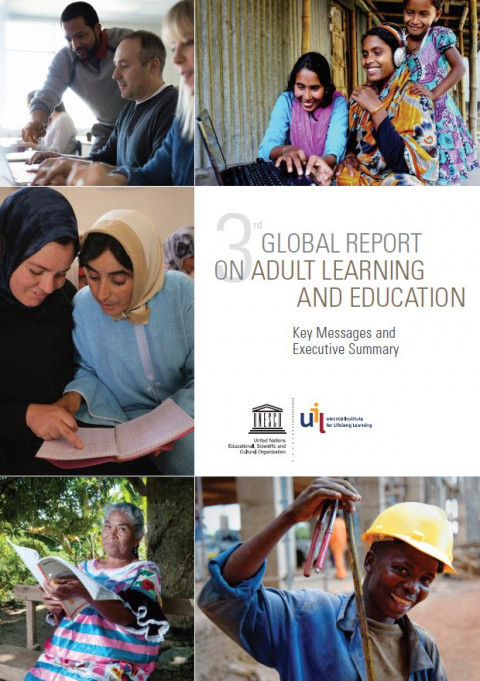 [Resumen] 3do Informe mundial sobre el aprendizaje y la educación de adultos: el impacto del aprendizaje y la educación de adultos sobre la salud y el bienestar, el empleo y el mercado de trabajo, y la vida social, cívica y comunitaria, mensajes clave y resumen ejecutivo Año de publicación: 2016 Autor corporativo: UNESCO Institute for Lifelong Learning (UIL) El tercer Informe mundial sobre el aprendizaje y la educación de adultos (GRALE III) se funda en los estudios de monitoreo completados por 139 Estados Miembros de la UNESCO a fin de producir una visión diferenciada sobre el estado global del aprendizaje y la educación de adultos (AEA). Evalúa el progreso de los países en lo que respecta al cumplimiento de los compromisos que hicieron en el Marco de acción de Bélem, aprobado en la VI Conferencia Internacional de Educación de Adultos (CONFINTEA VI) en 2009.Además, el informe examina el impacto del AEA en tres áreas importantes: salud y bienestar; empleo y mercado de trabajo, así como vida cívica y comunitaria. El GRALE III brinda a los responsables de la formulación de política, investigadores y practicantes pruebas convincentes de los más amplios beneficio del AEA en todas estas áreas. Al hacerlo, destaca algunas de las contribuciones más importantes que el AEA puede hacer para realizar los objetivos de la Agenda 2030 para el Desarrollo Sostenible.El presente informe responde a tres objetivos: en primer lugar, analizar los resultados de una encuesta de seguimiento realizada entre los Estados Miembros de la UNESCO y determinar si los países están cumpliendo los compromisos que contrajeron en CONFINTEA VI; en segundo lugar, reforzar los argumentos en favor del aprendizaje y la educación de adultos con datos fehacientes sobre los beneficios que reportan en los ámbitos de la salud y el bienestar, el empleo y el mercado de trabajo y la vida social, cívica y comunitaria; y en tercer lugar, proporcionar un referente a partir del cual debatir y pasar a la acción a escala nacional, regional e internacional.
  Inclusión, educación para el desarrollo sostenible, aprendizaje de adultos, educación superior e investigación: cuatro conferencias internacionales para promover la equidad, la calidad, la pertinencia y la responsabilidad social en materia de educación Año de publicación: 2008 Autor corporativo: UNESCO This cycle of conferences brings together a wide array of influential stakeholders in the common interest of creating education systems that serve the needs of all learners, address the challenges of today's world and make learning a springboard of development. Educación de adultos y desarrollo: La educación para la ciudadanía mundial (no 82, 2015) Año de publicación: 2015 Autor corporativo: DVV International Issue 82/2015 of the international journal Adult Education and Development (AED) explores the topic global citizenship education.In the international debates, we are witnessing a growing interest in the concept of global citizenship education. It is one of the three pillars of the Global Education First Initiative (GEFI) launched by the United Nations Secretary-General in 2012 and is being internationally promoted by the work of UNESCO. According to the GEFI, education that fosters global citizenship “must fully assume its central role in helping people to forge more just, peaceful, tolerant and inclusive societies”. The 2030 Agenda for Sustainable Development, adopted by the United Nations General Assembly in September 2015, refers to global citizenship as one tool to “ensure that all learners acquire the knowledge and skills needed to promote sustainable development”.The ambitions are high, but the concrete understanding of global citizenship education and its implications differ widely. Is it just another abstract concept? What meaning can the word citizenship have if it does not refer to a specific nation? What do people in different parts of the world understand by global citizenship? And how can global citizenship education be put into practice?Adult Education and Development decided to engage in the debate and invited authors from different regions, backgrounds and disciplines to share their thoughts and experiences on the topic and related questions such as identity, migration, peace, the meaning of citizenship, globalisation and sustainable development.Irina Bokova, Director-General of UNESCO, explains the organisation’s understanding of global citizenship education, and why adult education and “learning beyond the classrooms” are crucial when it comes to promoting global citizenship. Canadian author and journalist Doug Saunders (“Arrival City: How the Largest Migration in History Is Reshaping Our World”) talks about the challenges and opportunities of what he refers to as the last great human migration, that from the countryside to the cities, and about the positive role adult education can play during this transition.In the section “Citizens’ voices” people from all over the world talk about what global citizenship means to them and in what ways they see themselves as global citizens. And photographer Viktor Hilitksi travelled through Belarus and captured with his camera how villages rediscover their local traditions and cultures.