
Recursos
Exploren una amplia gama de recursos valiosos en GCED para profundizar su comprensión y promover su búsqueda, incidencia, enseñanza y aprendizaje.
26 resultados encontrados
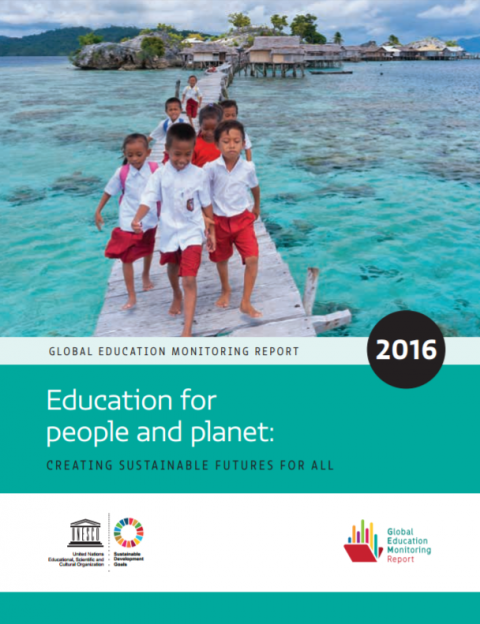 Informe de Seguimiento de la Educación en el Mundo, 2016: La Educación al servicio de los pueblos y el planeta: creación de futuros sostenibles para todos Año de publicación: 2016 Autor corporativo: UNESCO | Global Education Monitoring Report Team Education for People and Planet: Creating Sustainable Futures for All explores the complex relationship between education and the new 2030 Agenda for Sustainable Development, covering six fundamental pillars – Planet, Prosperity, People, Peace, Place and Partnerships. This report shows that education will not deliver its full potential unless participation rates increase dramatically and sustainable development guides education system reform. It also warns of the destructive impact that climate change, conflict, unsustainable consumption and the increasing gap between rich and poor have on education. A huge transformation is needed if we are to create sustainable futures for all.
 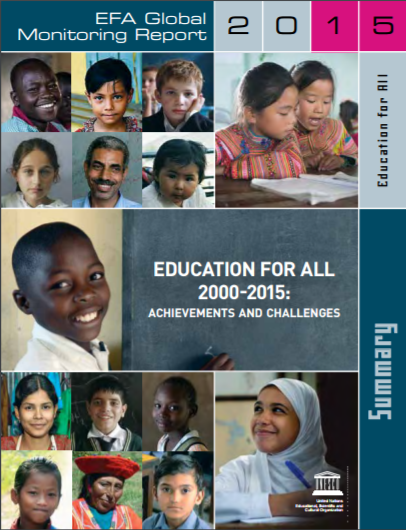 Education for All 2000-2015: Achievements and Challenges; EFA Global Monitoring Report, 2015; Summary Año de publicación: 2015 Autor corporativo: UNESCO At the World Education Forum in Dakar, Senegal, in 2000, governments from 164 countries, together with representatives of regional groups, international organizations, donor agencies, non-government organizations (NGOs) and civil society, adopted a Framework for Action to deliver Education for All (EFA) commitments. The Dakar Framework comprised 6 goals and their associated targets to be achieved by 2015, and 12 strategies to which all stakeholders would contribute. The EFA Global Monitoring Report (GMR) has monitored progress on an almost annual basis towards the EFA goals and the two education-related Millennium Development Goals (MDGs). The 2015 GMR provides a complete assessment of progress since 2000 towards the target date for reaching the Dakar Framework’s goals. It takes stock of whether the world achieved the EFA goals and stakeholders upheld their commitments. It explains possible determinants of the pace of progress. Finally, it identifies key lessons for shaping the post-2015 global education agenda. L'Education pour tous 2000-2015: progrès et enjeux, rapport mondial de suivi sur l'EPT, 2015, résumé Año de publicación: 2015 Autor corporativo: Organisation des Nations Unies pour l'éducation, la science et la culture (UNESCO) At the World Education Forum in Dakar, Senegal, in 2000, governments from 164 countries, together with representatives of regional groups, international organizations, donor agencies, non-government organizations (NGOs) and civil society, adopted a Framework for Action to deliver Education for All (EFA) commitments. The Dakar Framework comprised 6 goals and their associated targets to be achieved by 2015, and 12 strategies to which all stakeholders would contribute. The EFA Global Monitoring Report (GMR) has monitored progress on an almost annual basis towards the EFA goals and the two education-related Millennium Development Goals (MDGs). The 2015 GMR provides a complete assessment of progress since 2000 towards the target date for reaching the Dakar Framework’s goals. It takes stock of whether the world achieved the EFA goals and stakeholders upheld their commitments. It explains possible determinants of the pace of progress. Finally, it identifies key lessons for shaping the post-2015 global education agenda. Education for People and Planet: Creating Sustainable Futures for All, Global Education Monitoring Report, 2016 Año de publicación: 2016 Autor corporativo: UNESCO | Global Education Monitoring Report Team Education for People and Planet: Creating Sustainable Futures for All explores the complex relationship between education and the new 2030 Agenda for Sustainable Development, covering six fundamental pillars – Planet, Prosperity, People, Peace, Place and Partnerships. This report shows that education will not deliver its full potential unless participation rates increase dramatically and sustainable development guides education system reform. It also warns of the destructive impact that climate change, conflict, unsustainable consumption and the increasing gap between rich and poor have on education. A huge transformation is needed if we are to create sustainable futures for all.
 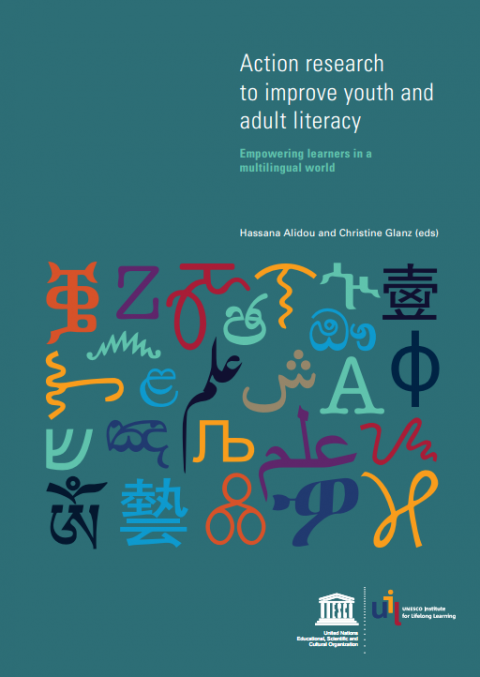 Action Research to Improve Youth and Adult Literacy: Empowering Learners in a Multilingual World Año de publicación: 2015 Autor corporativo: UNESCO Institute for Lifelong Learning (UIL) | UNESCO Abuja This guidebook is about the quest for quality, which is a lifelong pursuit linked to social justice. As we move in time and space new challenges emerge, but our vision is that no one should be left behind in the quest for self- and collective realization. We have to consider all possible means for enabling the active participation of all citizens in education. We must look at both challenges and opportunities, such as those that technology offers us for making linkages and improving access to information, knowledge and skills. We must seek out possibilities for retaining positive values and acquiring new ones which foster deeper appreciation for human, linguistic, cultural and ecological diversity.
  Global Alliance for Literacy within the Framework of Lifelong Learning (GAL): Strategy 2020–2025 Año de publicación: 2020 Autor corporativo: UNESCO Institute for Lifelong Learning (UIL) This strategy presents GAL’s vision, mission, goals and objectives for the period from 2020 to 2025. It builds upon GAL’s achievements from 2016 and 2019, and upon UNESCO’s previous initiatives supporting youth and adult literacy, including the UN Literacy Decade (2003–2012), Literacy Initiative for Empowerment (LIFE) from 2006 to 2015, and the 2015 Recommendation on Adult Learning and Education (RALE).