
Recursos
Exploren una amplia gama de recursos valiosos en GCED para profundizar su comprensión y promover su búsqueda, incidencia, enseñanza y aprendizaje.
358 resultados encontrados
 Réunion de consultation régionale sur l'ODD 4: Education 2030, Etats d'Europe et d'Amérique du Nord, Paris, 24-25 octobre 2016 Año de publicación: 2016 Autor corporativo: UNESCO
 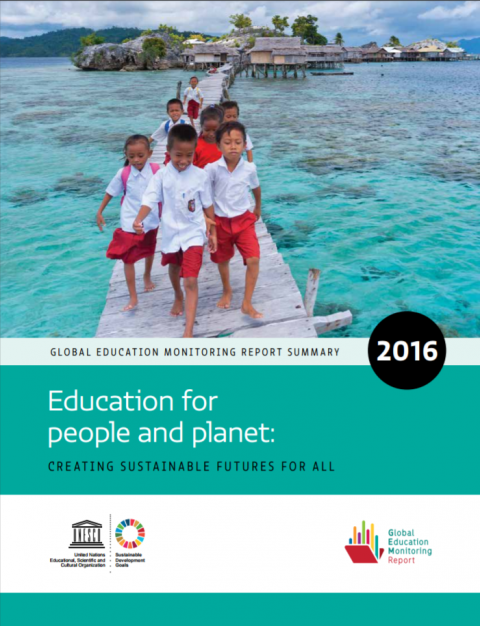 教育造福 人类与地球:为全民创造可持续的未来, 2016 全球教育监测报告; 摘要 Año de publicación: 2016 Autor corporativo: UNESCO The GEM Report provides an authoritative account of how education is the most vital input for every dimension of sustainable development. Better education leads to greater prosperity, improved agriculture, better health outcomes, less violence, more gender equality, higher social capital and an improved natural environment. Education is key to helping people around the world understand why sustainable development is such a vital concept for our common future. Education gives us the key tools – economic, social, technological, even ethical – to take on the SDGs and to achieve them. These facts are spelled out in exquisite and unusual detail throughout the report. Yet the report also emphasizes the remarkable gaps between where the world stands today on education and where it has promised to arrive as of 2030. التعليم من أجل الناس والكوكب: بناء مستقبل مستدام للجميع Año de publicación: 2016 Autor corporativo: UNESCO The GEM Report provides an authoritative account of how education is the most vital input for every dimension of sustainable development. Better education leads to greater prosperity, improved agriculture, better health outcomes, less violence, more gender equality, higher social capital and an improved natural environment. Education is key to helping people around the world understand why sustainable development is such a vital concept for our common future. Education gives us the key tools – economic, social, technological, even ethical – to take on the SDGs and to achieve them. These facts are spelled out in exquisite and unusual detail throughout the report. Yet the report also emphasizes the remarkable gaps between where the world stands today on education and where it has promised to arrive as of 2030.
 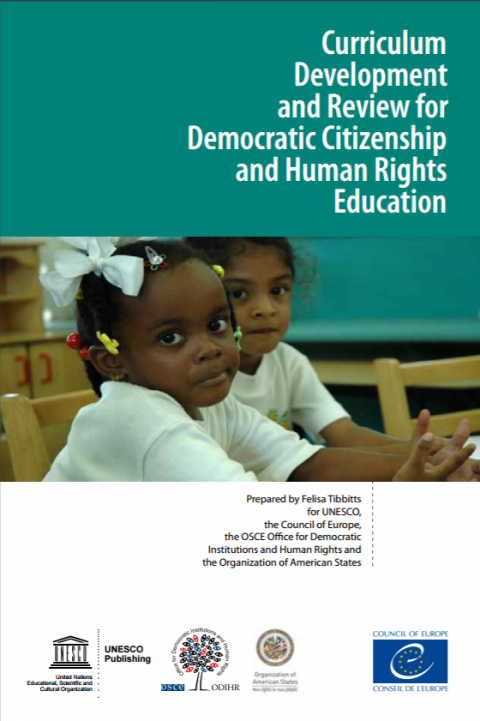 Curriculum Development and Review for Democratic Citizenship and Human Rights Education Año de publicación: 2016 Autor corporativo: UNESCO | Council of Europe | Organization of American States (OAS) | OSCE. Office for Democratic Institutions and Human Rights (ODIHR) Education for democratic citizenship and human rights education are vital for peaceful, sustainable and inclusive societies based on respect for the human rights of every person. Effective teaching and learning processes require well-trained teachers, positive learning environments and high-quality learning materials. This is underpinned by education policy, including curriculum development and review, which is the main focus of this book. The strengthening of education policies in the fields of education for democratic citizenship and human rights lies at the very heart of the efforts of the Council of Europe, the United Nations Educational, Scientific and Cultural Organization, the Office for Democratic Institutions and Human Rights of the Organization for Security and Co-operation in Europe, and the Organization of American States. These organisations have jointly produced this publication in order to support states’ commitment to fostering citizenship and human rights education and improving access to quality education for all. Élaboration et révision des programmes d'enseignement pour l'éducation à la citoyenneté démocratique et aux droits de l'homme Año de publicación: 2016 Autor corporativo: UNESCO | Conseil de l'Europe | Organization of American States (OAS) | OSCE. Office for Democratic Institutions and Human Rights (ODIHR) Education for democratic citizenship and human rights education are vital for peaceful, sustainable and inclusive societies based on respect for the human rights of every person. Effective teaching and learning processes require well-trained teachers, positive learning environments and high-quality learning materials. This is underpinned by education policy, including curriculum development and review, which is the main focus of this book. The strengthening of education policies in the fields of education for democratic citizenship and human rights lies at the very heart of the efforts of the Council of Europe, the United Nations Educational, Scientific and Cultural Organization, the Office for Democratic Institutions and Human Rights of the Organization for Security and Co-operation in Europe, and the Organization of American States. These organisations have jointly produced this publication in order to support states’ commitment to fostering citizenship and human rights education and improving access to quality education for all. Разработка и пересмотр учебных программ по воспитанию демократической гражданственности и образованию в области прав человека Año de publicación: 2016 Autor corporativo: UNESCO | Council of Europe | Organization of American States (OAS) | OSCE. Office for Democratic Institutions and Human Rights (ODIHR) Education for democratic citizenship and human rights education are vital for peaceful, sustainable and inclusive societies based on respect for the human rights of every person. Effective teaching and learning processes require well-trained teachers, positive learning environments and high-quality learning materials. This is underpinned by education policy, including curriculum development and review, which is the main focus of this book. The strengthening of education policies in the fields of education for democratic citizenship and human rights lies at the very heart of the efforts of the Council of Europe, the United Nations Educational, Scientific and Cultural Organization, the Office for Democratic Institutions and Human Rights of the Organization for Security and Co-operation in Europe, and the Organization of American States. These organisations have jointly produced this publication in order to support states’ commitment to fostering citizenship and human rights education and improving access to quality education for all.
  Education for 'global citizenship': a framework for discussion Año de publicación: 2013 Autor: Sobhi Tawil Autor corporativo: UNESCO La notion de ‘citoyenneté mondiale’ a récemment pris de l'importance dans le discours du développement international avec la Première Initiative Éducation Modiale adoptée récemment du Secrétaire Général de l’ONU(2012). Parmi les trois domaines prioritaires énoncés dans cette initiative mondiale, la troisième vise à ‘favorsier citoyenneté mondiale'. L'éducation doit assumer pleinement son rôle central en aidant les gens à forger plus justes, des sociétés pacifiques, tolérantes et inclusives. Il faut donner aux gens la compréhension, les compétences et les valeurs dont ils ont besoin de coopérer pour résoudre les défis interdépendants du 21ème siècle. La notion de ‘citoyenneté mondiale’, cependant, reste très large, sinon contestée, et par conséquent difficile à appliquer dans l'éducation. Il y a deux raisons possibles pour cela. Tout d'abord, il est difficile de savoir si la notion même de ‘citoyenneté mondiale’ est une métaphore, une contradiction dans les termes, ou un oxymore (Davies, 2006). Qu'est-ce que la ‘citoyenneté mondiale’ implique peut-être à la fois d'un point de vue juridique, ainsi que de celle de l'identité collective, le sentiment d'appartenance et l'engagement civique? Deuxièmement, lorsqu'il est appliqué à l'éducation, la notion de ‘citoyenneté mondiale’ implique un certain degré de confusion. Est-ce que 'éducation à la citoyenneté mondiale’(ou ‘éducation pour la citoyenneté mondiale’) est seulement une expression d'un objectif fondamental des systèmes éducatifs? Est-ce qu'il se réfère également à un large domaine de l'enseignement et l'apprentissage? Si oui, quels sont les contours de ce domaine? Comment est-elle liée à d'autres domaines qui se recoupent souvent de l'apprentissage associés à la socialisation civique et politique?
  Reflexiones Sobre el Progreso, el Desarrollo Sostenible y la Ciudadanía Mundial Año de publicación: 2013 Autor: Georges Haddad Autor corporativo: UNESCO Los argumentos desarrollados en esta breve ponencia ponen de manifiesto que el desarrollo sostenible, el progreso y la ciudadanía mundial sólidamente arraigados en la Sociedad del Conocimiento contribuyen indudablemente a construir este Nuevo Humanismo promovido por la Directora General de la UNESCO, y que todos coincidimos en considerar esencial para la riqueza y la prosperidad de la Humanidad, en un entorno común grato, pacífico y cordial.
  인권과 민주주의, 평화를 위한 교육 활동 선언과 통합 프레임워크 Año de publicación: 1995 Autor corporativo: 유네스코 본 문서는 1995년 11월 파리, 제 28회 유네스코 총회에서 승인된, 교육에 관한 제 44차 국제회의선언 문서이다. (1994년 10월, 제네바)
  Documento final de la consulta técnica sobre educación para la ciudadanía mundial: Educación para la ciudadanía mundial: una perspectiva emergente Año de publicación: 2013 Autor corporativo: UNESCO This document draws on inputs to, and common perspectives emerging from, a Technical Consultation on Global Citizenship Education organized by UNESCO and the Republic of Korea (i.e., the Ministries of Foreign Affairs and of Education, and the Asia-Pacific Centre of Education for International Understanding) in Seoul on 9-10 September 2013 . Informing this draft document are: a) responses from the expert participants to a questionnaire circulated by UNESCO in advance of the consultation; b) presentations from experts during the consultation; c) discussions during the consultation; and d) reference material contributing to, and prepared for, the consultation. The final draft of this document was prepared by UNESCO’s Division of Education for Peace and Sustainable Development at Headquarters in Paris, with the assistance of a drafting team.