
Recursos
Exploren una amplia gama de recursos valiosos en GCED para profundizar su comprensión y promover su búsqueda, incidencia, enseñanza y aprendizaje.
7 resultados encontrados
 Changing Minds, Not the Climate: UNESCO Mobilizes to Address the Climate Crisis Año de publicación: 2019 Autor corporativo: UNESCO The climate crisis is the challenge of the century. Scientific reports, including those of UNESCO, one after another describe increasingly pessimistic scenarios. All experts agree on one thing: we are in a race against time. A race to try to reserve our natural habitat in all of its beauty and diversity, to protect our ecosystems and natural resources and to pass them on to future generations. A race to mitigate the destructive effects of climate change and find the most appropriate innovative solutions.The disruptions caused by climate change are already part of our daily lives and trigger social, political, geopolitical and humanitarian upheavals. The climate crisis is not only threatening our ecosystems, it is also undermining fundamental rights, widening inequalities and creating new injustices. That is why ethical imperative must guide our action. Beyond the political and legal agreements essential to preparing for the future, change involves a shift in mindset, a different way of considering the place of humans in nature. This challenge mobilizes all resources, including education, research and creativity. It is an ethical and humanistic commitment. This is UNESCO’s mandate, and it is a matter of urgency. Changeons les esprits, pas le climat: l'UNESCO se mobilise face à la crise climatique Año de publicación: 2019 Autor corporativo: UNESCO La crise climatique est le défi du siècle. Les rapports scientifiques, dont ceux de l’UNESCO, se succèdent et dessinent des scénarios de plus en plus pessimistes. Tous les experts s’accordent sur une certitude : une course contre la montre est lancée. Une course pour tenter de préserver notre habitat naturel dans sa beauté et sa diversité, pour protéger nos ecosystèmes, nos ressources naturelles et les transmettre aux générations futures. Une course pour atténuer les effets destructeurs du changement climatique et trouver les solutions innovantes les plus appropriées.Ces dérèglements constituent déjà notre quotidien et provoquent des bouleversements sociaux, politiques, géopolitiques et humanitaires. La crise climatique ne met pas seulement en péril nos écosystèmes : elle ébranle certains droits fondamentaux, creuse des inégalités et crée de nouvelles injustices. C’est pourquoi l’exigence éthique doit orienter notre action. Bien au-delà des accords politiques et juridiques indispensables pour préparer l’avenir, le changement passe par une évolution des mentalités, une manière différente d’envisager la place de l’humain dans la nature. Ce défi mobilise toutes les ressources l’éducation, de la recherche, de la créativité. C’est un engagement éthique et humaniste.Tel est le mandat de l’UNESCO, et l’urgence aujourd’hui.
  Confronting the Causes and Repercussions of Climate Change: What Role for the Moroccan School and Educational Action? Año de publicación: 2016 Autor: Abdulaziz Faras Autor corporativo: Mohammed V University. Faculty of Education An article discussing the role that the public school and environmental education should play in tackling climate change. The study indicates the importance of the number of model programs for environmental education. The article also deals with the role imposed by the Moroccan school in confronting the causes and repercussions of climate change. مواجهة أسباب وتداعيات التغيرات المناخية: أي دور للمدرسة المغربية وللفعل التربوي؟ Año de publicación: 2016 Autor: Abdulaziz Faras Autor corporativo: Mohammed V University. Faculty of Education مقال يناقش الدور الذي يجب أن تساهم به المدرسة عامة والتربية البيئية في مواجهة تغير المناخ. تشير الدراسة لأهمية أعداد البرامج النموذجية للتربية البيئية. والمقال أيضا يتعرض للدور المفروض القيام به من قبل المدرسة المغربية في مواجهة أسباب وتداعيات التغير المناخي.
 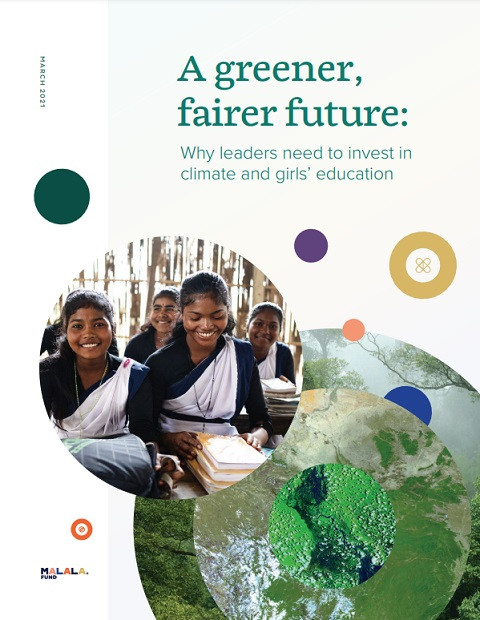 A Greener, Fairer Future: Why Leaders Need to Invest in Climate and Girls’ Education Año de publicación: 2021 Autor: Lucia Fry | Philippa Lei Autor corporativo: Malala Fund The world is on the brink of a climate catastrophe — and girls are disproportionately bearing the impact. Climate-related events like flooding, droughts and increased exposure to zoonotic diseases amplify the inequalities girls face and further limit their ability to access and complete their education. Malala Fund’s new report, A greener, fairer future: Why leaders need to invest in climate and girls' education, estimates that in 2021 climate-related events will prevent at least four million girls in low- and lower-middle-income countries from completing their education. If current trends continue, by 2025 climate change will be a contributing factor in preventing at least 12.5 million girls from completing their education each year.Yet evidence shows that closing gender gaps in education can help countries better adapt to the effects of climate change and decrease the rate and impact of global warming.“Girls in lower-income countries are the least responsible for the climate crisis, so it’s a travesty that it now threatens their very lifeline to a brighter future: quality education,” said Lucia Fry, Director of Research and Policy at Malala Fund. “Malala Fund wants leaders at COP26 to hear young people’s demands around education. They know that climate action helps girls stay in school, which in turn helps countries tackle the climate crisis. Young people are demanding an education that will prepare them to adapt to the effects of climate change and challenge the root causes of the crisis.”A greener, fairer future outlines the origins of the climate emergency and explains how confronting issues like the legacy of colonialism, racial discrimination and gender inequality through education is key to finding a sustainable solution to the crisis. The paper introduces the Gender-Equal Green Learning Agenda, a new framework to help leaders address the climate crisis through education.In this report, Malala Fund recommends how leaders can take urgent climate action at meetings this year, like COP26. This includes reducing carbon emissions, improving girls’ access to education, helping communities adapt to the realities of climate change and transforming education systems to provide all students with the knowledge, skills and values needed to challenge the social and economic inequalities fuelling the climate crisis.For more about the links between climate change and girls’ education, read the full paper below.
  Report on Roundtable for Advocating Global Citizenship Education and Climate Change Education Año de publicación: 2023 Autor corporativo: APCEIU This report shares the overview of the Roundtable for Advocating Global Citizenship Education and Climate Change Education, held on Saturday, 11 November 2023. The event was co-organized by the Permanent Delegation of the Republic of Korea to UNESCO, Office for Climate Education, Asia-Pacific Centre of Education for International Understanding (APCEIU) in partnership with the Group of Friends for Solidarity and Inclusion with GCED (Afghanistan, Armenia, Austria, Bangladesh, Canada, Colombia, Italy, Jordan, Kenya, Kuwait, Philippines, Republic of Korea, Saudi Arabia, Senegal, Serbia, Nigeria and Oman), in support of the Korean National Commission for UNESCO and the French National Commission for UNESCO. This report shares the summary of the event, particularly the presentations on GCED activities and Climate Change Education by experts from Uganda, the Republic of Korea, and France to promote the values and initiatives of GCED and CCE.
 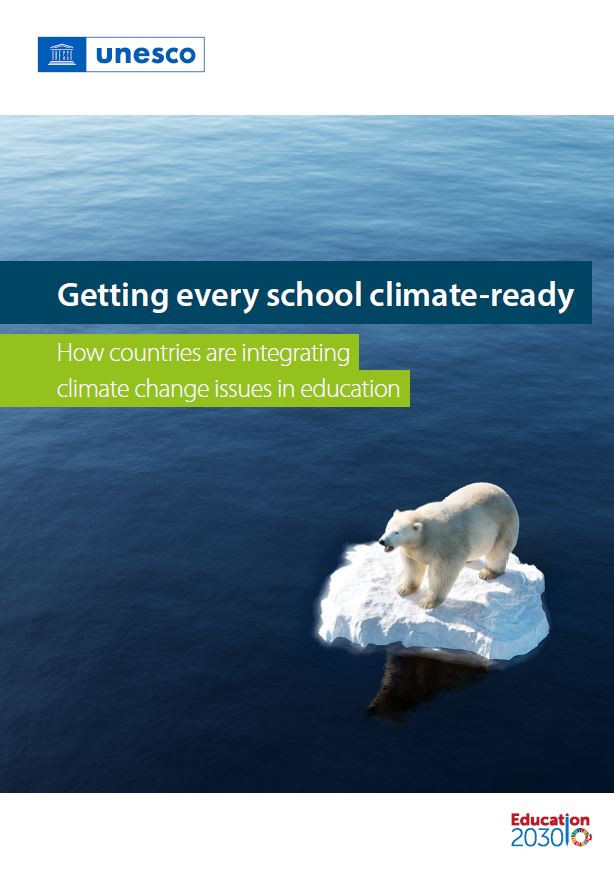 Getting Every School Climate-ready: How Countries are Integrating Climate Change Issues in Education Año de publicación: 2021 Autor corporativo: UNESCO This document summarizes the findings of selected studies by UNESCO and its partners on how climate change issues are integrated in education.These findings shed light on four key questions: where do we stand on climate change education; what do teachers say; what are the examples of country good practices on climate change education; and what does inter-ministerial collaboration on education for sustainable development look like?